



5 CRM Pain Points Every Mid-Size Clinic with 10 to 100 Providers Complains About

Mid-size clinics, those with 10 to 100 providers, occupy a challenging middle-ground in healthcare. They're too big to deal with spreadsheets and basic tools, but lack the resources to invest in enterprise-level health systems. It's a difficult place to be, creating immense struggles when dealing with administrative workloads.
According to 46 percent of physicians, administrative burden is the top cause of burnout. In this blog, we'll dive into the biggest pain points mid-size clinics face, particularly in patient management and administrative systems.
Pain Point 1: Disconnected Systems Creating Duplicate Data Entry
One of the most frustrating things mid-size clinics have to manage is separate, disconnected systems that don't share data or communicate with one another. Many clinics juggle separate EHR, billing software, scheduling platforms, patient communication tools and more. When those systems operate in silos, staff have no choice but to perform mountains of manual work, often re-entering patient details into multiple systems.
That disconnect forces redundant manual labor. Teams must spend time updating demographic data, copying insurance information and transferring appointment data. It's needlessly complex.
Not only are clinics wasting time and resources, but manual redundancy also creates more room for error and contributes to administrative burnout. It's so time-consuming that physicians spend, on average, 24 percent of their working hours on administrative work. That's time they could spend interacting with patients.
Pain Point 2: Manual Insurance Verification Drowning Front Office Staff
Insurance verification is a massive time-waster for mid-size clinics. That's because most complete the process manually, spending time making endless phone calls to payers. Those phone calls often lead to lengthy wait times and require checking portals across dozens of insurance companies, all while manually documenting coverage details.
Surveys suggest that staff typically spend one full day per week calling payers and manually updating information. It's an administrative nightmare, but its effects aren't limited to staff. Those lengthy processes also create bottlenecks that delay patient care. It can also create billing surprises and stretch teams thin. Manual verification is stressful for any mid-size practice, but it's particularly tough on those treating diverse patient populations with many different insurers.
The Hidden Cost of Insurance Verification Work
Did you know that maintaining accurate provider directory data costs billions of dollars annually across the healthcare industry? Old, outdated manual processes have a real financial impact.
Manual verification creates bottlenecks and downstream delays. Those delays lead to slower reimbursement cycles, which ultimately contribute to cash flow challenges. Plus, errors caused by manual data entry can increase the rate of denied claims.
Burnt-out staff contribute to these challenges. Repetitive, stressful manual work leads to more mistakes, including billing code errors or misplaced insurance information. Those mistakes take time and cost money to fix, only exacerbating the financial impact and operational hurdles mid-size practices face.
Automation Could Save on Admin Time
There is a way to avoid those hurdles and the true costs of inefficient manual insurance verification. Automation can reduce the burden of manual work by quickly and easily handling insurance verification tasks, without consuming hours of staff time. Systems with automated verification capabilities check payer portals, make direct payer calls, verify benefits at the CPT code level and deliver results, all without the manual work.
Automation streamlines the process. It eliminates the game of phone tag that staff have to play when contacting insurance companies, giving them their time back to focus on higher-value work. Best of all, automation can dramatically reduce the risk of errors. Platforms like Fuse can reduce admin time by as much as 95 percent through end-to-end verification automation, helping overwhelmed teams avoid wasted time and medical practice administrative burden.
Pain Point 3: No Shows and Appointment Management Chaos
Missed appointments are a problem that can affect practices of any size, but they're particularly frustrating for mid-size practices. No-shows reportedly cost U.S. providers an estimated $150 billion annually. Because mid-size practices don't have the resources of larger enterprises, they take a hit.
Many practices still rely on manual reminder processes, calling patients directly. However, that approach doesn't scale well with busy multi-provider practices. Missed appointments disrupt daily schedules, reduce overall staff productivity, waste valuable time slots and hinder access to other patients.
These days, roughly 60 percent of patients prefer text messages for care and appointment reminders instead of phone calls. Effective reminder systems will use multi-channel messaging via SMS, email and automated voice calls to provide reminders at key intervals. The right tools do everything for your practice, delivering reminders 72 hours before the scheduled appointment, 24 hours beforehand and the day of.
Clinic workflow automation makes a difference. In addition to reducing manual workload, it keeps patients engaged.
Pain Point 4: Lack of Visibility Into Patient Journey and Referrals
A lack of visibility into the entire patient journey presents problems for mid-size clinics. Most struggle to coordinate care across multiple providers because there's no centralized system helping to facilitate it. Practices can't track patient interactions, referrals and follow-ups to coordinate care effectively.
Inbound and outbound referrals often get lost. Furthermore, specialists can't access crucial patient information quickly, leading to care delays and poor coordination among care teams.
Practices need better tools to foster stronger communication between doctors, nurses, specialists and front-desk staff. Not only does poor coordination and patient lifecycle tracking create delays, but it also impacts the patient experience. It leaves gaps in care and creates missed revenue opportunities.
When Staff Burnout Becomes a Business-Critical Problem
This pain point also affects staff. Teams must scramble to find information, follow up with patients, contact other providers manually and more. It's yet another source of stress and burden, quickly resulting in burnout.
Healthcare staff burnout can escalate faster than most realize. Overstretched teams are more prone to making mistakes. That burnout can also lead to decreased engagement and slower response times. Practice revenue, patient satisfaction and operational efficiency suffer, creating business-critical problems and failures that impact a practice's success.
Pain Point 5: HIPAA Compliance Anxiety With Fragmented Tools
Finally, let's talk about provider administrative challenges concerning HIPAA compliance. With multiple disconnected systems for patient communication, data storage and workflow management, there's a real risk of HIPAA non-compliance. Every disjointed tool a practice adds to its tech stack is a potential vulnerability for the leakage of protected health information (PHI).
All healthcare clinics, regardless of size, must comply with HIPAA standards. Practice management software must have strong encryption protocols, secure messaging capabilities, role-based access controls, audit logs, signed Business Associate Agreements and other HIPAA requirements. Otherwise, compliance issues could arise.
Many practices worry about sanctions, regulatory penalties or removal from payer networks for non-compliance. One survey found that approximately 73 percent of practices admit they're not set up to minimize time on healthcare administrative tasks. Compliance adds an extra layer of complexity and yet another source of stress.
Reclaim Your Team's Time With Smarter Automation
Your practice doesn't have to settle for dealing with these pain points. As a mid-size clinic, addressing these issues isn't about working harder. It's about working smarter and with the right tools.
Automation solutions can elevate your practice, alleviating administrative burden and addressing countless issues you face. The right tools can handle insurance verification, patient intake, appointment reminders and more, all while reducing the manual work that eventually leads to burnout.
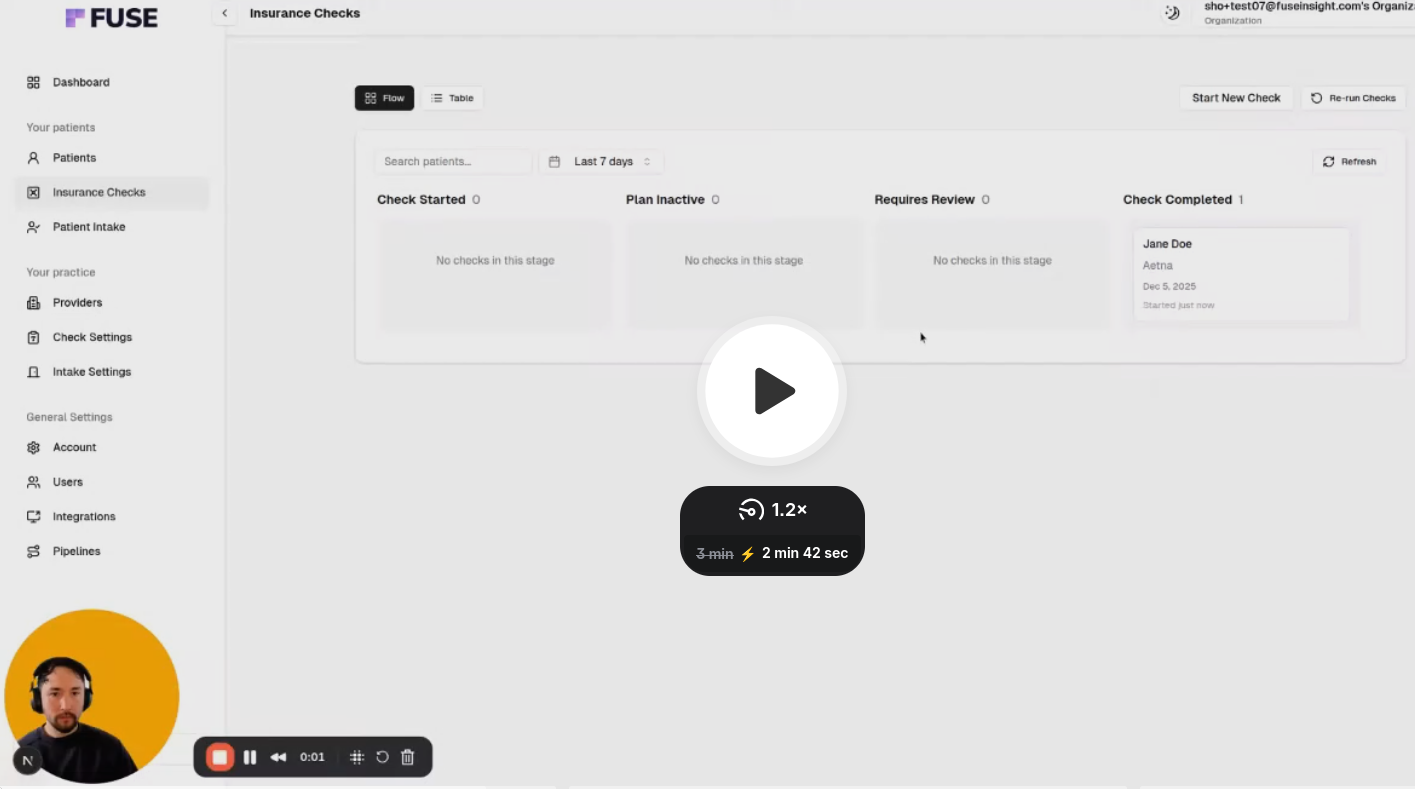
Fuse is a platform that can help automate patient intake and insurance verification. Fuse verifies insurance at the CPT code level, checks payer portals and automatically makes payer calls, reducing admin time by up to 95 percent while improving accuracy. With Fuse and automated workflows, you can significantly reduce administrative workloads for your practice, reduce burnout, improve operational efficiency and create more time to spend with patients.
Ready to see Fuse in action? Book your demo to see how Fuse's voice AI works and discover how automation can work with your existing EHR without installing new software.
Mid-size clinics, those with 10 to 100 providers, occupy a challenging middle-ground in healthcare. They're too big to deal with spreadsheets and basic tools, but lack the resources to invest in enterprise-level health systems. It's a difficult place to be, creating immense struggles when dealing with administrative workloads.
According to 46 percent of physicians, administrative burden is the top cause of burnout. In this blog, we'll dive into the biggest pain points mid-size clinics face, particularly in patient management and administrative systems.
Pain Point 1: Disconnected Systems Creating Duplicate Data Entry
One of the most frustrating things mid-size clinics have to manage is separate, disconnected systems that don't share data or communicate with one another. Many clinics juggle separate EHR, billing software, scheduling platforms, patient communication tools and more. When those systems operate in silos, staff have no choice but to perform mountains of manual work, often re-entering patient details into multiple systems.
That disconnect forces redundant manual labor. Teams must spend time updating demographic data, copying insurance information and transferring appointment data. It's needlessly complex.
Not only are clinics wasting time and resources, but manual redundancy also creates more room for error and contributes to administrative burnout. It's so time-consuming that physicians spend, on average, 24 percent of their working hours on administrative work. That's time they could spend interacting with patients.
Pain Point 2: Manual Insurance Verification Drowning Front Office Staff
Insurance verification is a massive time-waster for mid-size clinics. That's because most complete the process manually, spending time making endless phone calls to payers. Those phone calls often lead to lengthy wait times and require checking portals across dozens of insurance companies, all while manually documenting coverage details.
Surveys suggest that staff typically spend one full day per week calling payers and manually updating information. It's an administrative nightmare, but its effects aren't limited to staff. Those lengthy processes also create bottlenecks that delay patient care. It can also create billing surprises and stretch teams thin. Manual verification is stressful for any mid-size practice, but it's particularly tough on those treating diverse patient populations with many different insurers.
The Hidden Cost of Insurance Verification Work
Did you know that maintaining accurate provider directory data costs billions of dollars annually across the healthcare industry? Old, outdated manual processes have a real financial impact.
Manual verification creates bottlenecks and downstream delays. Those delays lead to slower reimbursement cycles, which ultimately contribute to cash flow challenges. Plus, errors caused by manual data entry can increase the rate of denied claims.
Burnt-out staff contribute to these challenges. Repetitive, stressful manual work leads to more mistakes, including billing code errors or misplaced insurance information. Those mistakes take time and cost money to fix, only exacerbating the financial impact and operational hurdles mid-size practices face.
Automation Could Save on Admin Time
There is a way to avoid those hurdles and the true costs of inefficient manual insurance verification. Automation can reduce the burden of manual work by quickly and easily handling insurance verification tasks, without consuming hours of staff time. Systems with automated verification capabilities check payer portals, make direct payer calls, verify benefits at the CPT code level and deliver results, all without the manual work.
Automation streamlines the process. It eliminates the game of phone tag that staff have to play when contacting insurance companies, giving them their time back to focus on higher-value work. Best of all, automation can dramatically reduce the risk of errors. Platforms like Fuse can reduce admin time by as much as 95 percent through end-to-end verification automation, helping overwhelmed teams avoid wasted time and medical practice administrative burden.
Pain Point 3: No Shows and Appointment Management Chaos
Missed appointments are a problem that can affect practices of any size, but they're particularly frustrating for mid-size practices. No-shows reportedly cost U.S. providers an estimated $150 billion annually. Because mid-size practices don't have the resources of larger enterprises, they take a hit.
Many practices still rely on manual reminder processes, calling patients directly. However, that approach doesn't scale well with busy multi-provider practices. Missed appointments disrupt daily schedules, reduce overall staff productivity, waste valuable time slots and hinder access to other patients.
These days, roughly 60 percent of patients prefer text messages for care and appointment reminders instead of phone calls. Effective reminder systems will use multi-channel messaging via SMS, email and automated voice calls to provide reminders at key intervals. The right tools do everything for your practice, delivering reminders 72 hours before the scheduled appointment, 24 hours beforehand and the day of.
Clinic workflow automation makes a difference. In addition to reducing manual workload, it keeps patients engaged.
Pain Point 4: Lack of Visibility Into Patient Journey and Referrals
A lack of visibility into the entire patient journey presents problems for mid-size clinics. Most struggle to coordinate care across multiple providers because there's no centralized system helping to facilitate it. Practices can't track patient interactions, referrals and follow-ups to coordinate care effectively.
Inbound and outbound referrals often get lost. Furthermore, specialists can't access crucial patient information quickly, leading to care delays and poor coordination among care teams.
Practices need better tools to foster stronger communication between doctors, nurses, specialists and front-desk staff. Not only does poor coordination and patient lifecycle tracking create delays, but it also impacts the patient experience. It leaves gaps in care and creates missed revenue opportunities.
When Staff Burnout Becomes a Business-Critical Problem
This pain point also affects staff. Teams must scramble to find information, follow up with patients, contact other providers manually and more. It's yet another source of stress and burden, quickly resulting in burnout.
Healthcare staff burnout can escalate faster than most realize. Overstretched teams are more prone to making mistakes. That burnout can also lead to decreased engagement and slower response times. Practice revenue, patient satisfaction and operational efficiency suffer, creating business-critical problems and failures that impact a practice's success.
Pain Point 5: HIPAA Compliance Anxiety With Fragmented Tools
Finally, let's talk about provider administrative challenges concerning HIPAA compliance. With multiple disconnected systems for patient communication, data storage and workflow management, there's a real risk of HIPAA non-compliance. Every disjointed tool a practice adds to its tech stack is a potential vulnerability for the leakage of protected health information (PHI).
All healthcare clinics, regardless of size, must comply with HIPAA standards. Practice management software must have strong encryption protocols, secure messaging capabilities, role-based access controls, audit logs, signed Business Associate Agreements and other HIPAA requirements. Otherwise, compliance issues could arise.
Many practices worry about sanctions, regulatory penalties or removal from payer networks for non-compliance. One survey found that approximately 73 percent of practices admit they're not set up to minimize time on healthcare administrative tasks. Compliance adds an extra layer of complexity and yet another source of stress.
Reclaim Your Team's Time With Smarter Automation
Your practice doesn't have to settle for dealing with these pain points. As a mid-size clinic, addressing these issues isn't about working harder. It's about working smarter and with the right tools.
Automation solutions can elevate your practice, alleviating administrative burden and addressing countless issues you face. The right tools can handle insurance verification, patient intake, appointment reminders and more, all while reducing the manual work that eventually leads to burnout.
Fuse is a platform that can help automate patient intake and insurance verification. Fuse verifies insurance at the CPT code level, checks payer portals and automatically makes payer calls, reducing admin time by up to 95 percent while improving accuracy. With Fuse and automated workflows, you can significantly reduce administrative workloads for your practice, reduce burnout, improve operational efficiency and create more time to spend with patients.
Ready to see Fuse in action? Book your demo to see how Fuse's voice AI works and discover how automation can work with your existing EHR without installing new software.


FAQs
Mid-size practices struggle with disconnected systems, inefficient insurance verification processes, high volumes of appointment no-shows, limited visibility into the entire patient journey and HIPAA compliance anxiety caused by disjointed software tools. These pain points increase administrative burden and take away time from improving the patient experience.
Excessive workloads, repetitive manual tasks and dealing with multiple, disjointed systems drive burnout by overwhelming staff. The constant strain leads to increased mistakes, lower job satisfaction and requires less time spent interacting with patients.
Automation tools can transform how practices operate by handling critical tasks such as insurance verification and patient intake. Fuse automatically checks payer portals, calls payers directly and verifies insurance at the CPT code level for greater accuracy, all without hours of manual labor. It frees up staff to focus on serving patients.
Mid-size practices should prioritize practice management software with features that directly address pain points. Tools should integrate with existing EHR systems, automate repetitive tasks such as insurance verification, support multi-channel patient communications and facilitate provider coordination. It should make healthcare administrative tasks easier while maintaining HIPAA compliance.
Disconnected systems hinder patient care by creating unnecessary bottlenecks and delays. When systems can't share data, staff must manually enter data across different platforms. When teams can't access the right data quickly and efficiently, it can lead to gaps in care, missed follow-ups and poor overall coordination, negatively impacting the patient journey.
Questions?




.avif)
.avif)
.avif)

.avif)
.avif)