Anthem Blue Cross and Blue Shield Behavioral Health Reimbursement Rates in Ohio (2026)
“Anthem Blue Cross and Blue Shield” in Ohio is a trade name of Community Insurance Company, and its negotiated behavioral health rates live in the machine readable files that entity publishes monthly under the federal Transparency in Coverage rule. There is no lookup page behind those files, and no single “Anthem Ohio rate” inside them either: what a 60-minute session allows depends on the employer group or marketplace plan, the provider’s credential, and the contract behind each arrangement. Any statewide number is an aggregation choice someone made.
Here is the aggregation behind this page. Fuse built software that reads Anthem’s September 2026 Ohio network file in full, 13 gigabytes of pricing data once unpacked. We pulled every dollar-denominated fee schedule rate attached to the three CPT codes below (percentage-of-charges rows are excluded), matched each listed NPI against the federal NPPES registry, kept only individual behavioral health clinicians whose registered practice location is in Ohio, and computed statistics across distinct provider-rate pairs so a clinician appearing in many plans counts once per distinct rate. Anthem’s index bundles every state’s files together with BlueCard mirrors of other Blues plans, so the first methodology decision was simply making sure every rate in the pool is actually an Ohio Anthem rate.
Anthem’s Negotiated Behavioral Health Rates in Ohio by CPT Code
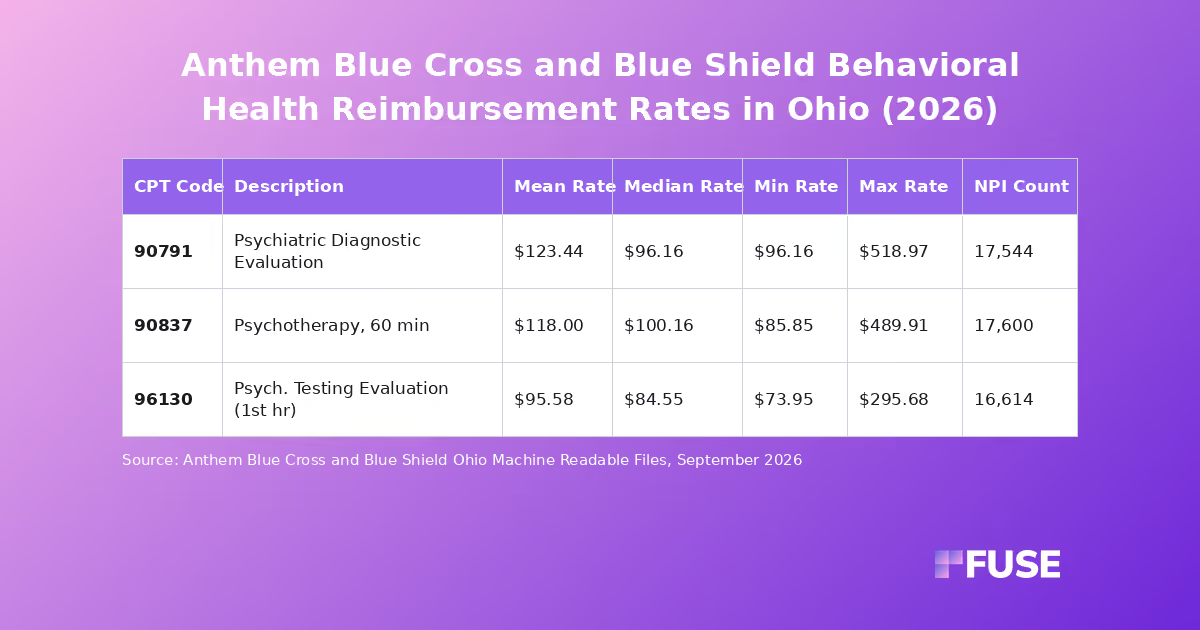
Anthem Blue Cross and Blue Shield publishes negotiated rates for behavioral health services through its Ohio machine readable files. The table below reflects September 2026 data for three commonly billed codes.
| CPT Code | Description | Mean Negotiated Rate | Median Negotiated Rate | Min | Max | Unique NPI Count |
|---|---|---|---|---|---|---|
| 90791 | Psychiatric Diagnostic Evaluation | $123.44 | $96.16 | $96.16 | $518.97 | 17,544 |
| 90837 | Psychotherapy, 60 minutes | $118.00 | $100.16 | $85.85 | $489.91 | 17,600 |
| 96130 | Psychological Testing Evaluation, 1st hour | $95.58 | $84.55 | $73.95 | $295.68 | 16,614 |
Rates extracted from Anthem’s September 2026 Ohio machine readable files.
Ohio’s 90837 median is the lowest of the six Blue plans Fuse has analyzed; the BCBS 90837 reimbursement rates by state page compares all six.
The files are republished monthly and each carries an as-of date, so the table above is labeled with its extraction month and will drift as Anthem updates its disclosures.
Behavioral Health at Anthem Ohio Runs Through Carelon
For Anthem’s Ohio commercial and Medicare Advantage plans, behavioral health is administered through Carelon Behavioral Health, the Elevance Health subsidiary formerly known as Beacon Health Options. In practice that means the operational spine of a behavioral health practice’s relationship with Anthem runs on different rails than a medical practice’s: credentialing and recredentialing go through Carelon’s national provider service line, demographic updates flow through the Carelon provider portal and CAQH, and utilization review sits with Carelon staff even though authorization requests are submitted through the same Interactive Care Reviewer application in Availity that medical providers use.
Two practical consequences follow. First, network status questions have two possible answers: a clinician can be in Anthem’s medical directory story and still have an open item in Carelon’s credentialing file, so confirm status with Carelon directly when joining or adding clinicians. Second, routine outpatient psychotherapy under commercial plans generally does not carry blanket precertification, but Carelon reviews outpatient care for medical necessity when utilization patterns stand out, and higher levels of care such as intensive outpatient and residential treatment do require authorization. The member-specific benefit check, not a general rule, is what protects the claim.
Telehealth Therapy in Ohio: Covered the Same, Not Necessarily Paid the Same
A large share of Ohio outpatient behavioral health now happens over video, and Ohio law treats that traffic in a specific way that matters for the rates on this page. Revised Code section 3902.30, expanded by House Bill 122 effective March 2022, requires commercial plans to cover telehealth services on the same basis as in-person care and caps telehealth cost-sharing at the in-person level. But the statute says twice, in so many words, that it does not require a plan to reimburse telehealth at the in-person rate. Ohio has coverage parity, not payment parity.
For a practice, that turns one rate question into two. The negotiated rates in the table above are what Anthem’s files disclose for the codes; whether a virtual 90837 pays the same as an office 90837 depends on the individual contract, and nothing in Ohio law forces the two to match. The companion statute, section 4743.09, also bars providers from charging a facility fee, origination fee or equipment fee for telehealth, so there is no side channel that makes up a gap. Practices with heavy virtual caseloads should read their Anthem contract’s telehealth language before assuming the statewide benchmark applies to their sessions.
Self-Pay Therapy Rates in Ohio
Published cash schedules from Ohio practices put useful goalposts around the commercial numbers. Still Meadow Counseling in Columbus lists $200 for an initial diagnostic assessment (90791) and $175 for a 53-to-60-minute session (90837). Anchor Counseling Services publishes $175 and $150 for the same two codes. Inclusive Counseling in Blue Ash, outside Cincinnati, prices by license level: $190 for a 90791 intake with an independently licensed clinician against $145 with a dependently licensed one, and $175 against $135 for a 90837 session.
That license-tier pricing is worth noticing because it mirrors how the insurance side works too: Ohio Medicaid pays physicians and psychologists more than masters-level clinicians for the identical code, and commercial contracts commonly do the same. Published cash pricing for psychological testing (96130) is scarce here as elsewhere, since testing is usually quoted as a bundled assessment package rather than priced per code.
What This Means for Your Practice
Every number above depends on the rules we applied: one network file, dollar rates only, behavioral health credentials, Ohio practice locations. We state them plainly so the figures can be checked, but a different rule set applied to the same raw files would produce different averages. Treat the table as a market reference, not as anyone’s contract.
The number that actually governs your revenue is the one in your own remittances. Pull what Anthem paid your practice per code, check it against your contracted schedule, and compare against the statewide medians here to see which side of the market you sit on. That comparison, done on your own claims, is the strongest starting point for a rate conversation with Anthem, and it is also how underpayments surface: a contract only pays what it says if someone is checking.
Fuse does this work for practices: CPT-level verification of benefits before the visit, reimbursement checks against past claims, and analytics that flag the gap between contracted and paid before it compounds.
Verify Anthem Benefits Before the Visit
A statewide benchmark cannot say what one patient’s plan allows for one visit, especially in a state where telehealth payment is contract-specific and behavioral health administration runs through Carelon. Fuse verifies current eligibility and plan-specific benefits at the CPT code level before the appointment, combining past claims data with automated phone calls to payers, so the practice knows the expected copay, coinsurance and deductible before the patient sits down. See how CPT-level benefits verification works for behavioral health practices.
Disclaimer: This article uses rate information from the Machine Readable Files that Anthem Blue Cross and Blue Shield publishes under the federal Transparency in Coverage rule. These files are posted to satisfy the regulation, not to be read: the file behind this analysis unpacks to 13 gigabytes of raw pricing data, millions of negotiated rates that no spreadsheet can open. Fuse built software that reads it in full and verifies the figures above. This analysis focuses on a single payer and will not reflect rates from all available insurance options in Ohio. Fuse makes every effort to provide accurate and current information, but healthcare pricing can change frequently, and individual circumstances may affect actual costs. This information does not guarantee specific pricing. Practices should verify current rates directly with Anthem before relying on them for billing or negotiation decisions.
Fuse analyzes your claims for allowed-amount variance to spot underpayments and denial trends.
Get Your Free Revenue AnalysisFAQs
What does Anthem pay for a 60-minute therapy session in Ohio?
Fuse's extraction of Anthem's September 2026 Ohio machine readable files shows the negotiated rate for CPT 90837, a 60-minute psychotherapy session, spans a wide range across plans and providers. The statewide mean was $118.00 and the median was $100.16 as of that extraction. Both are benchmarks pooled across many separate Anthem plan arrangements, not a rate any individual contract is guaranteed to pay.
What does Anthem reimburse for a psychiatric diagnostic evaluation in Ohio?
Fuse's extraction of Anthem's Ohio rate data shows a psychiatric diagnostic evaluation, billed as CPT 90791, carried a statewide mean of $123.44 and a median of $96.16 as of the September 2026 files. What a specific patient's visit actually allows depends on their plan and the provider's contract, so treat the statewide figure as a reference point rather than a quote.
Who handles behavioral health prior authorization for Anthem in Ohio?
Behavioral health utilization for Anthem's Ohio commercial plans is administered through Carelon Behavioral Health, an Elevance Health company, with authorization requests submitted through the Interactive Care Reviewer application in the Availity portal. Routine outpatient psychotherapy generally does not require precertification, but requirements are plan-specific, so verify the member's benefits before the first visit rather than assuming.
Why do Anthem's negotiated mental health rates vary so much across Ohio?
Fuse's analysis shows Anthem's Ohio files pool thousands of separate negotiated arrangements, organized by employer group for group coverage and by marketplace plan for individual coverage, across markets as different as Columbus, Cleveland, Cincinnati and rural Appalachian counties. Provider credential and setting matter too: the same CPT code can price differently for a psychiatrist, a psychologist and a masters-level counselor. A statewide average flattens all of that into one number.
How do Ohio Medicaid's behavioral health rates compare to Anthem's commercial rates?
They come from a different framework entirely. Ohio Medicaid publishes fixed maximums in the fee schedule attached to Ohio Administrative Code rule 5160-27-03: a 60-minute psychotherapy session (90837) pays $135.71 for physicians and psychologists and $115.35 for masters-level clinicians, a psychiatric diagnostic evaluation (90791) pays $147.39 and $125.28 on the same split, and the first hour of psychological testing evaluation (96130) pays $66.82. Those are administered prices that vary by practitioner credential, not negotiated contract rates, so they are context for Anthem's commercial numbers rather than a comparable benchmark.