BCBS 90837 Reimbursement Rates by State: What Blue Cross Plans Pay for Therapy (2026)
If you bill CPT 90837, a 60-minute psychotherapy session, to a Blue Cross Blue Shield plan, the first thing to know is that “the BCBS rate” does not exist. The Blue brand is licensed to more than 30 independent insurers, and each negotiates its own contracts in its own market. The rate that matters is your state’s Blue, and until recently there was no practical way to see what it actually pays.
There is now. Under the federal Transparency in Coverage rule, every one of those insurers publishes machine readable files listing its negotiated rates. The files are enormous and unreadable by design, but Fuse built software that reads them in full. This page compares what six Blue plans pay for 90837, from each plan’s own disclosures: Anthem in California, Colorado, New York and Ohio, BCBSTX in Texas, and Florida Blue in Florida.
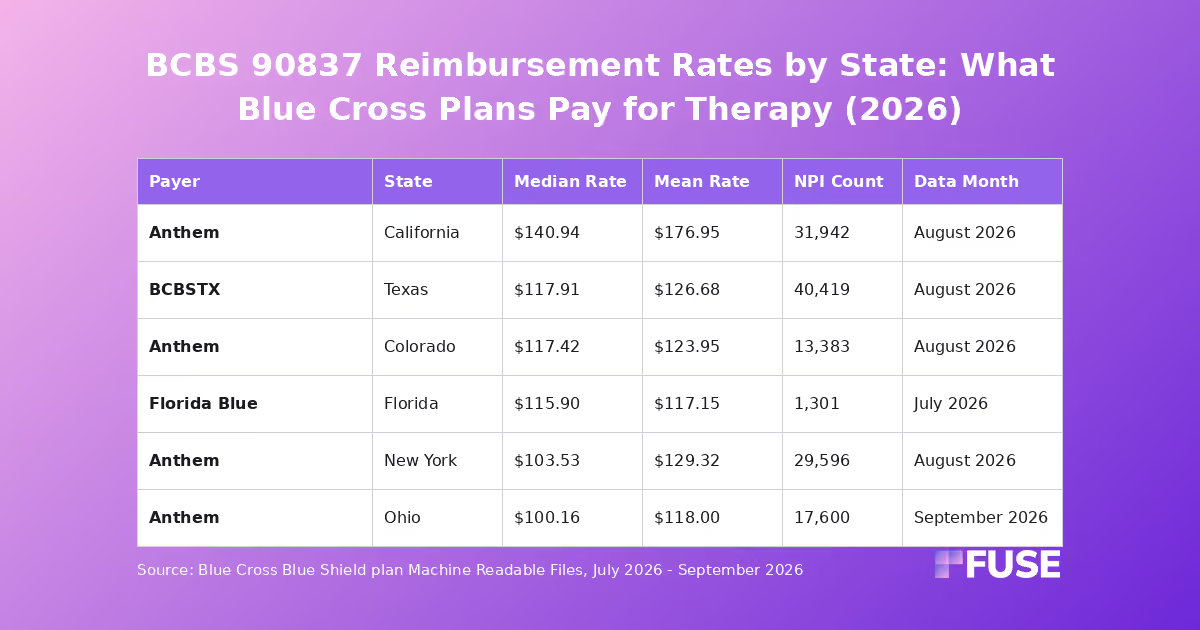
BCBS 90837 Reimbursement Rates by State (2026 Table)
| Payer | State | Median Rate | Mean Rate | Min | Max | Unique NPI Count | Data Month |
|---|---|---|---|---|---|---|---|
| Anthem | California | $140.94 | $176.95 | $85.10 | $702.08 | 31,942 | August 2026 |
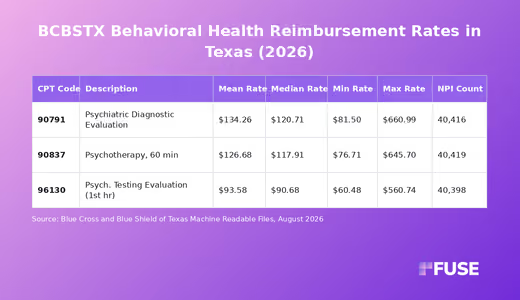
| BCBSTX | Texas | $117.91 | $126.68 | $76.71 | $645.70 | 40,419 | August 2026 |
| Anthem | Colorado | $117.42 | $123.95 | $77.00 | $580.22 | 13,383 | August 2026 |
| Florida Blue | Florida | $115.90 | $117.15 | $49.06 | $319.00 | 1,301 | July 2026 |
| Anthem | New York | $103.53 | $129.32 | $68.12 | $572.98 | 29,596 | August 2026 |
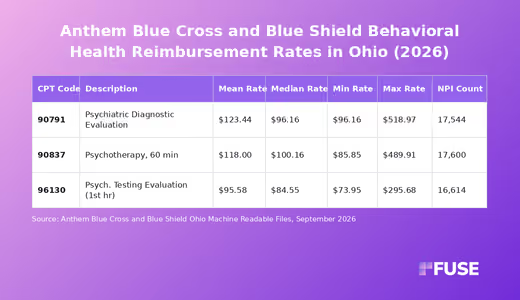
| Anthem | Ohio | $100.16 | $118.00 | $85.85 | $489.91 | 17,600 | September 2026 |
Each row comes from that plan’s own machine readable files in the month shown, filtered to individual behavioral health clinicians whose registered practice location is in that state.
Two reading notes. First, the medians span roughly $40 from top to bottom: California pays about 40 percent more for the same hour of psychotherapy than Ohio does. Texas, Colorado and Florida sit within a few dollars of one another in the middle, while New York and Ohio anchor the bottom, so California is the clear outlier. Second, the mean runs above the median in every state, most dramatically in California and New York, because a small number of high-rate arrangements pull averages up. The median is the better “typical contract” number.
Why the Same Code Pays Differently Under the Same Brand
Each row in the table is a different company. Anthem’s four states belong to Elevance Health, but even those are separate legal entities with separate networks: Blue Cross of California (the company behind the Anthem Blue Cross brand), Rocky Mountain Hospital and Medical Service in Colorado, the former Empire entities in New York, and Community Insurance Company in Ohio. Blue Cross and Blue Shield of Texas is a division of Health Care Service Corporation, and Florida Blue belongs to GuideWell. The brand is shared; the contracts are not.
Within each company, the published rates then reflect that state’s market: how many clinicians the plan needs, what competing payers offer, the mix of employer groups and marketplace plans in the files, and the credential mix of the network, since the same CPT code commonly prices differently for a psychiatrist, a psychologist and a masters-level counselor. A state’s median compresses all of that into one number, which is why the state pages linked below break each market down code by code.
State by State: What Each Blue Plan Pays for 90837
California is the highest-paying and widest-spread market of the six, with a median of $140.94 and a mean of $176.95 across roughly 32,000 clinicians. The gap between those two numbers is the tell: a long tail of high-rate arrangements sits above a broad base. Full analysis in our Anthem Blue Cross California behavioral health rates page.
Texas carries the largest provider pool in the table, about 40,000 NPIs, with a median of $117.91. BCBSTX’s files carry a hazard of their own: thousands of exact-zero and percent-of-charge rows that would crater any average taken naively, all excluded here. Details in the BCBSTX Texas behavioral health rates breakdown.
Colorado sits just below Texas at a $117.42 median, with the tightest mean-to-median gap among the Anthem states, meaning fewer extreme arrangements at either end. See the Anthem Colorado behavioral health rates page.
Florida prices near the middle at a $115.90 median. The NPI count is the smallest in the table because Florida Blue organizes its disclosures differently than the Anthem plans, publishing per-network files that list far fewer distinct clinicians against each rate. The Florida Blue behavioral health rates page covers what that structure means for reading the numbers.
New York lands near the bottom at a $103.53 median despite its cost of living, with a mean a full quarter above the median, the second-widest skew after California. New York’s files also carry a quirk worth knowing about: contract multipliers mislabeled as dollar rates, which we filter out. Both are unpacked in the Anthem New York behavioral health rates analysis.
Ohio is the lowest median of the six at $100.16. Ohio behavioral health administration also runs through Carelon rather than Anthem directly, and state law requires telehealth coverage parity without payment parity, both covered in the Anthem Ohio behavioral health rates page.
How We Built These Numbers
Each row is an independent extraction of that plan’s machine readable files, run through the same method: pull every dollar-denominated negotiated rate for CPT 90837, drop percentage-of-charge and per-diem rows, match every listed NPI against the federal NPPES registry, keep individual behavioral health clinicians whose registered practice location is in the target state, and compute statistics over distinct provider-rate pairs so a clinician appearing in dozens of plan files counts once per distinct rate.
The Data Month column matters: the plans republish monthly on their own schedules, so the six extractions are not from a single date. Each state page carries its own extraction date and refreshes as new files are read. Cross-state comparisons here are between months at most two apart.
What This Means for Your Contract
A state median is a market reference, not a quote, but it is a genuinely useful one in a negotiation. If your contracted 90837 rate sits below your state’s median, you now have the payer’s own published data showing that more than half of its negotiated arrangements pay better than yours. That is a stronger opening position than any survey, because the source is the payer’s own federal disclosure. Our guide to negotiating insurance contract rates walks through how to run that conversation, and the rate lookup explainer shows how to pull your own numbers from any insurer’s files.
The number that governs your revenue, though, is what actually lands in your remittances. Fuse checks paid amounts against contracted schedules at the CPT level and flags the gap before it compounds, alongside benefits verification that tells you what a specific patient’s plan allows before the visit.
Disclaimer: This article uses rate information from the Machine Readable Files that Blue Cross Blue Shield licensees publish under the federal Transparency in Coverage rule. Each state’s figures come from a separate extraction of that plan’s own files in the month shown in the table. These files are posted to satisfy the regulation, not to be read: they unpack to hundreds of gigabytes of raw pricing data across the six states. Fuse built software that reads them in full and verifies the figures above. This analysis covers six Blue plans and will not reflect rates from every insurer in these states. Fuse makes every effort to provide accurate and current information, but healthcare pricing can change frequently, and individual circumstances may affect actual costs. This information does not guarantee specific pricing. Practices should verify current rates directly with their payer before relying on them for billing or negotiation decisions.

Fuse analyzes your claims for allowed-amount variance to spot underpayments and denial trends.
Get Your Free Revenue AnalysisFAQs
Which state has the highest BCBS reimbursement rate for 90837?
Of the six states Fuse has analyzed from Blue plans' own published rate files, California pays the most: Anthem Blue Cross California's median negotiated rate for CPT 90837 was $140.94 in the August 2026 files, against a six-state range whose low end is Ohio at $100.16. Highest median does not mean every California contract pays more; the spread within each state is wider than the spread between states.
Why does Blue Cross pay different 90837 rates in different states?
Because there is no single Blue Cross. The Blue Cross Blue Shield Association licenses the brand to more than 30 independent companies, each of which builds its own networks and negotiates its own contracts: Elevance Health's Anthem plans in California, Colorado, New York and Ohio, Health Care Service Corporation in Texas, and GuideWell's Florida Blue in Florida. Different companies, different provider markets, different plan mixes, different rates.
What is a good 90837 rate from a BCBS plan?
The most useful benchmark is your own state Blue plan's median from its published files, shown in the table on this page for six states. A contract at or above the state median sits in the top half of that plan's negotiated arrangements for CPT 90837. Credential matters too: the medians pool psychiatrists, psychologists and masters-level clinicians, and contracts commonly tier by license level.
Do these BCBS rates apply to telehealth 90837 sessions?
Not automatically. Telehealth payment rules are set state by state and contract by contract. Some states require payment parity with in-person care and others, like Ohio, require plans to cover telehealth without requiring them to pay the in-person rate for it. The rates in the table are what each plan's files disclose for the code; whether a virtual session prices the same as an office session depends on the individual contract's telehealth language.