Anthem Blue Cross and Blue Shield TMS Reimbursement Rates in New York (2026)
A TMS chair changes the economics of a psychiatric practice because of claim volume: a medication-management patient produces one claim a month, while a TMS patient produces one almost every weekday for six weeks or longer. Whether that volume turns into profit in New York comes down to what Anthem Blue Cross and Blue Shield pays per session, how many patients finish their courses, and how much prior authorization work sits in front of each one. This article answers all three from Anthem’s own published rates.
One naming note up front, because it confuses providers and patients alike: Anthem in New York is the former Empire BlueCross BlueShield, rebranded in 2024, and its rate files still report under the legacy Empire name. Same networks, same contracts.
Where These Numbers Come From
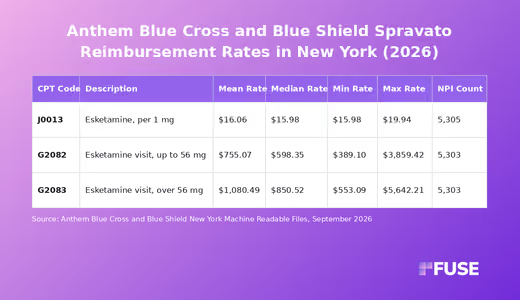
Every insurer must publish its negotiated rates in machine readable files under the federal Transparency in Coverage rule. Anthem’s statewide New York file unpacks to 14 gigabytes, so Fuse built software that reads the whole thing. From it we pulled every rate attached to the three TMS codes, kept only dollar fee-schedule amounts billed as professional claims in the office setting (the New York file also carries contract multipliers mislabeled as dollar rates, which we exclude), matched each NPI against the federal NPPES registry, kept individual psychiatric prescribers whose practice location is in New York, and computed the statistics over distinct provider-rate pairs. Practices that also offer esketamine should see the companion analysis of Anthem’s Spravato rates in New York.
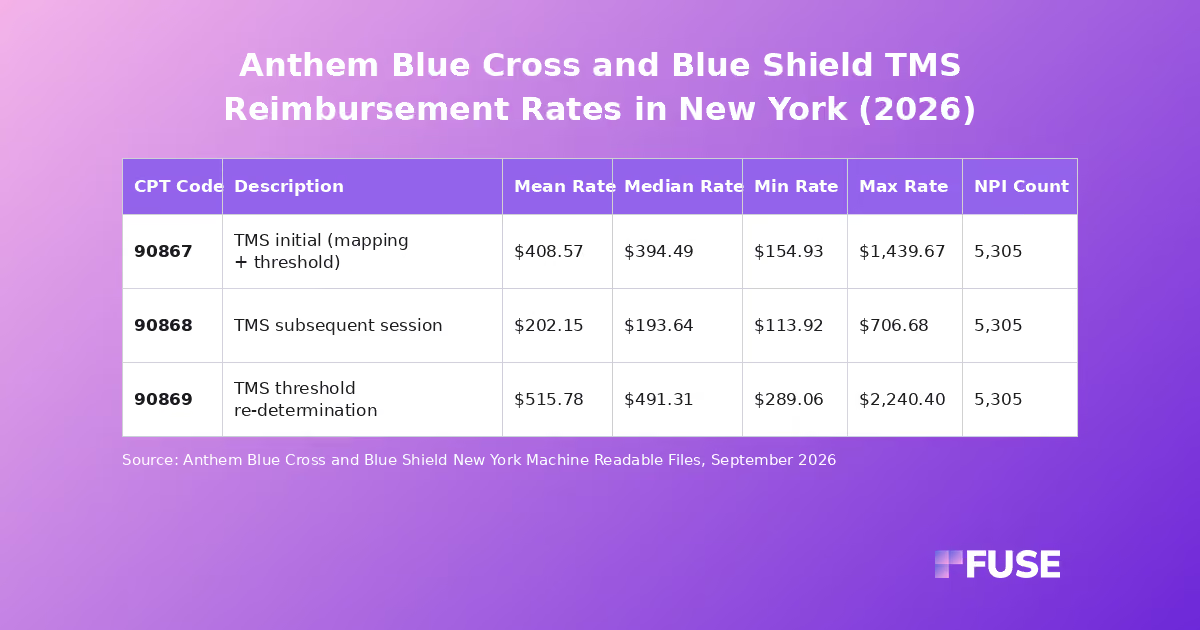
Anthem’s Negotiated TMS Rates in New York
The table reflects September 2026 data.
| CPT Code | Description | Mean Negotiated Rate | Median Negotiated Rate | Min | Max | Unique NPI Count |
|---|---|---|---|---|---|---|
| 90867 | TMS treatment, initial, including cortical mapping, motor threshold determination, delivery and management | $408.57 | $394.49 | $154.93 | $1,439.67 | 5,305 |
| 90868 | TMS treatment, subsequent delivery and management, per session | $202.15 | $193.64 | $113.92 | $706.68 | 5,305 |
| 90869 | TMS treatment, subsequent motor threshold re-determination with delivery and management | $515.78 | $491.31 | $289.06 | $2,240.40 | 5,305 |
Rates extracted from Anthem’s September 2026 New York machine readable files.
One pattern worth flagging: the median for 90869 (motor threshold re-determination) sits above the initial 90867 mapping session. That is what Anthem publishes, and the same inversion shows up in its California file, so treat it as how these codes are contracted rather than a data error. Each code is priced line by line, not derived from one fee schedule multiplier.
What a Full TMS Course Pays in New York
The billing pattern is fixed: one initial mapping session (90867, billed once per course, never more than once in six weeks) and roughly 35 treatment sessions (90868). At the September 2026 medians of $394.49 for the initial session and $193.64 per treatment session, a completed acute course comes to about $7,171.89 per patient, before any motor threshold re-determinations (90869) that become medically necessary along the way. Because treatment sessions are technician-delivered under supervision in most practice models, that revenue stacks on top of the existing visit panel rather than displacing it.
Check those medians against New York’s cash market before deciding what they mean. Manhattan clinics publish self-pay TMS prices in a narrow band: Madison Avenue TMS & Psychiatry lists $225 to $265 per session, about $7,000 to $8,000 for a full course, and Hudson Mind lists $240 per session. Anthem’s per-session median of $193.64 sits below that band, so unlike some states, in-network TMS in New York does not out-earn the posted cash market session by session. Over a completed course the gap mostly closes, because the mapping session and any threshold re-checks pay several times the per-session rate: the in-network course total of $7,171.89 lands inside the published cash-course range. The case for network participation here is volume, reaching the far larger pool of insured patients who would never write an $8,000 check, rather than a rate premium. And watch the spread before signing anything: 90868 runs from $113.92 to $706.68 across 5,305 matched clinicians, so benchmark your contract against the median, not the extremes.
To turn the statewide medians into your own answer, replace them with your numbers: pull your Anthem fee schedule or recent remittances for 90867, 90868 and 90869, then weigh that against your device cost, technician time and a realistic completion rate.
How Anthem Approves TMS in New York
Unlike California, where state law forces a different rulebook for fully insured plans, New York members are reviewed under one set of criteria: Anthem archived its own TMS medical policy (BEH.00002) in mid-2020 across its plans and reviews TMS under the MCG behavioral health guideline for transcranial magnetic stimulation, and its New York medical policy portal carries no Anthem-authored TMS guideline of its own. New York adds its own check on top: since the state’s 2019 parity modernization, insurers must use evidence-based medical necessity criteria for mental health that are approved by the state Office of Mental Health, and OMH’s published summary lists Anthem’s New York commercial entities among the approved insurers.
What the review actually asks for is spelled out on Anthem’s multi-state TMS request form, whose footer names the New York entities and which is mandatory before treatment starts: age 18 or older, severe treatment-resistant major depressive disorder, and an inadequate response (or intolerance) to antidepressant trials from at least two different medication classes at adequate dose and duration. The standard course is capped at five sessions per week for six weeks, 30 sessions, plus a taper. Theta-burst protocols have their own line on the form. Maintenance TMS after a sustained remission gets its own line too, and Anthem’s published customizations of the MCG guideline have treated maintenance TMS as not medically necessary, so build the program plan around acute courses and retreatment rather than maintenance. Retreatment requires documentation that the prior course produced at least a 50 percent improvement on a standardized scale. Plan-specific code lists live behind Availity’s authorization lookup, so verify each patient’s plan there rather than assuming.
The diagnosis anchors matter too: the form requires severe major depressive disorder, which in coding terms maps to F32.2 or F33.2 (severe, without psychotic features), the same two codes New York Medicaid explicitly limits its TMS benefit to, so claims outside them invite scrutiny. Denial risk concentrates at the initial authorization and at any mid-course review, and a course that stalls two-thirds through forfeits the back half of the revenue above, so calendar every review date the day the authorization is approved.
New York’s Parity and Step-Therapy Laws Work in Your Favor
New York has regulated mental health coverage longer than most states. Timothy’s Law forced mental health benefits into state-regulated plans in 2007, and the 2019 modernization aligned state law with federal parity, removed the old day and visit limits, and capped cost-sharing for outpatient mental health care at in-network facilities at the member’s primary care copay level. Parity does the quiet work for a TMS program: a plan cannot impose visit limits or heavier cost-sharing on mental health treatment than on comparable medical care. Even so, a patient facing a copay 36 times in six weeks is a completion risk, so check each plan’s actual cost-sharing at intake rather than assuming.
The step-therapy override is the other lever worth knowing. Since 2017, New York insurance law requires a plan to grant a step-therapy override within 72 hours (24 hours if the patient’s health is in serious jeopardy) when the prescriber documents that the required step is contraindicated, was already tried, or is expected to be ineffective, and a plan that misses the deadline has the override deemed approved. When an authorization stalls on “try another medication first” for a patient whose history already shows the failed trials, that statute is the escalation path.
Public coverage widened recently as well: New York State Medicaid added the three TMS codes as a covered benefit effective October 1, 2025 for fee-for-service and November 1, 2025 for Medicaid Managed Care, for adults with severe treatment-resistant depression treated by a psychiatrist with TMS training, and Medicare has covered TMS for years. The referral base for a New York TMS program now spans commercial, Medicare and Medicaid patients.
What This Means for Your Practice
The rates say a TMS chair can carry itself in New York; whether it does in your practice is decided patient by patient, at the level of coverage: who meets the severe-TRD criteria, what their specific plan pays, and whether each authorization and mid-course review clears on schedule. Fuse verifies benefits at the CPT code level before the visit, so a six-week course starts on a confirmed benefit rather than an assumption. And if you are still deciding whether to add TMS at all, we can analyze your patient base first and estimate how many patients would likely qualify and what the revenue uplift could be.
Disclaimer: This article uses rate information from the Machine Readable Files that Anthem Blue Cross and Blue Shield publishes under the federal Transparency in Coverage rule. These files are posted to satisfy the regulation, not to be read: the file behind this analysis unpacks to 14 gigabytes of raw pricing data that no spreadsheet can open. Fuse built its own pipeline to extract and verify the figures above. This analysis focuses on a single payer and will not reflect rates from all available insurance options in New York. Fuse makes every effort to provide accurate and current information, but healthcare pricing and coverage policy change frequently, and individual circumstances affect actual payment. This information does not guarantee specific pricing. Practices should verify current rates and criteria directly with Anthem before relying on them for billing or negotiation decisions.

Fuse analyzes your claims data to estimate how many patients could be eligible, benchmarks your contracted rates against the market medians, and sizes the revenue uplift.
Get Your Free AnalysisFAQs
What is Anthem's reimbursement rate for TMS in New York?
Based on Anthem's September 2026 New York machine readable files, the median negotiated rate for a subsequent TMS session (CPT 90868) is $193.64, and the initial session with cortical mapping and motor threshold determination (CPT 90867) has a median of $394.49. Individual contracts vary widely, so treat these as statewide reference points rather than a quoted rate.
How much revenue does a full TMS course represent?
A standard acute course is one initial session (CPT 90867) followed by roughly 35 subsequent sessions (CPT 90868) over six weeks or more. At Anthem's New York median rates that full course works out to about $7,171.89 per patient, before any motor threshold re-determinations (CPT 90869) that become medically necessary mid-course.
Which CPT codes are used to bill TMS?
Three codes cover therapeutic repetitive TMS: 90867 for the initial session (including cortical mapping and motor threshold determination, reported only once per course of treatment), 90868 for each subsequent delivery-and-management session, and 90869 for a subsequent session that requires re-determining the motor threshold. 90867 and 90869 are never reported together or with 90868 on the same date of service.
Does TMS require prior authorization?
Virtually all commercial plans, including Anthem, require prior authorization before starting TMS. Expect to document a qualifying major depressive disorder diagnosis, the antidepressant trials that failed at adequate dose and duration, and a standardized severity score such as the PHQ-9. Many plans also conduct a mid-course review before authorizing the full session count.
Does New York Medicaid cover TMS?
Yes, and the coverage is recent: New York State Medicaid added CPT codes 90867, 90868 and 90869 as a covered benefit effective October 1, 2025 for fee-for-service and November 1, 2025 for Medicaid Managed Care plans. Coverage is limited to adults with severe treatment-resistant major depressive disorder (diagnosis codes F32.2 or F33.2) after two adequate antidepressant trials, and the treatment must be performed by a psychiatrist with specialized TMS training. Medicaid rates are set by the state fee schedule and are separate from the commercial rates analyzed here.
Is Anthem in New York the same company as Empire BlueCross BlueShield?
Yes. Empire BlueCross BlueShield rebranded to Anthem Blue Cross and Blue Shield in 2024; the underwriting entities are now named Anthem HealthChoice Assurance, Inc. and Anthem HealthChoice HMO, Inc. The machine readable files behind this analysis still report under the legacy Empire entity name, but the rates, networks and contracts are the same organization's.