Anthem Blue Cross and Blue Shield Spravato Reimbursement Rates in New York (2026)
Whether a Spravato (esketamine) program is profitable in a New York psychiatric practice depends on what Anthem Blue Cross and Blue Shield pays, how the drug reaches your office, and how much unbillable overhead the REMS program and prior authorization add. Start with the drug’s path to your office, because it decides which numbers below apply to you. Under buy-and-bill, you purchase Spravato from a specialty distributor, administer it, and bill Anthem for both the drug and your services; the drug margin is yours, and so is the drug spend. Under white-bagging, a specialty pharmacy ships each patient’s doses to your clinic and bills the plan directly; you never touch a drug claim, and your revenue is the visit and observation time. The drug economics in this article apply to buy-and-bill only.
A New York naming note: Anthem here is the former Empire BlueCross BlueShield, rebranded in 2024, and the rate files behind this analysis still report under the Empire name. The contracts and networks are the same organization’s.
Where These Numbers Come From
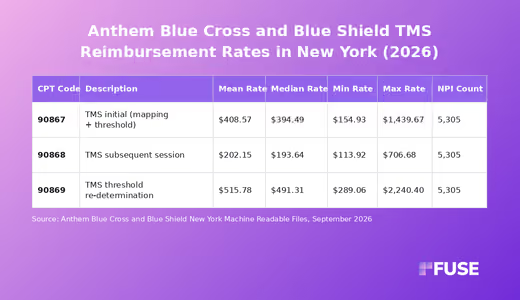
The figures below come from the machine readable files Anthem publishes under the federal Transparency in Coverage rule. Its statewide New York file unpacks to 14 gigabytes of raw pricing data, far past what any spreadsheet opens, so Fuse built software that reads it in full. We pulled every Spravato code, kept dollar fee-schedule rates billed as professional claims in the office setting, matched each NPI against the federal NPPES registry, kept individual psychiatric prescribers practicing in New York, and computed statistics over distinct provider-rate pairs. The office filter is load-bearing: the same file prices the bundled codes far lower when the drug rides on a hospital claim, and pooling those facility-setting rows with office rates would wreck the averages. If TMS is also on your menu, the companion analysis of Anthem’s TMS rates in New York runs the same method on the same file.
Anthem’s Negotiated Spravato Rates in New York
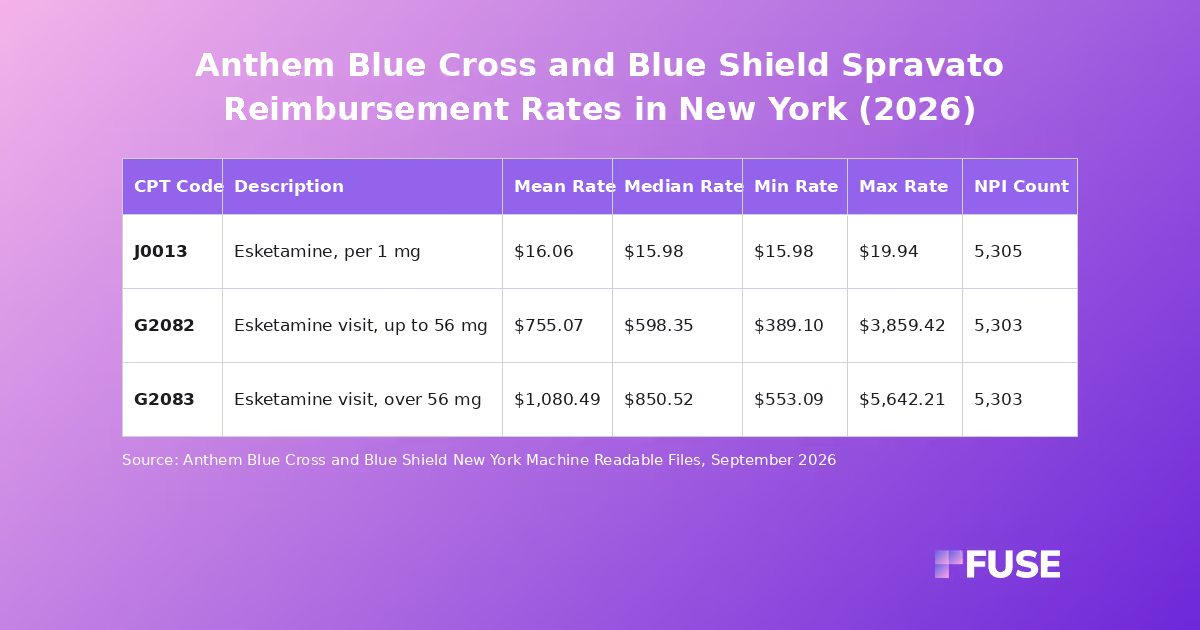
The table reflects September 2026 data. Watch the units: J0013 is the drug alone, priced per single milligram, while G2082 and G2083 are bundles paying the visit, the drug and the required two-hour observation in one amount (up to 56 mg, and above 56 mg).
| CPT Code | Description | Mean Negotiated Rate | Median Negotiated Rate | Min | Max | Unique NPI Count |
|---|---|---|---|---|---|---|
| J0013 | Esketamine (Spravato), nasal spray, 1 mg | $16.06 | $15.98 | $15.98 | $19.94 | 5,305 |
| G2082 | Office visit with esketamine self-administration, up to 56 mg, including 2 hours of post-administration observation | $755.07 | $598.35 | $389.10 | $3,859.42 | 5,303 |
| G2083 | Office visit with esketamine self-administration, over 56 mg, including 2 hours of post-administration observation | $1,080.49 | $850.52 | $553.09 | $5,642.21 | 5,303 |
Rates extracted from Anthem’s September 2026 New York machine readable files.
One coding vintage note: J0013 replaced the old esketamine code S0013 on January 1, 2026 (Anthem’s clinical criteria document records S0013 ending December 31, 2025). Our full scan of the September New York file confirms the transition is complete on Anthem’s side too: J0013 is priced throughout and S0013 no longer appears at all, so remittances and fee schedules from last year reference a code this file has already retired.
What a Spravato Session Pays in New York
Start with the number that decides the sourcing question in New York. An 84 mg session billed as a single G2083 bundle pays $850.52 at the state median. The drug inside that bundle costs you about $429.43 per 28 mg device at the June 2026 national average drug acquisition cost, and an 84 mg dose is three devices, roughly $1,288. That means the median bundle pays roughly $440 less than the drug alone costs, before a minute of staff time. The up-to-56 mg bundle runs the same direction: $598.35 at the median against roughly $859 for two devices, about $260 underwater. Unless your contract sits far above the median (the top of the range is $5,642.21), buy-and-bill under the bundled codes loses money in New York.
The per-milligram path fares better, but only just. Anthem’s J0013 pricing is nearly uniform across the state, running from $15.98 to $19.94 per mg with a median of $15.98, so an 84-unit claim bills $1,342.32 against the same $1,288 acquisition cost: roughly $50 of drug margin per session, before storage, spoilage risk and the working capital tied up in inventory. Dosing is front-loaded, twice a week for the first four weeks, so an induction month at 84 mg is eight sessions, or $10,738.56 of drug billing for one patient. You carry that spend until claims pay, and at a $50-per-session margin, one denied claim erases the drug profit from two dozen clean ones.
Put plainly: at these medians the arithmetic favors the pharmacy path in New York. Let a REMS-certified specialty pharmacy own the drug spend, and build the program’s revenue on the visit, the observation time and the psychotherapy around it. Buy-and-bill only makes sense here if your negotiated rates sit well above the medians in the table, which is exactly what to check before committing capital.
To run this for your own practice, swap in your numbers. Your rates: your Anthem fee schedule or recent remittances for J0013, G2082 and G2083. Your drug cost: physician practices buy Spravato only through the four authorized specialty distributors (Besse Medical, Cardinal Health Specialty, CuraScript SD and Henry Schein), after selecting buy-and-bill in REMS enrollment, clearing Johnson & Johnson’s Know Your Customer questionnaire, and signing a physician pricing agreement; that agreement, not the national average, is your real cost.
Anthem’s Own New York Billing Guidance
New York is one of the states where Anthem has published its own Spravato coding instructions, in a provider bulletin issued under the Empire name: when a professional provider purchases, administers and observes the drug, the coding tips bulletin directs one bundled code per session, G2082 or G2083, covering the drug, the administration and the two-hour observation with nothing billed separately. When a REMS-certified specialty pharmacy supplies the drug, the pharmacy bills the drug on its own claim and the practice bills only the visit and observation services. Never bill the G-codes and the drug code together; the clinical criteria document says the same.
On the pharmacy path, the bulletin does not point to the prolonged clinical staff codes 99415 and 99416 that Janssen’s national billing guide suggests for Spravato monitoring. For observation when no bundled code is billed, it lists the evaluation and management codes 99202 through 99205 and 99212 through 99215 plus 99417, the prolonged physician or qualified health professional code, and notes that 99417 can only be billed with 99205 or 99215. That routing may explain our scan of the New York file: 99416 is priced but 99415 is absent, and if Anthem channels prolonged observation time through 99417 rather than clinical staff codes, the missing rate reflects policy rather than a gap to query. Before building observation revenue into the plan, ask the plan whether it accepts 99415 and 99416 at all, not just how the first hour of monitoring is reported.
The Overhead: Prior Authorization and REMS in New York
Anthem reviews esketamine under clinical criteria document CC-0086, and in New York the review runs through Anthem’s medical specialty drug review team with a quantity limit of four kits per 28 days in place since May 2024. The criteria: age 18 or older, moderate to severe major depressive disorder, and an inadequate response, meaning under 50 percent symptom reduction on a standard rating scale, to two antidepressants at maximum tolerated dose in the current episode. Since the February 2025 review, Spravato can be approved as monotherapy for treatment-resistant depression. The separate pathway for depression with acute suicidal ideation or behavior still requires a concurrent oral antidepressant and is approved only in four-week increments. Initial approvals run three months; maintenance renews yearly on documented response.
New York adds a lever most states lack: when an authorization stalls on “try more medications first” for a patient whose chart already documents the failed trials, the state’s step-therapy override statute requires the plan to answer within 72 hours (24 in urgent cases), and a missed deadline counts as an approval.
REMS is the fixed operating cost under all of it: a certified setting with a designated authorized representative, a signed enrollment form for every outpatient, self-administration under direct observation, two hours of monitoring, and a monitoring form after each session. Enrollment is also where you declare buy-and-bill, pharmacy supply, or both, the same fork the math above turns on. None of that time is billable; the per-session margin has to absorb it.
Will Buy-and-Bill Stay Open in New York?
The rate table already argues for the pharmacy path in New York, and the payer is drifting the same way. Across the country, Anthem plans have been steering office-administered drugs toward designated specialty pharmacies, increasingly the Paragon Healthcare business Anthem’s parent bought in 2024, and the direction of travel is visible in New York: on the Medicaid side, Anthem’s New York plan began requiring prior authorization for buy-and-bill Spravato in May 2026, reviewed under InterQual criteria rather than the commercial document above. The commercial bulletin still describes buy-and-bill as the expected professional pattern, but check whether Spravato appears on your plan’s designated specialty pharmacy list before committing capital to drug inventory, and recheck at every contract renewal.
What This Means for Your Practice
The rates say a Spravato program can work in New York, on the right sourcing model: at the published medians the pharmacy path carries the overhead and buy-and-bill does not. What decides it for a specific practice is coverage, patient by patient: who meets the criteria, what their plan actually pays on which billing pattern, and whether the authorization clears before the first device is ordered. Fuse verifies benefits at the code level (J0013, G2082, G2083 and the visit codes around them), so every session is confirmed covered before it happens. And if you are still weighing whether to add Spravato at all, we can analyze your patient base first and estimate how many patients would likely qualify and what the revenue uplift could be.
Disclaimer: This article uses rate information from the Machine Readable Files that Anthem Blue Cross and Blue Shield publishes under the federal Transparency in Coverage rule. These files are posted to satisfy the regulation, not to be read: the file behind this analysis unpacks to 14 gigabytes of raw pricing data that no spreadsheet can open. Fuse built its own pipeline to extract and verify the figures above. This analysis focuses on a single payer and will not reflect rates from all available insurance options in New York. Drug acquisition costs cited are national survey averages and change frequently. Fuse makes every effort to provide accurate and current information, but healthcare pricing and coverage policy change frequently, and individual circumstances affect actual payment. This information does not guarantee specific pricing. Practices should verify current rates and criteria directly with Anthem before relying on them for billing or negotiation decisions.
Fuse analyzes your claims data to estimate how many patients could be eligible, benchmarks your contracted rates against the market medians, and sizes the revenue uplift.
Get Your Free AnalysisFAQs
What does Anthem pay for Spravato (esketamine) in New York?
In Anthem's September 2026 New York machine readable files, the median negotiated rate for the drug itself (HCPCS J0013) is $15.98 per 1 mg unit. Spravato is dosed at 56 mg or 84 mg per session, so the drug component at the median works out to roughly $894.88 for a 56 mg dose and $1,342.32 for an 84 mg dose, billed as 56 or 84 units of J0013.
Do these drug rates apply if a specialty pharmacy supplies the Spravato?
No. The J0013 rates in the machine readable file are buy-and-bill rates: they apply only when the practice purchases the drug and bills the plan for it. When a specialty pharmacy ships the drug to the clinic and bills the plan directly (white-bagging), the practice never bills J0013 and the drug revenue and margin belong to the pharmacy. The practice then bills only the visit, observation and any psychotherapy provided.
What is the difference between J0013 and G2082 or G2083?
J0013 is the drug-only code, billed in 1 mg units; it replaced S0013 on January 1, 2026. G2082 and G2083 are bundled codes that cover the established-patient visit, the drug and the required two-hour post-administration observation in a single payment (G2082 for doses up to 56 mg, G2083 above 56 mg). Medicare requires the G-codes and does not pay J0013. Commercial acceptance varies by payer, but Anthem's published coding guidance directs professional providers who purchase, administer and observe the drug to bill the bundled G-codes rather than billing the drug and observation separately; confirm the preferred pattern with the local plan. Never bill the G-codes and J0013 together.
Does Spravato require prior authorization?
Yes. Plans typically require documentation of treatment-resistant depression (an inadequate response to at least two antidepressants at adequate dose and duration in the current episode) and administration in a REMS-certified healthcare setting with two hours of post-dose monitoring. Many plans historically also required an oral antidepressant alongside Spravato; Anthem's 2025 criteria now allow monotherapy for treatment-resistant depression, though the oral antidepressant is still required for the acute-suicidal-ideation indication. Initial approvals are commonly time-limited and renewed based on documented response.
Does New York Medicaid cover Spravato?
Yes. New York State Medicaid has covered esketamine since August 2022 under criteria set by its Drug Utilization Review Board: a baseline score on a validated depression scale, at least two adequate oral antidepressant trials for treatment-resistant depression, and re-attestation of clinical improvement every six months. Administration must still meet the federal REMS requirements, including in-office observation. Medicaid pricing is set by the state and is separate from the commercial rates analyzed here.
Is Anthem in New York the same company as Empire BlueCross BlueShield?
Yes. Empire BlueCross BlueShield rebranded to Anthem Blue Cross and Blue Shield in 2024; the underwriting entities are now named Anthem HealthChoice Assurance, Inc. and Anthem HealthChoice HMO, Inc. The machine readable files behind this analysis still report under the legacy Empire entity name, but the rates, networks and contracts are the same organization's.