 Digital patient intake
 Patient cost estimates
 Claims automation
 Revenue intelligence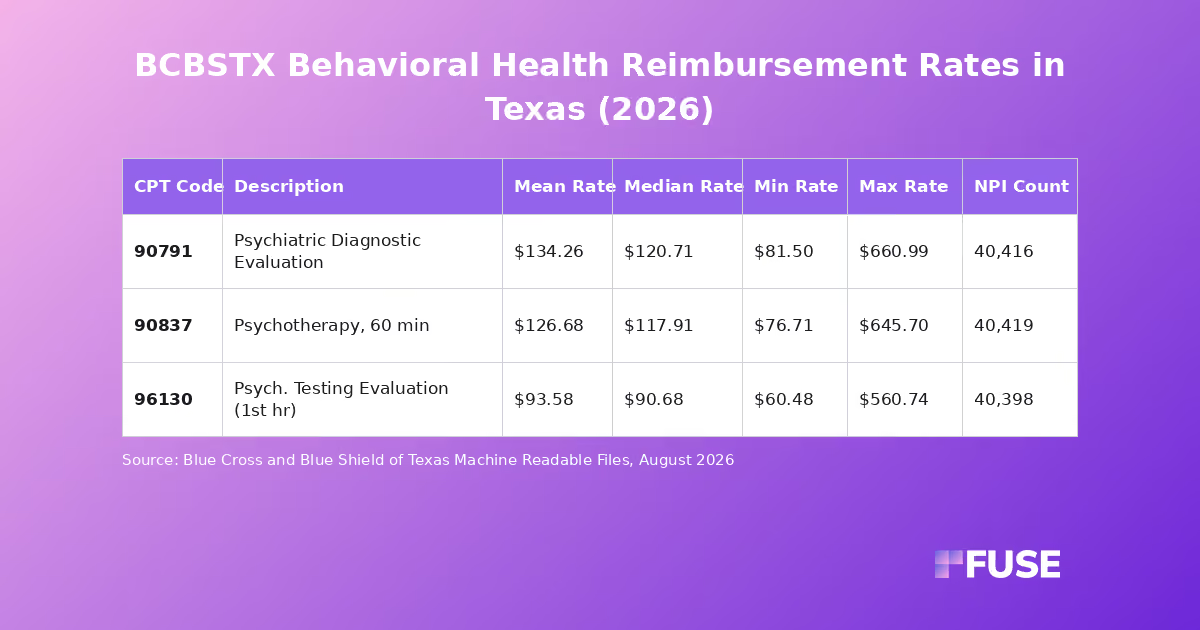
BCBSTX Behavioral Health Reimbursement Rates in Texas (2026)
Before a BCBSTX behavioral health rate can be counted as “the Texas rate” for anything, someone has to decide what counts as Texas in the first place. BCBSTX’s machine readable files disclose provider and rate data, but they do not supply a ready-made statewide behavioral health benchmark or define the inclusion rule for building one. A provider’s Texas practice location has to be established explicitly, and repeated rate observations for the same clinician have to be deduplicated, before a statewide figure means anything. Two different, defensible inclusion rules can produce two different statewide numbers from the same raw files.
There is a second trap in the raw data: most of what BCBSTX’s own index links is not BCBSTX’s Texas network at all. The index mixes BCBSTX’s own network files in with BlueCard mirrors of dozens of other Blue plans around the country, so a hand pull can land on another state’s Blues rate and mistake it for a Texas figure.
Here is the inclusion rule behind the numbers on this page. Fuse built software that reads BCBSTX’s August 2026 files in full, 38 gigabytes of raw pricing data once unpacked. We identified the files for BCBSTX’s own Texas networks (Blue Choice PPO, Blue Essentials, Blue Advantage HMO, Blue Premier, MyBlue Health HMO and the traditional ParPlan network), pulled every negotiated rate attached to these CPT codes, matched each listed NPI against the federal NPPES registry, kept only individual behavioral health clinicians whose registered practice location is in Texas, and computed the statistics across distinct provider-rate pairs so a clinician repeated across plans is not double counted. Dollar-denominated rates only: the files also carry a small number of percent-of-charge contract rows and $0.00 placeholder rows, and both are excluded so they cannot drag the averages.
BCBSTX’s Negotiated Behavioral Health Rates by CPT Code
Blue Cross and Blue Shield of Texas publishes negotiated rates for behavioral health services through its Transparency in Coverage machine readable files. The table below reflects August 2026 data for three commonly billed codes.
| CPT Code | Description | Mean Negotiated Rate | Median Negotiated Rate | Min | Max | Unique NPI Count |
|---|---|---|---|---|---|---|
| 90791 | Psychiatric Diagnostic Evaluation | $134.26 | $120.71 | $81.50 | $660.99 | 40,416 |
| 90837 | Psychotherapy, 60 minutes | $126.68 | $117.91 | $76.71 | $645.70 | 40,419 |
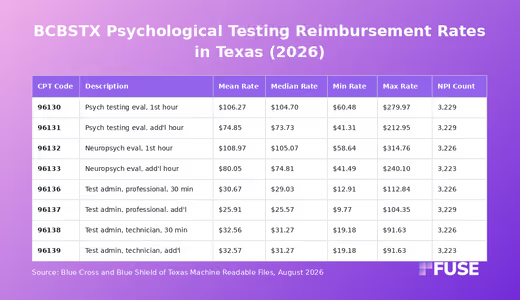
| 96130 | Psychological Testing Evaluation, 1st hour | $93.58 | $90.68 | $60.48 | $560.74 | 40,398 |
Rates extracted from BCBSTX’s August 2026 machine readable files, pooled across its Texas commercial network files.
Where BCBSTX’s 90837 rate lands among six Blue plans nationally is mapped in the BCBS 90837 rates by state comparison.
BCBSTX’s files update on a monthly cycle, so this table is labeled with its extraction date and should not be treated as a fixed, permanent figure.
Why “the Texas Rate” Depends on Whose Definition of Texas You Use
BCBSTX’s in-network files are large and difficult to open, built for software to process rather than for a person to read in a browser or spreadsheet. That scale is compounded by Texas geography: the state spans four genuinely distinct major metro markets in Houston, Dallas-Fort Worth, Austin and San Antonio, plus a large non-metro footprint, all folded into the same raw files before any inclusion rule gets applied. A statewide mean quietly blends whatever mix of those markets survives the chosen rule.
No one has published a validated network size comparison for BCBSTX and Aetna in Texas either. Raw NPI counts from a machine readable file are not that comparison: they can repeat the same clinician across plan products, locations, contracts and places of service, and they include organizational and facility NPIs alongside individual clinicians. Treat any claim that one payer’s Texas network is bigger as unverified, not as evidence.
Self-Pay Rates for Behavioral Health Care in Texas
A telehealth practice serving clients located in Texas, Healing Is a Journey LLC, lists self-pay rates of $195 for CPT 90791 and $175 for CPT 90837 on its published fee sheet. The practice notes it participates with both Aetna and Aetna Medicaid as well as Blue Cross Blue Shield and BCBS Medicaid, which shows that one practice can maintain published self-pay fees alongside multiple payer-specific in-network arrangements.
Be Still Counseling and Consulting, a Mansfield practice in the Dallas-Fort Worth area, publishes a range instead of a single code-specific figure: $100 to $200 for an initial assessment and $100 to $150 for a 60-minute individual counseling session. Published cash pricing specific to CPT 96130 is harder to find in Texas. Psychological testing is frequently billed as part of a bundled assessment package rather than priced as a standalone code, so a practice’s public rate sheet may not separate it out.
What Texas Law Actually Requires for Self-Pay Disclosure
Texas House Bill 2090, passed in 2021, governs health plan price transparency. It added Insurance Code Chapter 1662, which requires health plan issuers to publish negotiated rates, out-of-network allowed amounts and prescription drug prices in monthly machine readable files, and it created the state’s All-Payor Claims Database. What it does not create is a cash-price posting requirement for outpatient behavioral health practices. Fuse did not identify a Texas statewide law requiring therapy practices to publicly post cash prices, so the two obligations should not be conflated: HB 2090 is about what payers disclose, not what a therapy practice has to post.
The disclosure obligation that actually applies to uninsured or self-pay patients comes from the federal Good Faith Estimate requirement instead. A patient paying out of pocket is generally entitled to an estimate of expected charges on request, or automatically when a service is scheduled at least three business days in advance. Texas practices already reference this rule on their own fee pages: Healing Is a Journey, the practice cited above, points self-pay clients to a Good Faith Estimate alongside its published rates.
What This Means for Your Practice
Take this data with caution. Every figure in this article is the product of methodology choices: which network files were pooled, which rate types were excluded, which provider specialties were counted, and whose practice location counted as Texas. Change any of those filters and the mean and median move. A different analysis of the same files, applying different rules, can honestly report different numbers.
The most accurate picture of what BCBSTX pays is in your own data. Pull what BCBSTX actually paid your practice per CPT code, verify those payments manually against your contract, and compare the results with practices you know that are comparable in size, location and treatment mix. That comparison tells you whether you are paid at, above or below market in a way no statewide table can.
Fuse supports practices with exactly this work, alongside CPT-level verification of benefits before the visit, automated claims submission, and accounts receivable analytics that surface underpayments and stalled claims, so you collect what you are owed.
Confirm Network Status Before You Schedule
A statewide BCBSTX benchmark helps with budgeting and contract negotiation, but it cannot tell you what a specific patient’s plan will pay for a specific visit. Fuse verifies current eligibility and plan-specific benefits at the CPT code level before the appointment, so the practice can estimate the expected copay, coinsurance and deductible responsibility for the scheduled procedure instead of leaning on a statewide average. See how CPT-level verification works for behavioral health practices.
Disclaimer: This article uses rate information from the Machine Readable Files that Blue Cross and Blue Shield of Texas publishes under the federal Transparency in Coverage rule and Texas House Bill 2090. These files are posted to satisfy the regulations, not to be read: the files behind this analysis unpack to 38 gigabytes of raw pricing data, millions of negotiated rates that no spreadsheet can open. Fuse built software that reads them in full and verifies the figures above. This analysis focuses on a single payer and will not reflect rates from all available insurance options in Texas. Fuse makes every effort to provide accurate and current information, but healthcare pricing can change frequently, and individual circumstances may affect actual costs. This information does not guarantee specific pricing. Practices should verify current rates directly with BCBSTX before relying on them for billing or negotiation decisions.
Fuse reads your paid claims and shows what each payer actually pays you per CPT code, next to these medians.
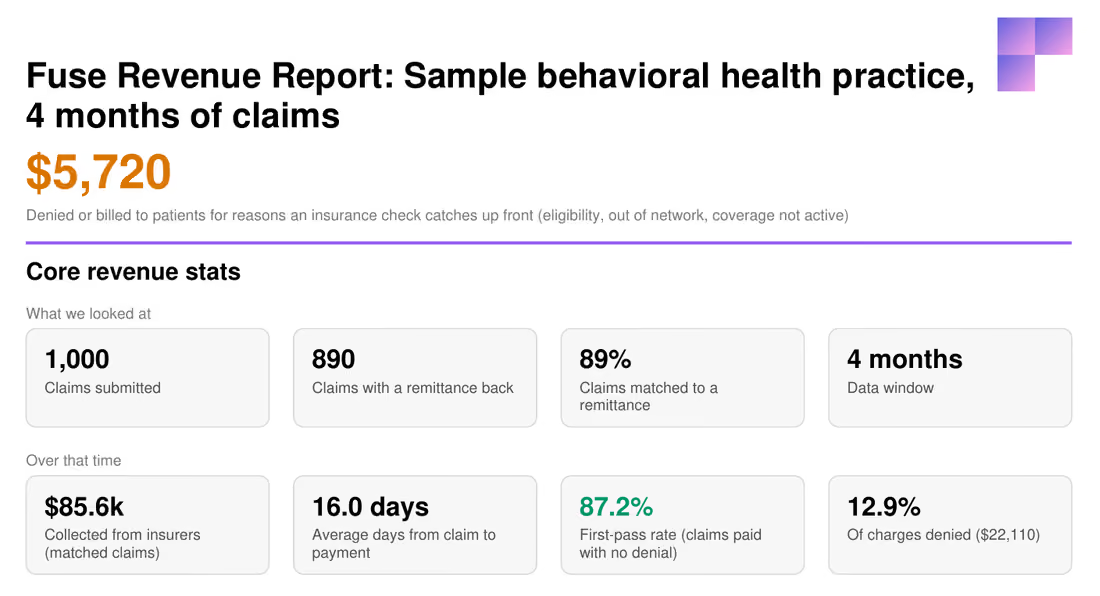
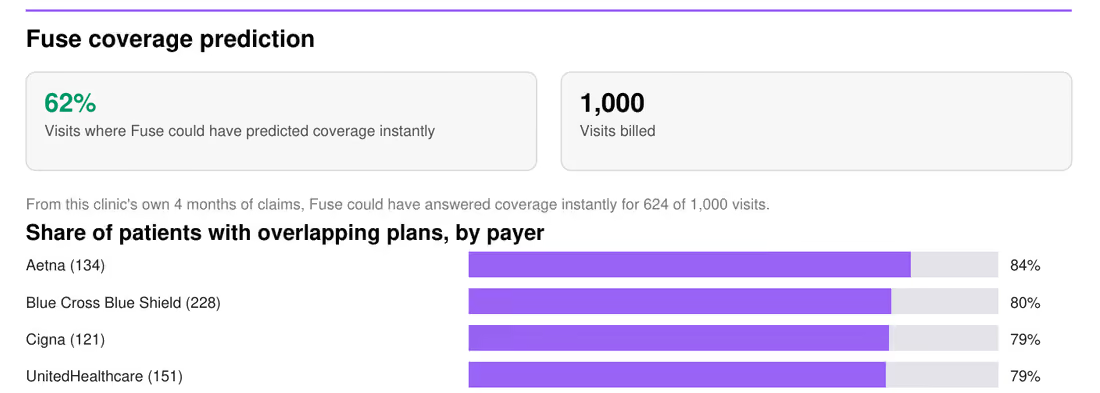

Fuse builds a model of payer behavior from your claims: underpayments flagged, lapsed plans caught, coverage predicted for scheduled patients.
Get Your Free Revenue AnalysisFAQs
What does BCBSTX pay for a 60-minute therapy session in Texas?
Fuse's review of BCBSTX's Texas rate data shows the negotiated rate for CPT 90837, a 60-minute psychotherapy session, varies by plan and provider. As of the August 2026 extraction, the statewide mean negotiated rate was $126.68 and the median was $117.91, pooled across BCBSTX's commercial network files. The published mean and median are statewide benchmarks across many distinct plans, not a guaranteed payment amount for an individual patient.
What does BCBSTX pay for a psychiatric diagnostic evaluation in Texas?
Fuse's review of BCBSTX's Texas rate data shows a psychiatric diagnostic evaluation, billed as CPT 90791, has a negotiated rate that depends on the specific plan and provider setting. As of the August 2026 extraction, the statewide mean was $134.26 and the median was $120.71. Treat the statewide figure as a benchmark, not a payment guarantee for a specific patient's plan.
Why do BCBSTX's negotiated mental health rates vary across Texas?
Fuse's review of BCBSTX's data shows a Texas-wide benchmark pools providers across Houston, Dallas-Fort Worth, Austin, San Antonio and non-metro communities, along with several distinct network files (Blue Choice PPO, Blue Essentials, Blue Advantage HMO, Blue Premier, MyBlue Health and the traditional ParPlan network). Rates also differ by plan, provider credential, setting and contract terms. Confirming a regional rate split would require a separate geographic analysis of the raw files, which has not been done here.
Do practices owe a Good Faith Estimate when the patient has BCBSTX coverage?
Fuse notes that the federal Good Faith Estimate requirement applies to uninsured and self-pay patients, not to a visit billed through active BCBSTX coverage. Patients with active BCBSTX coverage instead have their costs determined by their specific plan's copay, coinsurance and deductible terms, the same plan-level details Fuse verifies directly for practices.
How is Texas Medicaid's behavioral health fee schedule different from BCBSTX's commercial rates?
Fuse's comparison shows Texas Medicaid publishes fixed outpatient behavioral health fees that vary by patient age and provider type rather than by negotiated contract. On the TMHP fee schedule for psychologists, a psychiatric diagnostic evaluation (90791) pays $144.83 for patients age 20 and under and $137.93 for adults (effective March 1, 2024), a 60-minute psychotherapy session (90837) pays $133.88 and $127.50 (raised effective March 1, 2026), and the first hour of psychological testing evaluation (96130) pays $92.62 and $88.21 (effective January 1, 2019). Licensed counselors, social workers and marriage and family therapists are paid 70 percent of those amounts. None of this is directly comparable to BCBSTX's negotiated commercial rates, since the two use different payment frameworks entirely.