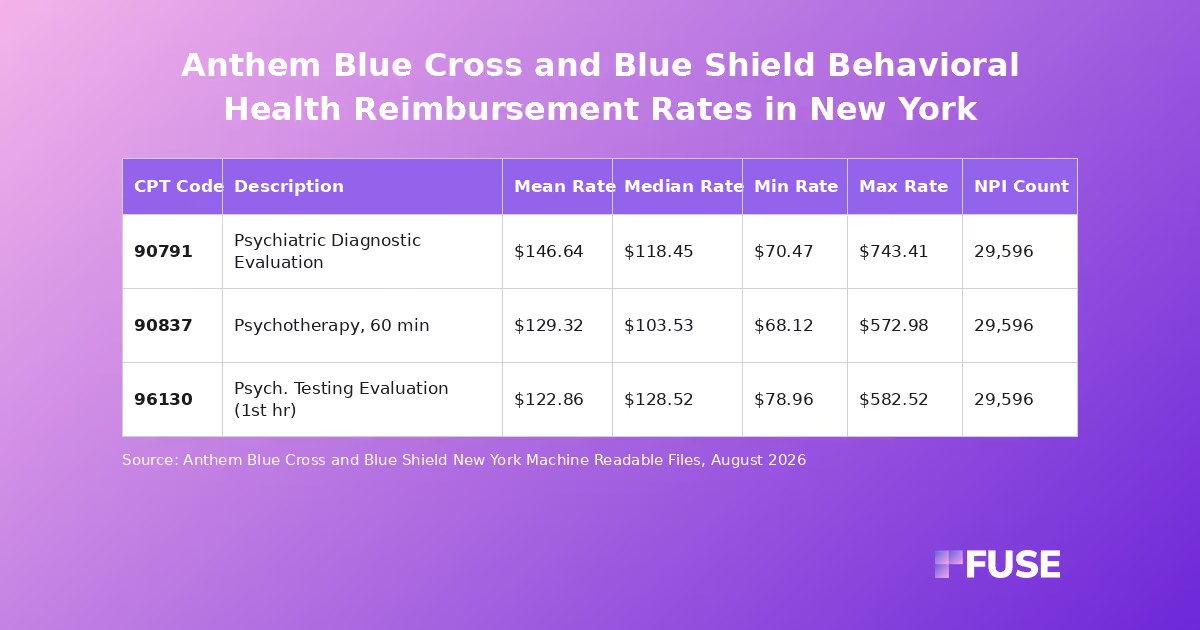
Anthem Blue Cross and Blue Shield Behavioral Health Reimbursement Rates in New York (2026)
Anthem Blue Cross and Blue Shield — known until January 2024 as Empire BlueCross BlueShield — organizes its New York behavioral health rate files by employer EIN for group plans and by HIOS number for individual plans, not by a single statewide list a practice can search. That means the “Anthem rate” for a given CPT code isn’t one number, it’s whatever the aggregation across many separate employer and individual filings happens to average out to.
A quick note on methodology: the figures below come from Fuse’s own extraction of Anthem’s August 2026 New York machine readable files. We pulled every dollar-denominated fee schedule rate attached to these CPT codes in the statewide network file (excluding percentage-of-charges entries and a block of sub-dollar contract multipliers the file mislabels as fee-schedule rates), matched each listed NPI against the federal NPPES registry, kept only individual behavioral health clinicians (psychiatrists, psychologists, therapists, counselors and psychiatric nurse practitioners) whose registered practice location is in New York, and computed the statistics across distinct provider-rate pairs. Practices running care-management programs can find the same analysis for Anthem’s RPM, CCM and RTM rates in New York.
Anthem’s Negotiated Rates for Behavioral Health CPT Codes
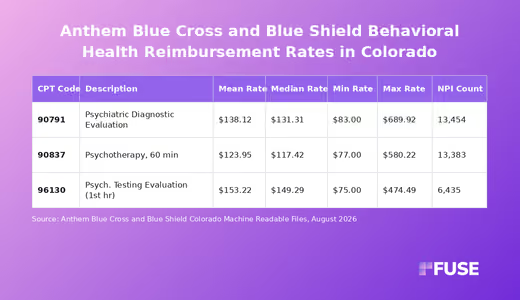
Anthem Blue Cross and Blue Shield publishes negotiated rates for behavioral health services through its New York Machine Readable Files. The table below reflects August 2026 data for three commonly billed codes.
| CPT Code | Description | Mean Negotiated Rate | Median Negotiated Rate | Min | Max | Unique NPI Count |
|---|---|---|---|---|---|---|
| 90791 | Psychiatric Diagnostic Evaluation | $146.64 | $118.45 | $70.47 | $743.41 | 29,596 |
| 90837 | Psychotherapy, 60 minutes | $129.32 | $103.53 | $68.12 | $572.98 | 29,596 |
| 96130 | Psychological Testing Evaluation, 1st hour | $122.86 | $128.52 | $78.96 | $582.52 | 29,596 |
Rates extracted from Anthem’s August 2026 New York machine readable files.
Anthem’s files update monthly, so this table is labeled with its extraction date and should not be treated as a fixed, permanent figure.
Why One Anthem Number Represents Many Separate Filings
A statewide mean or median from Anthem’s New York files pools an enormous number of distinct negotiated arrangements. Anthem organizes its files by employer EIN or HIOS number, so the aggregation choices behind any published statistic materially shape the result. Two practices billing the identical CPT code to Anthem in New York can see meaningfully different reimbursement depending on the specific plan, the employer group behind it and the provider’s credential or setting.
Anthem also notes that its files represent an as-of-date snapshot subject to change before the next monthly update. That means a rate pulled today is directional information about where Anthem’s New York network tends to land, not a number a practice can treat as fixed. A statewide average can provide a directional market benchmark, but it cannot predict payment for a particular plan, provider or visit.
What Self-Pay Behavioral Health Care Costs in New York
Cash rates for behavioral health services in New York vary practice by practice, and much of the published self-pay pricing in this market takes the form of sliding scales rather than per-CPT fee sheets. The IPTAR Clinical Center, a reduced-cost psychotherapy and psychoanalysis clinic that has served the New York City metropolitan area since 1993, publishes a sliding scale that typically ranges from $65 to $250 per session, with the fee set through a review of the patient’s financial resources and lower fees reserved for financial hardship or higher session frequency. NYC Affirmative Psychotherapy, a sliding-scale group practice, publishes no-questions-asked tiers of $70, $90 or $125 per session for those who need them, alongside its insurance-based options. The spread between those published schedules is itself the lesson: a single “New York cash rate” no more exists than a single Anthem rate does.
Published cash pricing specific to CPT 96130 is harder to find. Psychological testing is often billed as part of a bundled assessment package rather than priced as a standalone code, so a practice’s public rate sheet may not separate it out the way it does for an evaluation or a therapy session.
What New York’s Surprise-Billing Law Does and Doesn’t Cover
New York’s Emergency Medical Services and Surprise Bills Law, in effect since March 31, 2015 and the first law of its kind in the nation, protects patients from balance billing for emergency services and for surprise bills from out-of-network providers at in-network facilities, holding patients to their in-network cost-sharing. Payment disputes between plans and providers go to the state’s baseball-style independent dispute resolution process under Financial Services Law Article 6, a model that influenced the federal No Surprises Act, which since 2022 extends similar protections to the self-funded employer plans state law cannot reach. Neither law creates a self-pay pricing disclosure requirement for behavioral health practices; the relevant obligation for uninsured or self-pay patients comes from the federal Good Faith Estimate requirement.
Under the federal Good Faith Estimate requirement, providers generally must give patients a written estimate, triggered when an uninsured or self-pay patient requests one or schedules care at least three business days in advance. If the actual bill exceeds that estimate by $400 or more, the patient can pursue the federal patient-provider dispute resolution process.
What This Means for Your Practice
Anthem rate tables pool many distinct EIN- and HIOS-organized plans into one statewide figure, which is exactly the kind of aggregation that makes a published average unreliable for a single patient.
The practical response is to verify current eligibility and plan-specific benefits for the scheduled CPT code before the visit, rather than reading a pooled statewide average as a patient-specific payment estimate.
The same logic applies on the payment side. A statewide average cannot tell you whether Anthem is actually paying your practice what your contract says it should. That requires checking reimbursements against your own contracted rates, claim by claim. Fuse helps practices do exactly this: it verifies reimbursements against past claims data and places automated phone calls to payers to confirm insurance coverage, so discrepancies between what a contract promises and what actually gets paid surface before they quietly accumulate into lost revenue.
Verify Anthem Benefits Before the Visit
A statewide average is a starting point for budgeting and negotiation conversations, not a substitute for confirming what a specific patient’s plan will actually pay. Fuse verifies current eligibility and plan-specific benefits at the CPT code level before the visit, combining past claims data with automated phone calls to payers, helping practices estimate expected copay, coinsurance and deductible responsibility for the scheduled procedure and get paid what they are contractually owed. See how CPT-level verification works for behavioral health practices.
Disclaimer: This article uses rate information from the Machine Readable Files that Anthem Blue Cross and Blue Shield publishes under the federal Transparency in Coverage rule. These files are posted to satisfy the regulation, not to be read: the file behind this analysis unpacks to 22 gigabytes of raw pricing data, millions of negotiated rates that no spreadsheet can open. Fuse built its own pipeline to extract and verify the figures above. This analysis focuses on a single payer and will not reflect rates from all available insurance options in New York. Fuse makes every effort to provide accurate and current information, but healthcare pricing can change frequently, and individual circumstances may affect actual costs. This information does not guarantee specific pricing. Practices should verify current rates directly with Anthem before relying on them for billing or negotiation decisions.

Fuse analyzes your claims for allowed-amount variance to spot underpayments and denial trends.
Get Your Free Revenue AnalysisFAQs
What does Anthem Blue Cross and Blue Shield pay for a 60-minute therapy session in New York?
Fuse's review of Anthem Blue Cross and Blue Shield's New York rate data shows the negotiated rate for CPT 90837, a 60-minute psychotherapy session, varies by plan and provider. As of the August 2026 extraction, the statewide mean negotiated rate was $129.32 and the median was $103.53. The table's mean and median are statewide benchmarks across many Anthem plan arrangements; they are not a guaranteed reimbursement amount for an individual provider.
How much does a psychiatric evaluation cost with Anthem Blue Cross and Blue Shield in New York?
Fuse's review of Anthem Blue Cross and Blue Shield's New York rate data shows a psychiatric diagnostic evaluation, billed as CPT 90791, has a negotiated rate that depends on the specific plan and provider setting. As of the August 2026 extraction, the statewide mean was $146.64 and the median was $118.45. Treat the statewide figure as a benchmark, not a payment guarantee for a specific patient's plan.
Why do Anthem's negotiated rates vary so much across New York?
Fuse's analysis of Anthem's New York machine readable files shows rates vary because the data pools many distinct employer plans, organized by EIN for group coverage or HIOS number for individual coverage. Provider credential, facility versus office setting and geographic service location all factor into what a specific contract actually pays, which is why Fuse verifies rates at the individual plan level rather than relying on a statewide mean.
Do I need a Good Faith Estimate if I have Anthem Blue Cross and Blue Shield insurance?
Fuse notes that the federal Good Faith Estimate requirement applies to uninsured and self-pay patients, not to those using Anthem Blue Cross and Blue Shield insurance for a covered visit. Patients with active Anthem coverage instead have their costs determined by their specific plan's copay, coinsurance and deductible terms, the same plan-level details Fuse verifies directly for practices.
How is New York Medicaid's behavioral health payment different from Anthem's commercial rates?
They are entirely different frameworks. New York Medicaid covers outpatient behavioral health mainly through managed care plans, mainstream plans and the specialty Health and Recovery Plans (HARPs), but state law requires those plans to pay 100 percent of the state-set "government rates" for outpatient behavioral health services delivered by OMH- or OASAS-licensed programs, calculated under the Ambulatory Patient Group (APG) methodology rather than negotiated plan by plan. None of that is comparable to the negotiated commercial rates in Anthem's MRF data, so practices should not read Medicaid arrangements and commercial benchmarks as interchangeable.