Anthem Blue Cross and Blue Shield Remote Therapeutic Monitoring (RTM) Reimbursement Rates for New York PT, OT & Respiratory Practices (2026)
Remote therapeutic monitoring (RTM) sits in its own lane among the remote-care code families: where remote patient monitoring captures physiologic readings and chronic care management pays for care-coordination time, RTM covers non-physiologic therapeutic data, respiratory and musculoskeletal status, medication and therapy adherence, and functional status, a distinction CMS makes directly in its claims-processing material. That scope is why the billers here are different too: physical therapists, occupational therapists, respiratory care practices and behavioral health clinicians, many of whom cannot bill RPM at all. For any of them, the monthly recurrence of RTM billing means the negotiated rate assumption behind a program gets tested against reality every single billing cycle, which is reason enough not to mistake Anthem’s statewide New York figures for a contract rate. See how CPT-level verification works.
New York brings a naming question the other states don’t have. Following the January 2024 Empire rebrand, the same Anthem business answers to Anthem Blue Cross and Blue Shield in eastern and southeastern New York and to Anthem Blue Cross upstate. Whether the underlying transparency data splits along that line is resolved under the rate table, consistent with the treatment on Fuse’s companion New York pages.
The build behind the figures: from Anthem’s August 2026 statewide New York network file, Fuse kept the dollar-denominated fee schedule rates for the RTM code family (percentage-of-charges rows excluded) and resolved every listed NPI through the federal NPPES registry. Because RTM’s billers are therapy and behavioral clinicians rather than primary care, the provider universe here is individual physical, occupational and respiratory therapists plus behavioral health clinicians practicing in New York, a deliberately different filter from the primary-care universe on the RPM and CCM pages. Statistics run across distinct provider-rate pairs, and since Anthem negotiates fee schedules at the plan and provider-group level rather than by clinician type, the figures stay representative for any RTM biller. Companion analyses: Anthem’s RPM rates in New York, Anthem’s CCM rates in New York, and our original look at Anthem’s behavioral health rates in New York.
Anthem’s Rates for Remote Therapeutic Monitoring (RTM) CPT Codes in New York
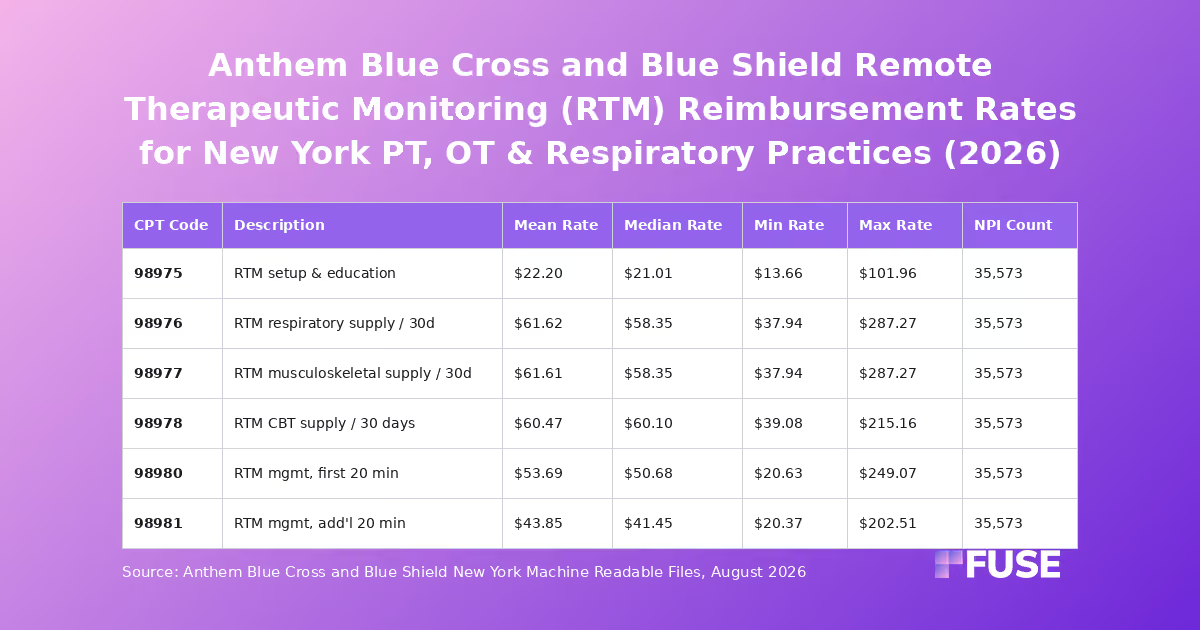
Anthem Blue Cross and Blue Shield publishes negotiated rates for remote therapeutic monitoring through its New York Machine Readable Files. The table below reflects August 2026 data for the five core RTM codes.
| CPT Code | Description | Mean Negotiated Rate | Median Negotiated Rate | Min | Max | Unique NPI Count |
|---|---|---|---|---|---|---|
| 98975 | Remote therapeutic monitoring setup and patient education | $22.20 | $21.01 | $13.66 | $101.96 | 35,573 |
| 98976 | RTM device supply, respiratory system, each 30 days | $61.62 | $58.35 | $37.94 | $287.27 | 35,573 |
| 98977 | RTM device supply, musculoskeletal system, each 30 days | $61.61 | $58.35 | $37.94 | $287.27 | 35,573 |
| 98980 | RTM treatment management, first 20 minutes per month | $53.69 | $50.68 | $20.63 | $249.07 | 35,573 |
| 98981 | RTM treatment management, each additional 20 minutes | $43.85 | $41.45 | $20.37 | $202.51 | 35,573 |
Rates extracted from Anthem’s August 2026 New York machine readable files.
As for the two-brand question: Anthem’s New York in-network files all carry one reporting-entity name, Empire BlueCross BlueShield, the legacy umbrella for both successor brands, with no field that dependably separates downstate networks from upstate ones. One statewide table covering both brand regions is therefore the honest structure, and it matches the companion RPM and CCM pages. Each monthly file release replaces the last, so these figures belong to their extraction date.
Additional RTM Codes in Anthem’s Rate Data
Three more RTM codes carry negotiated rates in the New York data, each confirmed in Anthem’s clinical policy CG-MED-91 and priced in the CMS 2026 physician fee schedule relative value files: 98978, the device-supply code for cognitive behavioral therapy monitoring, plus the new-for-2026 short-duration supply codes 98984 (respiratory) and 98985 (musculoskeletal). Each gets its own section below.
| CPT Code | Description | Mean Negotiated Rate | Median Negotiated Rate | Min | Max | Unique NPI Count |
|---|---|---|---|---|---|---|
| 98978 | RTM device supply, cognitive behavioral therapy, each 30 days (16-30 days of data) | $60.47 | $60.10 | $39.08 | $215.16 | 35,573 |
| 98984 | RTM device supply, respiratory system, 2-15 days in a 30-day period | $49.05 | $52.11 | $33.88 | $259.02 | 36,183 |
| 98985 | RTM device supply, musculoskeletal system, 2-15 days in a 30-day period | $48.42 | $51.44 | $33.45 | $255.69 | 36,183 |
Rates extracted from Anthem’s August 2026 New York machine readable files.
What Anthem’s New York RTM Rates Actually Tell You
The right way to read the tables is as a spread of contracts, not a price. Anthem assembles its New York file from plan-level arrangements keyed to employer EINs and HIOS identifiers, so every statewide statistic pools thousands of separate negotiations; which contract sits behind a specific claim, not the statewide mean, decides the payment. The distance between the min and max columns is the practical takeaway: two therapy practices in the same city can be paid from opposite ends of it for identical work.
There is also a shelf life to account for. Anthem publishes these machine readable files monthly as as-of-date snapshots (Anthem, Machine Readable Files), each superseding the last, and a listed rate is evidence of what the network pays rather than a promise that a particular claim clears. Coverage criteria, plan edits and documentation requirements all operate downstream of the file.
Remote Therapeutic Monitoring for Behavioral Health Practices: CPT 98978
Behavioral health is part of RTM’s billing population, unlike RPM’s. CPT 98978 covers supplying the device or software that tracks a patient’s engagement with a cognitive behavioral therapy program, billed once per 30 days with 16-30 days of data, parallel to the respiratory (98976) and musculoskeletal (98977) supply codes. The statewide statistics above remain representative for behavioral health billers even though the sample also includes PT, OT and respiratory practices, because Anthem sets fee schedules at the plan and provider-group level rather than by clinician type.
What’s New in RTM Billing for 2026: CPT 98984 and 98985
Two short-duration supply codes joined the family on January 1, 2026: 98984 (respiratory) and 98985 (musculoskeletal) cover months with only 2-15 days of data transmission, below the 16-30-day threshold of the standard supply codes 98976 and 98977. A given 30-day period bills the short-duration code or the full-month code, never both. Anthem added both to CG-MED-91’s coding table in its January 2026 update, and both already carry negotiated New York rates in the table above.
Anthem’s Coverage Requirements for RTM in New York
Anthem’s clinical policy CG-MED-91, “Remote Therapeutic and Physiologic Monitoring Services,” is published for its New York plans through the policy portal operated for Anthem HealthChoice HMO and Anthem HealthChoice Assurance, the former Empire legal entities behind both New York brands. For RTM it requires that the monitoring be clinically appropriate for the patient’s condition, that the collected data be regularly assessed to detect acute changes and prompt intervention, and that the patient be at risk of clinically significant changes in medical status, alongside the policy’s remaining criteria. CMS’s claims-processing material independently confirms the core code family and its non-physiologic-data scope.
One piece of New York background belongs here with its limits stated: the state’s telehealth non-exclusion rule (NY Department of Financial Services, Insurance Law sections 3217-h and 4306-g) bars an insurer from excluding an otherwise-covered service solely because it is delivered via telehealth. It does not establish RTM’s coverage, any negotiated rate, or freedom from prior authorization, and a rate in the machine readable file plus that rule together still do not confirm a specific claim will be paid.
Why RTM Can’t Be Billed on the Same Clock as CCM or RPM
RTM’s denial-risk mechanism when programs overlap is time accounting: a patient can qualify for RTM alongside remote patient monitoring or chronic care management in the same period, but no clinical-staff or practitioner minute can count toward more than one service, and the documentation must show separately qualifying work for each service billed. Practices running combined programs should read this page together with Anthem’s New York RPM reimbursement rates and Anthem’s New York CCM reimbursement rates.
What This Means for Your Practice
An RTM program in New York answers to two gates at once: CG-MED-91’s medical-necessity criteria and the member plan’s own coverage terms, and a statewide average speaks to neither. The cost of assuming shows up monthly, because RTM bills monthly. Fuse’s role is the verification layer: it checks reimbursements against a practice’s own past claims and places automated phone calls to payers to confirm coverage, so a mismatch between the assumed rate and the plan’s reality surfaces before it repeats across an enrolled panel.
Verify RTM Coverage and Billing Before Every Claim
Use the statewide tables for what they are good at, budgeting and program design, and resolve the payable question plan by plan: what the member’s plan covers, what CG-MED-91 requires, and what the contract actually pays. Fuse verifies current eligibility and plan-specific benefits at the CPT code level before the visit, combining past claims data with automated phone calls to payers, helping practices estimate expected copay, coinsurance and deductible responsibility and get paid what they are contractually owed. See how CPT-level verification works.
Disclaimer: This article uses rate information from the Machine Readable Files that Anthem Blue Cross and Blue Shield publishes under the federal Transparency in Coverage rule. These files are posted to satisfy the regulation, not to be read: the file behind this analysis unpacks to 17 gigabytes of raw pricing data, millions of negotiated rates that no spreadsheet can open. Fuse built its own pipeline to extract and verify the figures above. This analysis focuses on a single payer and will not reflect rates from all available insurance options in New York. Fuse makes every effort to provide accurate and current information, but healthcare pricing can change frequently, and individual circumstances may affect actual costs. This information does not guarantee specific pricing. Practices should verify current rates directly with Anthem before relying on them for billing or negotiation decisions.

Fuse analyzes your claims data to estimate how many patients could be eligible, benchmarks your contracted rates against the market medians, and sizes the revenue uplift.
Get Your Free AnalysisFAQs
What does Anthem Blue Cross and Blue Shield pay for remote therapeutic monitoring (RTM) in New York?
Fuse's review of Anthem Blue Cross and Blue Shield's New York machine readable files shows the negotiated rate varies by plan and provider. As of the August 2026 extraction, RTM treatment management (CPT 98980) had a statewide mean negotiated rate of $53.69 and a median of $50.68, while the musculoskeletal device-supply code 98977 had a mean of $61.61 and a median of $58.35. Treat statewide figures as benchmarks, not a guaranteed reimbursement amount for an individual provider.
Does Anthem Blue Cross and Blue Shield require prior authorization for RTM in New York?
RTM falls under Anthem's clinical policy CG-MED-91, which sets medical-necessity criteria: the monitoring must be clinically appropriate, the data must be regularly assessed to detect acute changes and prompt intervention, and the patient must be at risk of clinically significant changes in medical status. A payable rate in the machine readable file does not by itself confirm authorization or coverage for a specific claim, so practices should verify the applicable member plan's current requirements before billing.
Can a practice bill RTM and CCM for the same patient?
Yes. A patient can generally qualify for remote therapeutic monitoring and chronic care management in the same calendar month, but the same clinical-staff or practitioner time cannot be counted toward more than one service. Documentation has to support separately qualifying work for each service billed, and commercial plans can impose their own edits, so Fuse recommends confirming the combination against the patient's specific Anthem plan.
How is RTM different from RPM?
Remote physiologic monitoring (RPM) covers physiologic data - weight, blood pressure, pulse oximetry, glucose - collected by a medical device, while remote therapeutic monitoring (RTM) covers non-physiologic therapeutic data such as respiratory or musculoskeletal status, medication and therapy adherence, and functional status. RTM is also billable by a broader set of practitioners, including physical and occupational therapists who cannot bill RPM. In Anthem's New York data, RTM management (98980) had a median of $50.68.
Why do Anthem's negotiated RTM rates vary so much across New York?
Fuse's analysis of Anthem's New York machine readable files shows rates vary because the data pools many distinct plans, organized by employer EIN for group coverage or HIOS number for individual coverage. The provider's credential, contract and geographic service location all factor into what a specific arrangement actually pays, which is why a statewide average is a benchmark rather than a payment guarantee for any one practice.
Is Anthem Blue Cross and Blue Shield the same company as Empire BlueCross BlueShield?
Yes, in eastern and southeastern New York. Effective January 1, 2024, Empire BlueCross BlueShield was renamed Anthem Blue Cross and Blue Shield in that region, and Empire BlueCross became Anthem Blue Cross in upstate New York. The two remain distinct regional brands rather than one identical statewide plan. In the machine readable files behind this analysis, the data is still filed under the Empire BlueCross BlueShield reporting-entity name as one statewide filing, which is why this page presents a single statewide table.