Anthem Blue Cross Spravato Reimbursement Rates in California (2026)
Thinking about adding Spravato (esketamine) to a California psychiatric practice? The first question is whether it will actually be profitable, and that depends on three things: what the payer pays, how you source the drug, and how much overhead prior authorization and REMS add. This article works through all three using Anthem Blue Cross’s own published rates.
Sourcing first, because it decides which numbers apply to you. There are two models. Buy-and-bill: you purchase Spravato from a distributor, administer it in the office, and bill Anthem for the drug and your services. White-bagging: a specialty pharmacy ships each patient’s doses to your clinic and bills the plan directly; you never bill the drug at all, and your revenue is the visit, the observation time and any psychotherapy around it. The drug economics below apply to buy-and-bill only.
Where These Numbers Come From
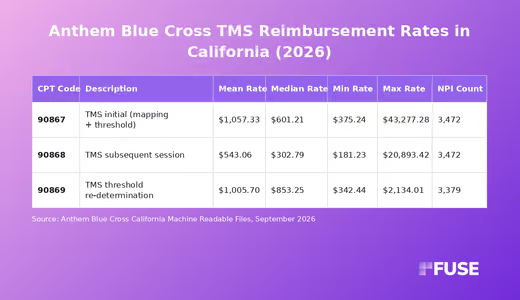
Under the federal Transparency in Coverage rule, every payer publishes machine readable files listing its negotiated rate for every billing code. These are not files anyone can open in a spreadsheet: the single statewide Anthem California file behind this analysis unpacks to 8 gigabytes of raw pricing data, and Fuse built software that reads it in full. From it we pulled every Spravato code, kept dollar fee-schedule rates billed as professional claims in the office setting, matched every NPI against the federal NPPES registry, kept individual psychiatric prescribers practicing in California, and computed statistics over distinct provider-rate pairs. One filter worth explaining: the same file carries facility-setting rates of $17 to $125 for the bundled codes, which is what they pay when the drug rides on a hospital claim; pooling those with office rates would wreck the averages. There is also a companion analysis of Anthem’s TMS rates in California.
Anthem’s Negotiated Spravato Rates in California
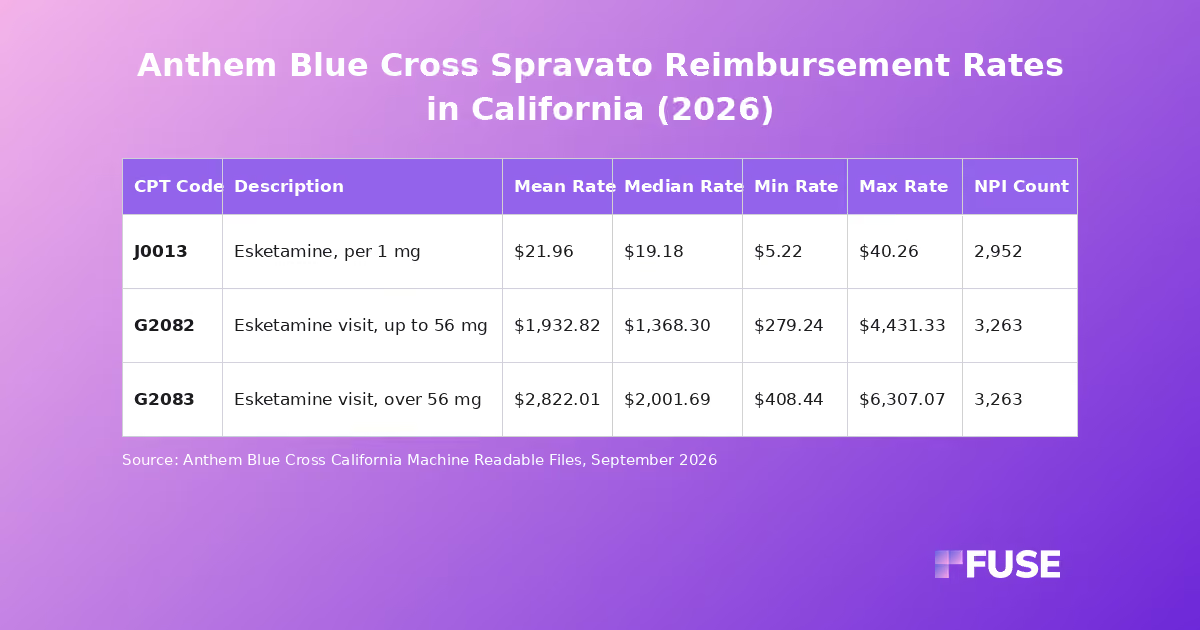
The table reflects September 2026 data. Note the units: J0013 is the drug itself, priced per single milligram; G2082 and G2083 are bundles that pay the visit, the drug and the required two-hour observation in one amount (up to 56 mg, and above 56 mg).
| CPT Code | Description | Mean Negotiated Rate | Median Negotiated Rate | Min | Max | Unique NPI Count |
|---|---|---|---|---|---|---|
| J0013 | Esketamine (Spravato), nasal spray, 1 mg | $21.96 | $19.18 | $5.22 | $40.26 | 2,952 |
| G2082 | Office visit with esketamine self-administration, up to 56 mg, including 2 hours of post-administration observation | $1,932.82 | $1,368.30 | $279.24 | $4,431.33 | 3,263 |
| G2083 | Office visit with esketamine self-administration, over 56 mg, including 2 hours of post-administration observation | $2,822.01 | $2,001.69 | $408.44 | $6,307.07 | 3,263 |
Rates extracted from Anthem’s September 2026 California machine readable files.
Two coding notes before the math. First, J0013 replaced S0013 on January 1, 2026 (Anthem’s CC-0086 criteria document records the switch); S0013 claims now reject, and our full scan confirms the old code no longer appears anywhere in Anthem’s California file. Second, which code you bill is not a free choice: Anthem’s published coding tips direct buy-and-bill professionals to bill one bundled G-code per session rather than billing the drug and observation separately, reserving J0013 for sessions where a pharmacy supplies the drug on its own claim. Those bulletins came through Anthem’s provider news channels in other states, and CC-0086 notes that a code’s inclusion does not guarantee reimbursement, so confirm the pattern with the plan before the first claim. Never bill the G-codes and J0013 together.
The Simple Math
Take an 84 mg session on buy-and-bill, billed as one G2083 bundle. At the California median the bundle pays $2,001.69. The drug inside it costs you about $429.43 per device (the June 2026 national average drug acquisition cost), and an 84 mg dose is three devices, roughly $1,288. That leaves roughly $700 of gross margin per session, which has to cover the two hours of monitoring, staff time and authorization work.
If your contract pays the drug separately instead, the same math runs per milligram: the median J0013 rate is $19.18 per mg, so 84 units bill $1,611.12 against the same $1,288 drug cost, about $320 of drug margin. Check the floor before committing: the lowest J0013 rate in this file is $5.22 per mg, below acquisition cost. At that rate the drug loses money on every session.
Dosing is front-loaded: twice a week for the first four weeks, weekly for the next four, then every one to two weeks. An induction month at 84 mg is eight sessions, which at the median per-mg rate is $12,888.96 of drug billing for a single patient. That cuts both ways: distributor payment terms soften the cash-flow gap, but you own the drug spend, and one denied claim erases the margin from several good ones.
To run this math for your own practice, swap our medians for your numbers. Your rates: pull your Anthem fee schedule or recent remittances for J0013, G2082 and G2083, or ask your network representative. Your drug cost: for physician practices, Spravato is sold only through four authorized specialty distributors (Besse Medical, Cardinal Health Specialty, CuraScript SD and Henry Schein). Janssen’s acquisition pathway is: select buy-and-bill on your REMS enrollment, clear Johnson & Johnson’s Know Your Customer questionnaire, then set up a physician pricing agreement with Johnson & Johnson alongside the distributor account. That agreement, not the national average, is your real drug cost. Then confirm with the plan whether it wants the bundle or the unbundled pattern. The medians here tell you whether your contract is above or below the market; they are not your contract.
One smaller line to check: on the pharmacy path, observation time bills separately, typically an evaluation and management visit plus prolonged clinical staff codes 99415 and 99416. Our scan found 99416 priced in this file but no 99415 at all, so verify both are contracted before building observation revenue into the plan.
The Overhead: Prior Authorization and REMS
Two fixed costs gate all of this. Anthem reviews esketamine under its clinical criteria document CC-0086, revised April 2025: age 18 or older, moderate to severe major depressive disorder, and an inadequate response (under 50 percent symptom reduction on a standard rating scale) to two antidepressants at the maximum tolerated dose in the current episode. Since the February 2025 review, Spravato can be approved as monotherapy; an oral antidepressant is no longer required for this pathway. Initial approval runs 3 months; maintenance renews in 12-month increments. The separate pathway for MDD with acute suicidal ideation or behavior is approved in 4-week increments and still requires an oral antidepressant.
REMS adds the operating requirements: a certified setting with a designated authorized representative, a signed Patient Enrollment Form for every outpatient, self-administration under direct observation, two hours of monitoring, and a Patient Monitoring Form after each session. Enrollment at spravatorems.com is also where you declare your acquisition method (specialty pharmacy, buy-and-bill, or both), the same fork the math above turns on. None of this is billable time; it is overhead the per-session margin has to absorb.
Will Buy-and-Bill Spravato Stay Open in California?
The buy-and-bill margin here exists at Anthem’s discretion. Across the country, Anthem has been requiring practices to get certain office-administered drugs from a pharmacy it designates instead of buying them, and since it bought Paragon Healthcare in 2024, that designated pharmacy is increasingly Anthem’s own. The shift is rolling out state by state through 2026. California is not on that schedule yet, and Anthem’s own Spravato coding guidance still describes buy-and-bill. But nothing in California law prevents a sourcing mandate (SB 958, the bill that would have restricted white-bagging requirements, died in 2022), so confirm Spravato is not on your plan’s designated specialty pharmacy list, and recheck at renewal.
How do these rates compare with just charging cash? California self-pay Spravato typically runs $1,000 to $1,500 per session when the clinic supplies the drug. Anthem’s median bundle rate of $2,001.69 pays more than that. For the pharmacy path, the cash benchmark is service-only: Exxceed Wellness in Hayward, for example, charges a published $725 per session for administration and monitoring, with the drug billed separately. In short, at the median, an in-network buy-and-bill program out-earns a cash-pay one, which is the argument for taking on the authorization and REMS overhead.
What This Means for Your Practice
The rates say Spravato can carry its overhead. What decides it for a specific practice is coverage, patient by patient: who is eligible, what their plan actually pays, and whether the authorization will clear before the first device is ordered. Fuse verifies benefits at the code level (J0013, G2082, G2083 and the visit codes around them), so every session is confirmed covered before it happens. And if you are still deciding whether to add Spravato at all, we can analyze your patient base first and estimate how many patients would likely qualify and what the revenue uplift could be.
Disclaimer: This article uses rate information from the Machine Readable Files that Anthem Blue Cross publishes under the federal Transparency in Coverage rule. These files are posted to satisfy the regulation, not to be read: the file behind this analysis unpacks to 8 gigabytes of raw pricing data that no spreadsheet can open. Fuse built its own pipeline to extract and verify the figures above. This analysis focuses on a single payer and will not reflect rates from all available insurance options in California. Drug acquisition costs cited are national survey averages and change frequently. Fuse makes every effort to provide accurate and current information, but healthcare pricing and coverage policy change frequently, and individual circumstances affect actual payment. This information does not guarantee specific pricing. Practices should verify current rates and criteria directly with Anthem before relying on them for billing or negotiation decisions.
Fuse analyzes your claims data to estimate how many patients could be eligible, benchmarks your contracted rates against the market medians, and sizes the revenue uplift.
Get Your Free AnalysisFAQs
What does Anthem pay for Spravato (esketamine) in California?
In Anthem's September 2026 California machine readable files, the median negotiated rate for the drug itself (HCPCS J0013) is $19.18 per 1 mg unit. Spravato is dosed at 56 mg or 84 mg per session, so the drug component at the median works out to roughly $1,074.08 for a 56 mg dose and $1,611.12 for an 84 mg dose, billed as 56 or 84 units of J0013.
Do these drug rates apply if a specialty pharmacy supplies the Spravato?
No. The J0013 rates in the machine readable file are buy-and-bill rates: they apply only when the practice purchases the drug and bills the plan for it. When a specialty pharmacy ships the drug to the clinic and bills the plan directly (white-bagging), the practice never bills J0013 and the drug revenue and margin belong to the pharmacy. The practice then bills only the visit, observation and any psychotherapy provided.
What is the difference between J0013 and G2082 or G2083?
J0013 is the drug-only code, billed in 1 mg units; it replaced S0013 on January 1, 2026. G2082 and G2083 are bundled codes that cover the established-patient visit, the drug and the required two-hour post-administration observation in a single payment (G2082 for doses up to 56 mg, G2083 above 56 mg). Medicare requires the G-codes and does not pay J0013. Commercial acceptance varies by payer, but Anthem's published coding guidance directs professional providers who purchase, administer and observe the drug to bill the bundled G-codes rather than billing the drug and observation separately; confirm the preferred pattern with the local plan. Never bill the G-codes and J0013 together.
Does Spravato require prior authorization?
Yes. Plans typically require documentation of treatment-resistant depression (an inadequate response to at least two antidepressants at adequate dose and duration in the current episode) and administration in a REMS-certified healthcare setting with two hours of post-dose monitoring. Many plans historically also required an oral antidepressant alongside Spravato; Anthem's 2025 criteria now allow monotherapy for treatment-resistant depression, though the oral antidepressant is still required for the acute-suicidal-ideation indication. Initial approvals are commonly time-limited and renewed based on documented response.
Why is J0013 shown per 1 mg instead of per dose?
J0013 is defined as esketamine, nasal spray, 1 mg, so claims are billed in single-milligram units: 56 units for a 56 mg session and 84 units for an 84 mg session. The table shows the per-unit negotiated rate exactly as it appears in Anthem's machine readable files; multiply by the dose to estimate the drug line on a claim.