Anthem Blue Cross TMS Reimbursement Rates in California (2026)
Thinking about adding TMS to a California psychiatric practice? Whether it pays depends on three things: the per-session rate, whether patients complete their courses, and the prior authorization overhead in the way. This article works through all three using Anthem Blue Cross’s own published rates. The stakes compound quickly, because TMS bills unlike anything else in psychiatry: a medication-management patient generates one claim a month, while a TMS patient generates one nearly every weekday for six weeks or more.
Where These Numbers Come From
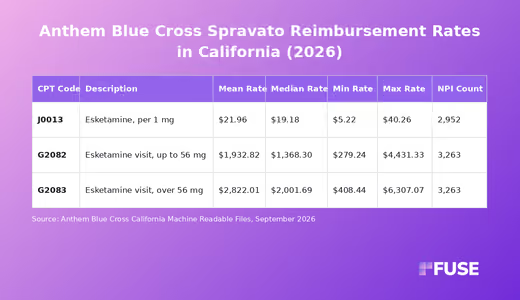
The figures below come from Anthem’s machine readable files, the giant rate disclosures every payer must publish under the federal Transparency in Coverage rule. The statewide California file behind this analysis is 8 gigabytes uncompressed, far too large to open, so Fuse built software that reads it in full. We pulled every rate attached to the three TMS codes, kept dollar fee-schedule rates billed as professional claims in the office setting, matched the NPIs against the federal NPPES registry, kept individual psychiatric prescribers located in California, and computed statistics over distinct provider-rate pairs. If you also run esketamine, see the companion analysis of Anthem’s Spravato rates in California.
Anthem’s Negotiated TMS Rates in California
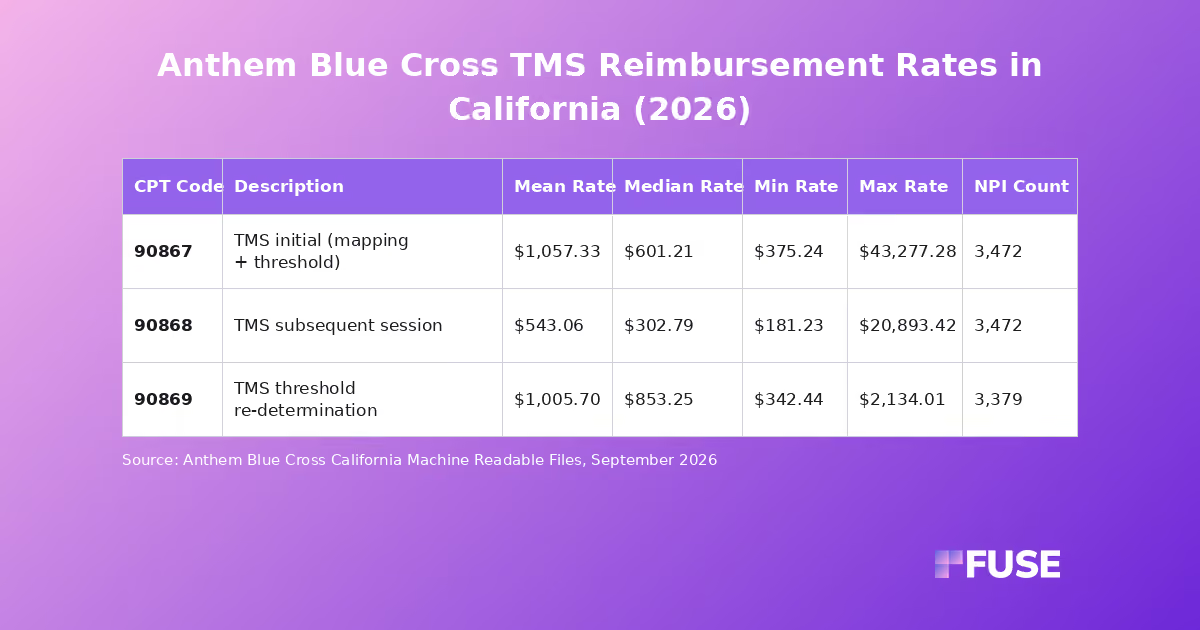
The table reflects September 2026 data.
| CPT Code | Description | Mean Negotiated Rate | Median Negotiated Rate | Min | Max | Unique NPI Count |
|---|---|---|---|---|---|---|
| 90867 | TMS treatment, initial, including cortical mapping, motor threshold determination, delivery and management | $1,057.33 | $601.21 | $375.24 | $43,277.28 | 3,472 |
| 90868 | TMS treatment, subsequent delivery and management, per session | $543.06 | $302.79 | $181.23 | $20,893.42 | 3,472 |
| 90869 | TMS treatment, subsequent motor threshold re-determination with delivery and management | $1,005.70 | $853.25 | $342.44 | $2,134.01 | 3,379 |
Rates extracted from Anthem’s September 2026 California machine readable files.
One oddity worth flagging: the median for 90869 (motor threshold re-determination) sits above the initial 90867 session. That is what Anthem publishes, not a processing artifact. These codes are contracted line by line, not derived from one fee schedule multiplier.
The Simple Math
A standard acute course is one mapping session (90867, billed once per course) and roughly 35 treatment sessions (90868). At the September 2026 medians of $601.21 and $302.79, a completed course is about $11,198.86 per patient, before any medically necessary motor threshold re-determinations (90869) along the way. A single chair completing two courses a month adds that revenue on top of the existing visit panel, since sessions are technician-delivered under supervision in most practice models.
Two sanity checks on the median. First, cash: Stella Mental Health publishes a California self-pay rate of $250 for mapping and $250 per session, so the in-network median beats the cash market. When the insured rate out-earns your own cash price, network participation is the growth channel, not a discount program. Second, the spread: 90868 runs from $181.23 to $20,893.42 across 3,472 matched clinicians. The extreme highs belong to small provider groups; the large statewide networks cluster far lower. Benchmark a contract against the median, not the maximum.
To run this math for your own practice, swap our medians for your numbers: pull your Anthem fee schedule or recent remittances for 90867, 90868 and 90869, or ask your network representative, and set that against your device cost, technician time and realistic completion rates. The medians here tell you whether your contract is above or below the market; they are not your contract.
The Overhead: Prior Authorization and Mid-Course Reviews
Expect prior authorization on every commercial TMS course: a qualifying major depressive disorder diagnosis, the antidepressant trials that failed at adequate dose and duration in the current episode, and standardized severity scores. The codes themselves are strict: 90867 bills once per course (and not more than once in six weeks), never on the same day as the other two, and the diagnosis anchors are F32.2 and F33.2, per CMS billing article A57072, which most payer edit logic mirrors.
Denial risk concentrates at two points: the initial authorization and the mid-course review some plans run around session 18 to 20. A course that stalls at session 19 forfeits the back half of the revenue above, so calendar the review the day the authorization is approved.
TMS Prior Authorization and Coverage in California
California approves TMS differently from other states, and the difference comes down to how the patient’s employer pays for insurance. If the plan is fully insured, California law (SB 855) says Anthem must judge medical necessity using criteria written by the relevant medical specialty’s professional association, not its own rulebook. For TMS, that means the CANMAT depression guidelines (from the Canadian Network for Mood and Anxiety Treatments), which Anthem’s California guideline lists adopted in August 2025. CANMAT recommends TMS once a single adequate antidepressant trial has failed, a lower bar than most commercial policies.
If the employer self-insures (common with large companies), federal law exempts the plan from SB 855, and Anthem reviews TMS under MCG guideline B-801-T instead, which looks closer to traditional treatment-resistance criteria: more failed trials, more documentation. Two patients with identical Anthem cards can be approved under different rules, and you often cannot tell which from the card. Build the full medication history into the intake packet for everyone.
The panel is also wider than it used to be: since August 1, 2024, Medi-Cal covers 90867, 90868 and 90869 for patients 15 and older (a Treatment Authorization Request is required), and Medicare covers TMS under its long-standing coverage policy.
What This Means for Your Practice
The rates say a TMS chair can pay for itself. What decides it for a specific practice is coverage, patient by patient: who qualifies under the criteria that apply to their plan, what that plan actually pays, and whether the authorization and mid-course review clear on schedule. Fuse verifies benefits at the CPT code level before the visit, so a six-week course starts on a confirmed benefit rather than an assumption. And if you are still deciding whether to add TMS at all, we can analyze your patient base first and estimate how many patients would likely qualify and what the revenue uplift could be.
Disclaimer: This article uses rate information from the Machine Readable Files that Anthem Blue Cross publishes under the federal Transparency in Coverage rule. These files are posted to satisfy the regulation, not to be read: the file behind this analysis unpacks to 8 gigabytes of raw pricing data that no spreadsheet can open. Fuse built its own pipeline to extract and verify the figures above. This analysis focuses on a single payer and will not reflect rates from all available insurance options in California. Fuse makes every effort to provide accurate and current information, but healthcare pricing and coverage policy change frequently, and individual circumstances affect actual payment. This information does not guarantee specific pricing. Practices should verify current rates and criteria directly with Anthem before relying on them for billing or negotiation decisions.

Fuse analyzes your claims data to estimate how many patients could be eligible, benchmarks your contracted rates against the market medians, and sizes the revenue uplift.
Get Your Free AnalysisFAQs
What is Anthem's reimbursement rate for TMS in California?
Based on Anthem's September 2026 California machine readable files, the median negotiated rate for a subsequent TMS session (CPT 90868) is $302.79, and the initial session with cortical mapping and motor threshold determination (CPT 90867) has a median of $601.21. Individual contracts vary widely, so treat these as statewide reference points rather than a quoted rate.
How much revenue does a full TMS course represent?
A standard acute course is one initial session (CPT 90867) followed by roughly 35 subsequent sessions (CPT 90868) over six weeks or more. At Anthem's California median rates that full course works out to about $11,198.86 per patient, before any motor threshold re-determinations (CPT 90869) that become medically necessary mid-course.
Which CPT codes are used to bill TMS?
Three codes cover therapeutic repetitive TMS: 90867 for the initial session (including cortical mapping and motor threshold determination, reported only once per course of treatment), 90868 for each subsequent delivery-and-management session, and 90869 for a subsequent session that requires re-determining the motor threshold. 90867 and 90869 are never reported together or with 90868 on the same date of service.
Does TMS require prior authorization?
Virtually all commercial plans, including Anthem, require prior authorization before starting TMS. Expect to document a qualifying major depressive disorder diagnosis, the antidepressant trials that failed at adequate dose and duration, and a standardized severity score such as the PHQ-9. Many plans also conduct a mid-course review before authorizing the full session count.
Does Medi-Cal cover TMS in California?
Yes. The Department of Health Care Services made CPT codes 90867, 90868 and 90869 a Medi-Cal benefit effective August 1, 2024, for beneficiaries 15 and older, with a Treatment Authorization Request required before starting treatment. California practices can now build TMS programs that span commercial and Medi-Cal panels. Medi-Cal rates are set by the state fee schedule and are not part of Anthem's commercial machine readable files analyzed here.