Anthem Blue Cross and Blue Shield Remote Patient Monitoring (RPM) Reimbursement Rates for New York Primary Care & Cardiology Practices (2026)
Remote patient monitoring (RPM) is its own billing category, separate from chronic care management and remote therapeutic monitoring: the code family is built around device-based collection of physiologic data (blood pressure, glucose, weight, pulse oximetry) rather than care-management time or therapeutic adherence data. For the primary care, cardiology and endocrinology practices that run RPM programs, the economics are recurring: whatever the negotiated rate turns out to be, it repeats for every enrolled patient, every month. That makes Anthem’s statewide New York figure a starting point for program math, not a contract rate. See how CPT-level verification works.
One New York wrinkle to settle up front. Since the January 2024 Empire rebrand, Anthem’s New York business operates under two regional names: Anthem Blue Cross and Blue Shield in the eastern and southeastern counties, and Anthem Blue Cross in upstate markets. Before presenting any numbers, Fuse checked whether the transparency files behind this page combine or separate those two regional structures; the resolution is documented under the rate table below.
How these figures were built: Fuse extracted the statewide network file Anthem published for New York in August 2026 and kept the dollar-denominated fee schedule rates for these CPT codes, discarding percentage-of-charges rows. Every listed NPI was matched against the federal NPPES registry, and the provider universe was narrowed to individual internal medicine and family medicine physicians, nurse practitioners and physician assistants with a registered practice location in New York, the clinician types running most RPM programs. Statistics are computed across distinct provider-rate pairs. This page covers RPM only; the companion analyses cover Anthem’s CCM rates in New York and Anthem’s RTM rates in New York.
Anthem’s Rates for Remote Patient Monitoring (RPM) CPT Codes in New York
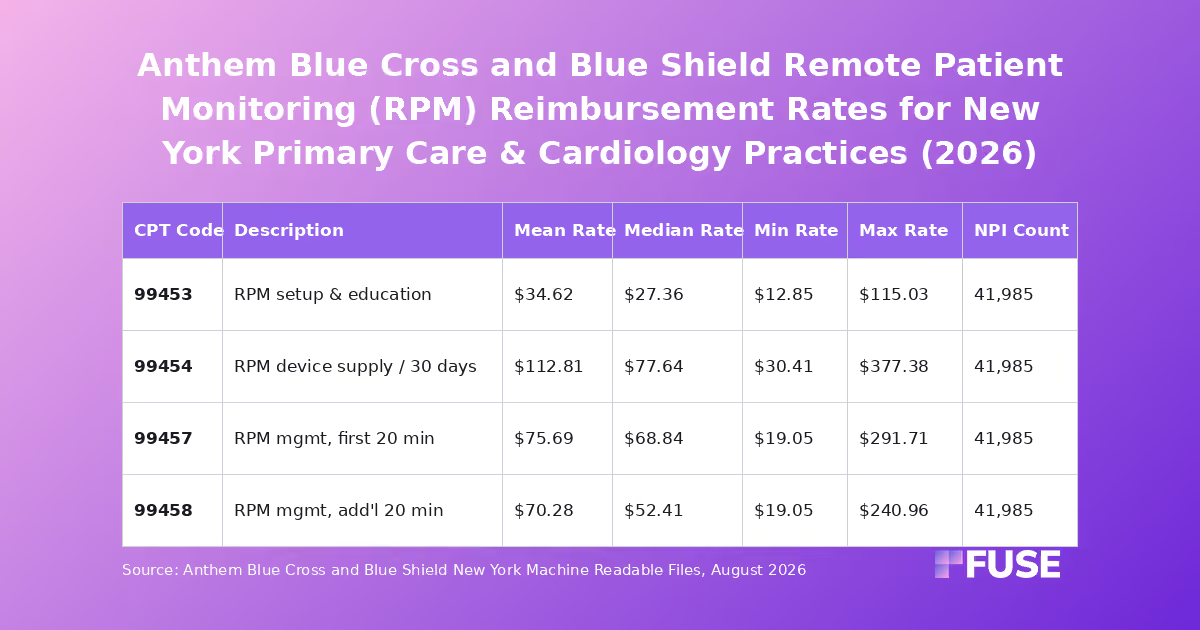
Anthem Blue Cross and Blue Shield publishes negotiated rates for remote patient monitoring through its New York Machine Readable Files. The table below reflects August 2026 data for the four core RPM codes.
| CPT Code | Description | Mean Negotiated Rate | Median Negotiated Rate | Min | Max | Unique NPI Count |
|---|---|---|---|---|---|---|
| 99453 | Remote physiologic monitoring setup and patient education | $34.62 | $27.36 | $12.85 | $115.03 | 41,985 |
| 99454 | RPM device supply with daily recordings, each 30 days | $112.81 | $77.64 | $30.41 | $377.38 | 41,985 |
| 99457 | RPM treatment management, first 20 minutes per month | $75.69 | $68.84 | $19.05 | $291.71 | 41,985 |
| 99458 | RPM treatment management, each additional 20 minutes | $70.28 | $52.41 | $19.05 | $240.96 | 41,985 |
Rates extracted from Anthem’s August 2026 New York machine readable files.
On the two-brand question: every Anthem in-network file for New York sits in Anthem’s single Transparency in Coverage index and reports under one entity name, Empire BlueCross BlueShield, the legacy umbrella for both successor brands. The files carry no field that reliably divides downstate networks from upstate ones, so this page presents a single statewide table covering both brand regions. Anthem’s files also update monthly; this table is labeled with its extraction date and should not be read as a permanent figure.
New RPM Codes for 2026: CPT 99445 and 99470
January 1, 2026 brought two additions to the RPM family, and Anthem’s New York files already price both. 99445 is the device-supply code for lower-engagement months, 2-15 days of data transmission in a 30-day period, and 99470 covers 10-19 minutes of treatment-management time. Each is mutually exclusive with its established counterpart (99454 and 99457 respectively): a given month bills one or the other, never both. Both codes were added to Anthem’s clinical policy CG-MED-91 in its January 2026 coding update.
| CPT Code | Description | Mean Negotiated Rate | Median Negotiated Rate | Min | Max | Unique NPI Count |
|---|---|---|---|---|---|---|
| 99445 | RPM device supply with daily recordings, 2-15 days in a 30-day period | $62.70 | $50.54 | $33.88 | $259.02 | 41,961 |
| 99470 | RPM treatment management, 10-19 minutes per month | $22.56 | $19.92 | $8.68 | $126.07 | 41,961 |
Rates extracted from Anthem’s August 2026 New York machine readable files.
What Anthem’s New York RPM Rates Actually Tell You
A statewide average compresses an entire market into one number. Anthem’s New York data is filed by employer EIN for group plans and by HIOS number for individual plans, so the mean and median above blend thousands of separately negotiated arrangements, and the min-to-max spread is the more honest description of what any single practice might see. The same CPT code, billed to the same payer, can be paid from contracts at opposite ends of that range depending on the plan and provider group behind the claim.
The numbers are also dated by design. Anthem publishes these machine readable files as monthly as-of-date snapshots of negotiated in-network rates with historical out-of-network data (Anthem, Machine Readable Files), and each monthly release replaces the last. A listed rate is evidence of what the network pays, not confirmation that a specific claim will be paid: coverage criteria, plan edits and billing mechanics all sit between the file and the remittance.
What Anthem’s RPM Codes Actually Require
The billing mechanics are confirmed independently by Anthem’s clinical policy CG-MED-91 and CMS’s physician fee schedule materials. 99453 covers the one-time initial setup and patient education. 99454 is the device supply with daily recording or programmed alert transmission for at least 16 days in a 30-day period. 99457 is the first 20 minutes of treatment-management time in a calendar month, and it requires at least one real-time interactive communication with the patient or caregiver. 99458 adds each additional 20 minutes.
Here is the denial-risk mechanism specific to RPM. A month that fell short of 16 transmission days used to be simply unbillable; since January 2026 it bills 99445 instead, which moves the exposure to code selection. Billing 99454 for a 15-day month, or billing the management codes without meeting the real-time communication requirement, loses the claim regardless of the negotiated rate behind it.
Anthem’s Coverage Requirements for RPM in New York
Anthem’s clinical policy CG-MED-91, “Remote Therapeutic and Physiologic Monitoring Services,” is published for its New York plans (the policy portal is operated for Anthem HealthChoice HMO and Anthem HealthChoice Assurance, the former Empire legal entities behind both New York brands). It recognizes RPM as medically necessary when the monitoring uses an FDA-recognized device that directly measures physiologic data, is clinically appropriate for the patient’s condition, the data is actively assessed to detect acute changes and prompt intervention, and the patient is at risk of clinically significant changes in medical status.
New York adds one piece of relevant background: under the state’s telehealth non-exclusion rule (NY Department of Financial Services, Insurance Law sections 3217-h and 4306-g), an insurer may not exclude an otherwise-covered service simply because it is delivered via telehealth. That rule does not establish any specific code’s coverage, a negotiated rate, freedom from prior authorization, medical necessity, device eligibility, or qualifying data and time requirements; insurers may still apply reasonable utilization management. A rate in the machine readable file plus the non-exclusion rule together still do not confirm a specific claim will be paid.
Remote Patient Monitoring Under New York’s Telehealth Law and Medicaid Program
New York is one of the few states whose public health law defines RPM directly. Public Health Law section 2999-cc makes remote patient monitoring its own telehealth modality: the use of synchronous or asynchronous electronic information and communication technologies to collect personal health information and medical data from a patient at an originating site, transmitted to a telehealth provider at a distant site, for managing conditions that require frequent monitoring. The statute lists qualifying conditions including congestive heart failure, diabetes, chronic obstructive pulmonary disease, wound care, polypharmacy, mental or behavioral problems, and technology-dependent care such as continuous oxygen or ventilator care, and it requires that RPM be ordered by a physician, nurse practitioner or midwife with a substantial and ongoing relationship with the patient.
The state’s Medicaid program moved too. Per the NYS Medicaid Update, New York Medicaid reimburses RPM treatment management (CPT 99457) effective January 1, 2025, billable once each 30 days regardless of the number of parameters monitored, with Medicaid Managed Care plans required to comply by March 1, 2025; the published fee is $41.80 per 30-day period. To keep the fences clear: the statute is a care-delivery and ordering-rule framework and the Medicaid expansion is Medicaid policy. Neither determines Anthem commercial coverage or the negotiated rates above; an Anthem-contracted practice is still governed by its own contract and the member plan’s terms.
Why RPM Can’t Be Billed on the Same Clock as CCM or RTM
A patient can qualify for RPM alongside chronic care management or remote therapeutic monitoring in the same month, but no minute of clinical-staff or practitioner time can count toward more than one of those services. The documentation must show separately qualifying work for each service billed. Practices running combined programs should read this page together with Anthem’s New York CCM reimbursement rates and Anthem’s New York RTM reimbursement rates.
What This Means for Your Practice
For an RPM program the expensive mistake is enrolling on an assumed rate: because the billing recurs, a wrong assumption repeats its error every month the patient stays enrolled, and New York’s two-brand structure adds one more reason not to treat a statewide average as your number. The reliable move is verifying eligibility and plan-specific benefits for the scheduled CPT code before the visit. Fuse does that verification at the CPT-code level, checking reimbursements against a practice’s own past claims and placing automated phone calls to payers to confirm coverage, so gaps between expected and actual payment show up while they are still correctable.
Verify RPM Coverage and Billing Before Every Claim
Treat the statewide table as what it is, a benchmark for budgeting and program design, and treat the payable question as plan-specific: what the member’s plan covers, what CG-MED-91’s criteria require, and what the contract actually pays. Fuse verifies current eligibility and plan-specific benefits at the CPT code level before the visit, combining past claims data with automated phone calls to payers, helping practices estimate expected copay, coinsurance and deductible responsibility and get paid what they are contractually owed. See how CPT-level verification works.
Disclaimer: This article uses rate information from the Machine Readable Files that Anthem Blue Cross and Blue Shield publishes under the federal Transparency in Coverage rule. These files are posted to satisfy the regulation, not to be read: the file behind this analysis unpacks to 17 gigabytes of raw pricing data, millions of negotiated rates that no spreadsheet can open. Fuse built its own pipeline to extract and verify the figures above. This analysis focuses on a single payer and will not reflect rates from all available insurance options in New York. Fuse makes every effort to provide accurate and current information, but healthcare pricing can change frequently, and individual circumstances may affect actual costs. This information does not guarantee specific pricing. Practices should verify current rates directly with Anthem before relying on them for billing or negotiation decisions.

Fuse analyzes your claims data to estimate how many patients could be eligible, benchmarks your contracted rates against the market medians, and sizes the revenue uplift.
Get Your Free AnalysisFAQs
What does Anthem Blue Cross and Blue Shield pay for remote patient monitoring in New York?
Fuse's review of Anthem Blue Cross and Blue Shield's New York machine readable files shows the negotiated rate varies by plan and provider. As of the August 2026 extraction, RPM treatment management (CPT 99457) had a statewide mean negotiated rate of $75.69 and a median of $68.84, while the device-supply code 99454 had a mean of $112.81 and a median of $77.64. Treat statewide figures as benchmarks, not a guaranteed reimbursement amount for an individual provider.
How many days of data does Anthem require for RPM billing?
Under the CPT definition of 99454 referenced in Anthem's clinical policy CG-MED-91, the RPM device-supply code covers device supply with daily recordings or programmed alert transmission for 16-30 days in a 30-day period. As of January 2026, a month with only 2-15 days of transmission bills the new code 99445 instead, so the 16-day threshold now decides which supply code applies rather than whether the month is billable at all. Patient engagement still sets the revenue: the lower-engagement code carries its own negotiated rate, and a month must reach at least 2 days of transmission to bill either.
Does Anthem Blue Cross and Blue Shield require prior authorization for RPM in New York?
RPM falls under Anthem's clinical policy CG-MED-91, which sets medical-necessity criteria: the monitoring must be clinically appropriate, the data must be assessed to detect acute changes and prompt intervention, and the patient must be at risk of clinically significant changes in medical status. A payable rate in the machine readable file does not by itself confirm authorization or coverage for a specific claim, so practices should verify the applicable member plan's current requirements before billing.
Can a practice bill RPM and CCM for the same patient?
Yes. A patient can generally qualify for remote patient monitoring and chronic care management in the same calendar month, but the same clinical-staff or practitioner time cannot be counted toward more than one service. Documentation has to support separately qualifying work for each service billed, and commercial plans can impose their own edits, so Fuse recommends confirming the combination against the patient's specific Anthem plan.
Has Anthem added any new RPM billing codes for 2026?
Yes. Effective January 1, 2026, two new RPM CPT codes were added - 99445, a device-supply code for months with only 2-15 days of data transmission, and 99470, which covers 10-19 minutes of treatment management time. Anthem's clinical policy CG-MED-91 added both to its coding table, and Fuse's August 2026 extraction of Anthem's New York machine readable file found negotiated rates already attached to each. Both are mutually exclusive with their established counterparts: a month bills 99445 or 99454 for device supply, and 99470 or 99457 for management time, never both.
Does New York Medicaid cover remote patient monitoring?
Yes. Effective January 1, 2025, New York State Medicaid reimburses RPM treatment management (CPT 99457), billable once each 30 days regardless of the number of parameters monitored, at a published fee of $41.80; Medicaid Managed Care plans had to comply by March 1, 2025. That is Medicaid coverage, not Anthem commercial coverage: an Anthem-contracted practice's reimbursement is still governed by its own negotiated rates and the member plan's terms.
Is Anthem Blue Cross and Blue Shield the same company as Empire BlueCross BlueShield?
Yes, in eastern and southeastern New York. Effective January 1, 2024, Empire BlueCross BlueShield was renamed Anthem Blue Cross and Blue Shield in that region, and Empire BlueCross became Anthem Blue Cross in upstate New York. The two remain distinct regional brands rather than one identical statewide plan. In the machine readable files behind this analysis, the data is still filed under the Empire BlueCross BlueShield reporting-entity name as one statewide filing, which is why this page presents a single statewide table.