Where Behavioral Health RTM Gets Paid in 2026 (and Why So Many Claims Don't)
Remote therapeutic monitoring should be a natural fit for behavioral health. The code family was extended in 2023 specifically to cover cognitive behavioral therapy monitoring, the digital therapeutics market is full of CBT apps, and a monitoring program produces exactly the kind of recurring monthly revenue that psychiatric practices rarely have. The reimbursement reality is harder. In our work with behavioral health practices, we have reviewed payer contracts that omit these codes entirely and heard the same denial stories from practices that tried to bill them, and the failure points repeat.
This article maps where behavioral health RTM billing works in 2026, using primary sources only: the CMS 2026 Physician Fee Schedule relative value file, the published fee schedules of six state Medicaid programs, and Fuse’s own extractions of Anthem’s August 2026 machine readable files in California, Colorado and New York.
First, the honest market context. RTM billing overall is still small and dominated by physical therapy. In 2024 Medicare claims for CPT 98980, the management code that anchors every RTM program, physical therapists accounted for roughly three quarters of the 105,643 services billed nationally, followed by pain medicine and orthopedics. Behavioral health does not yet register as a measurable share. Per the Peterson Center on Healthcare’s April 2025 analysis, fewer than 0.2% of Traditional Medicare beneficiaries received any RTM service in 2023. For a practice willing to get the payer mechanics right, that is an open field rather than a dead end. The mechanics are the hard part.
The Five Ways Behavioral Health RTM Claims Die
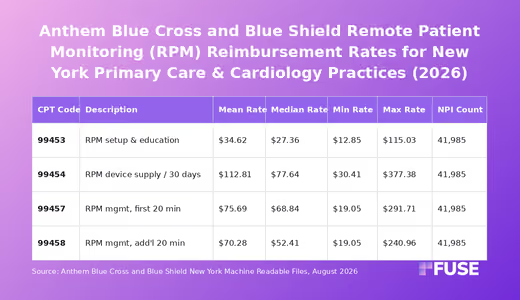
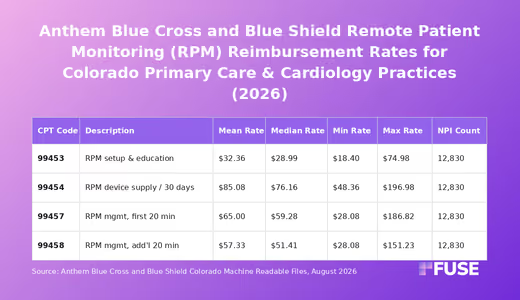
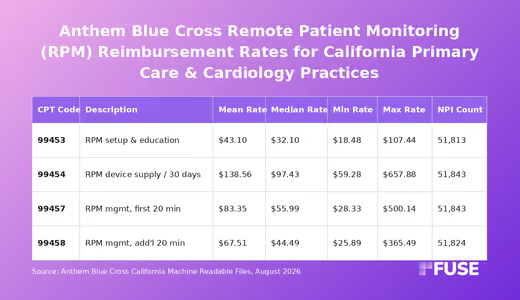
1. The claim uses the wrong code family. Remote patient monitoring (RPM, codes 99453 to 99458) and remote therapeutic monitoring (RTM, codes 98975 to 98985) are parallel families with parallel structures, and billing platforms sometimes blur them. The distinction is fatal for behavioral health. Several Medicaid programs restrict RPM to specific physical conditions; Colorado’s regulation limits it to diabetes, COPD, heart failure, asthma, pneumonia and high-risk pregnancy, judged by the primary diagnosis on the claim. A psychiatric F-code on an RPM claim in that environment fails medical necessity every time, and no documentation fixes it. Psychiatric monitoring belongs on RTM codes.
2. The claim uses the wrong RTM supply code. Within RTM, the device supply codes are body-system specific: 98976 is respiratory, 98977 is musculoskeletal, and 98978 is cognitive behavioral therapy. Most RTM platforms were built for physical therapy and default to 98977. A musculoskeletal supply code paired with a psychiatric diagnosis is internally contradictory, and payers deny it as not medically necessary for the code billed. The reviewer is technically correct. The fix is not an appeal; it is billing 98978.
3. The CBT code has no set price with most payers. This is the structural problem underneath behavioral health RTM. In CMS’s own 2026 fee schedule file, 98978 carries status code C, carrier-priced, meaning each Medicare Administrative Contractor decides whether and what to pay. Massachusetts Medicaid prices it as “Individual Consideration.” Arizona Medicaid lists it as “By Report.” Three payers, three names for the same answer: we will decide case by case. In our six-state review, Colorado is the only Medicaid program that commits to a number, $54.13 per 30 days. A practice billing 98978 with most payers is submitting claims into pricing discretion.
4. Prior authorization gates the recurring codes. Where PA applies, it often applies to the monthly management codes and not just device setup. Colorado requires an approved prior authorization request for every RTM code except 98975, reviewed against a six-part questionnaire: the monitoring must be in the plan of care, the app must meet the FDA definition of a medical device under section 201(h) of the FD&C Act, its effectiveness must be supported by evidence, a signed supplemental questionnaire must be attached, 16 of 30 monitoring days must be met, and the service must be furnished by qualified personnel. Note that the FDA test is the statutory definition of a device, not FDA clearance. A CBT app used to treat a diagnosed condition can qualify; a general wellness app cannot. Practices whose PA requests die on that question often have a documentation problem rather than a device problem.
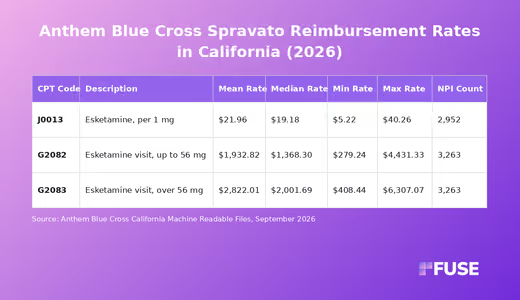
5. The contract does not include the codes at all. A payer publishing a rate for a code is not the same as your contract covering it. In one commercial payer’s published rate data, the only codes attached to a behavioral health group’s contract were TMS and esketamine administration codes, with no RTM codes at all. We have also reviewed a Medicaid managed care contract whose entire fee schedule contained no 989xx codes beyond telephone assessment. In both cases the practice’s only paths were a contract amendment or, on the Medicaid side, billing the state fee-for-service program directly where the codes are covered. Before enrolling a single patient, read the fee exhibit.
What Medicare Pays (2026)
Medicare has covered RTM nationally since 2022 with no prior authorization. National non-facility amounts, computed from the CMS 2026 relative value file at the 2026 conversion factor of $33.4009:
| CPT Code | Service | 2026 Medicare National Rate (Non-Facility) |
|---|---|---|
| 98975 | RTM setup and patient education | $21.71 |
| 98978 | Device supply, cognitive behavioral therapy, 16-30 days | Carrier-priced, no national rate |
| 98980 | Treatment management, first 20 minutes | $54.11 |
| 98981 | Treatment management, each additional 20 minutes | $41.42 |
| 98976 / 98977 | Device supply, respiratory / musculoskeletal, 16-30 days | $52.11 / $51.44 |
| 98984 / 98985 | Device supply, respiratory / musculoskeletal, 2-15 days | $52.11 / $51.44 |
The management codes pay a real, national, PA-free rate, which makes Medicare the most dependable payer for the time-based half of a behavioral health RTM program. The supply half is the carrier-priced gap described above: confirm what your MAC pays for 98978 before projecting device revenue.
What Six State Medicaid Programs Pay
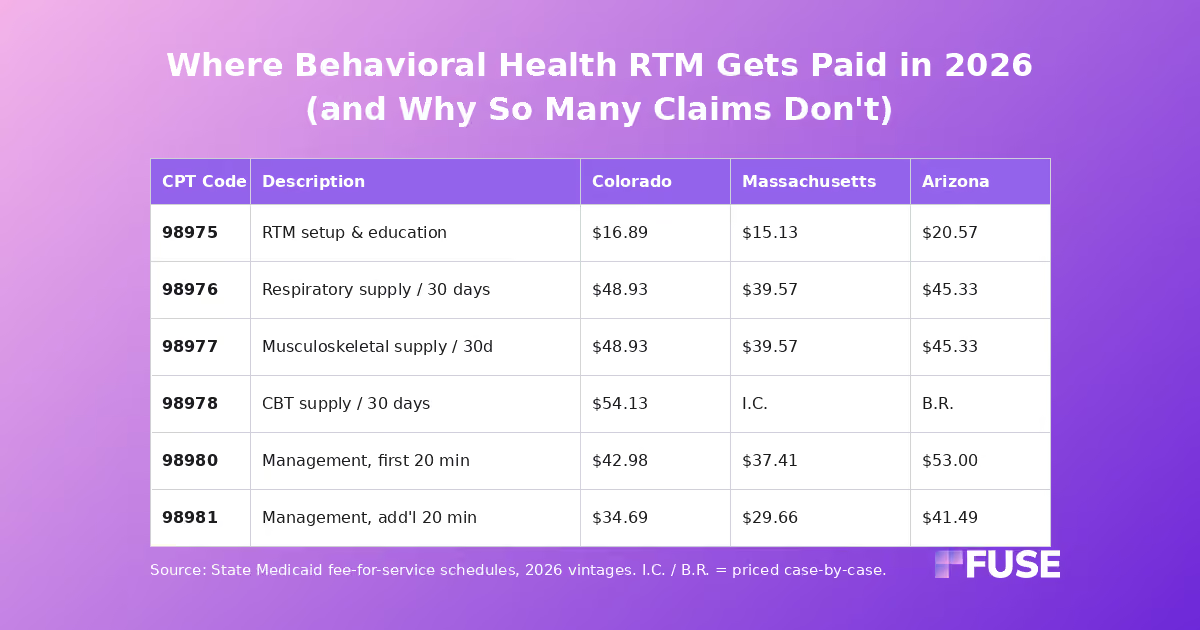
Fuse pulled the official fee schedule in six states. Three price RTM, three do not cover it at all:
| CPT Code | Colorado (Jul 2026) | Massachusetts (Jan 2026) | Arizona (FFY26) | Maryland | New York | Texas |
|---|---|---|---|---|---|---|
| 98975 | $16.89 | $15.13 | $20.57 | Not covered | Not covered | Not covered |
| 98978 | $54.13 | Individual Consideration | By Report | Not covered | Not covered | Not covered |
| 98980 | $42.98 | $37.41 | $53.00 | Not covered | Not covered | Not covered |
| 98981 | $34.69 | $29.66 | $41.49 | Not covered | Not covered | Not covered |
Sources: Health First Colorado fee schedule effective July 2026; 101 CMR 317.00 rates effective January 2026 (non-facility column); AHCCCS FFY26 physician fee schedule, non-facility, revised June 2026; Maryland Professional Services Fee Schedule (January 2026); eMedNY physician fee schedule (July 2026); TMHP static fee schedules (July 2026). Rates shown are fee-for-service, non-facility where the schedule differentiates; managed care plan policies may vary.
The details matter as much as the rates:
- Arizona is the friendliest of the six for the management codes: near Medicare parity and no prior authorization. But 98978 is “By Report,” so the device-supply revenue is unknowable in advance.
- Colorado is the only state here with a fixed CBT-supply rate, and it pairs that with the strictest PA regime: an approved request per code, including the recurring monthly management codes.
- Massachusetts publishes rates in its rate regulation, but the regulation explicitly disclaims coverage authorization. Verify MassHealth coverage policy before treating the listed numbers as billable.
- Maryland and New York cover the RPM family while listing no RTM codes whatsoever. New York pays $41.80 for RPM management (99457) and nothing for its RTM twin. For a behavioral health practice this is the worst configuration: the covered family rejects psychiatric diagnoses and the appropriate family is not covered.
- Texas covers neither standard family, only a home telemonitoring benefit restricted to diabetes and hypertension.
The wider pattern, per the APTA’s state Medicaid tracking, is that roughly 25 state Medicaid programs reimburse RTM in some form. For a Medicaid-heavy behavioral health practice, the state you operate in decides whether RTM is a program or a write-off, and the fee schedule is a ten-minute check that should precede any vendor conversation.
What Anthem Pays Commercially
Commercial coverage varies plan by plan, but it is measurable, because the federal Transparency in Coverage rule requires insurers to publish every negotiated rate. Fuse’s extractions of Anthem’s August 2026 machine readable files show median negotiated rates for in-network providers:
| CPT Code | Anthem CA (median) | Anthem CO (median) | Anthem NY (median) |
|---|---|---|---|
| 98975 | $28.16 | $28.19 | $21.01 |
| 98978 | $64.57 | $62.22 | $60.10 |
| 98980 | $45.62 | $60.59 | $50.68 |
| 98981 | $38.04 | $50.32 | $41.45 |
Two things stand out for behavioral health. Anthem publishes real negotiated rates for 98978 in all three states, at levels above every Medicaid figure in this article, which makes commercial contracts the most valuable RTM payer for a CBT-based program. And the variation across states is wide enough that a multi-state group should not assume one state’s economics carry over. Full state analyses: California, Colorado, New York. The caution from failure mode five applies here with force: a median in the payer’s public data does not mean the codes are in your fee exhibit. Check the contract first.
A Billing Playbook for Behavioral Health Practices
- Use the right stack: 98975, 98978, 98980, 98981, with your psychiatric diagnoses. Never let a platform default you onto 98977, and never put F-codes on RPM claims in a state that restricts RPM by condition.
- Read your fee exhibits before enrolling patients. Commercial and Medicaid managed care contracts frequently omit RTM. If the codes are absent, the choices are a contract amendment or the state fee-for-service pathway, not cleaner documentation.
- Price the friction, not just the rate. A $53.00 no-PA rate in Arizona is worth more operationally than a comparable rate behind a monthly authorization queue. Where PA exists, build the questionnaire answers into your intake workflow: name the app, document that it meets the FDA device definition through its intended treatment use, attach the effectiveness evidence, and track the 16-day threshold.
- Confirm the 98978 price before projecting revenue. With Medicare, ask your MAC. With Medicaid, check whether your state fixes a rate or prices case by case. With commercial payers, the negotiated rate in your contract is the only number that matters.
- Verify coverage per patient, per plan, at enrollment. RTM’s thresholds mean a denied claim wastes a full month of monitoring work. The coverage question has to be answered before the device is deployed, not after the claim comes back.
That last step is where Fuse fits. Fuse verifies eligibility and plan-specific benefits at the CPT code level before the visit, combining past claims data with automated phone calls to payers, so a behavioral health practice knows whether a patient’s plan pays for RTM before staff spend a month monitoring. See how CPT-level verification works for behavioral health practices.
Disclaimer: This article uses rate information from the CMS Physician Fee Schedule, state Medicaid fee schedules, and Machine Readable Files that payers publish publicly, current as of the vintages noted above. Healthcare pricing changes frequently, coverage policies vary by plan and provider type, and individual circumstances may affect actual reimbursement. This information does not guarantee specific pricing. Practices should verify current rates and coverage directly with each payer before relying on them for billing or program decisions.

Fuse analyzes your claims data to estimate how many patients could be eligible, benchmarks your contracted rates against the market medians, and sizes the revenue uplift.
Get Your Free AnalysisFAQs
Which CPT codes should a behavioral health practice use for remote therapeutic monitoring?
The behavioral health RTM stack is 98975 (one-time setup and patient education), 98978 (supply of a cognitive behavioral therapy monitoring device or app, billed per 30 days with 16 or more days of data), 98980 (first 20 minutes of treatment management in a calendar month, requiring at least one interactive communication) and 98981 (each additional 20 minutes). The codes 98976 and 98977 are for respiratory and musculoskeletal monitoring. Billing those with a psychiatric diagnosis is a common cause of medical necessity denials.
Why do behavioral health RTM claims get denied for medical necessity?
The most common causes Fuse sees are structural rather than clinical: billing RPM codes (99453 to 99458) with psychiatric diagnoses in states that restrict RPM to physical conditions, billing the musculoskeletal RTM supply code 98977 instead of the CBT code 98978, missing a required prior authorization, or using a monitoring app that does not meet the FDA definition of a medical device. Each has a different fix, so the denial letter matters more than the denial rate.
Does the CBT device code 98978 have a set reimbursement rate?
With most payers, no. Medicare lists 98978 as carrier-priced, meaning each Medicare Administrative Contractor decides what to pay. Massachusetts Medicaid prices it as Individual Consideration and Arizona Medicaid lists it as By Report. In Fuse's six-state review, Colorado is the only Medicaid program with a fixed rate, at $54.13 per 30 days. Anthem's machine readable files show negotiated 98978 medians of $60.10 to $64.57 in California, Colorado and New York, which makes commercial contracts one of the few places the code has a knowable price.
Do I need prior authorization to bill RTM to Medicaid?
It depends on the state. Medicare requires no prior authorization for RTM. Arizona Medicaid requires none either. Colorado requires an approved prior authorization request for every RTM code except the setup code 98975, including the recurring monthly management codes, which changes the operational cost of running a program. Always check the state fee schedule's PA column before enrolling patients.
Can a behavioral health practice bill RPM instead of RTM?
Usually not with psychiatric diagnosis codes. RPM (99453 to 99458) covers physiologic data such as blood pressure or glucose, and some Medicaid programs restrict it to specific physical conditions. Colorado, for example, limits RPM to diabetes, COPD, heart failure, asthma, pneumonia and high-risk pregnancy based on the primary diagnosis on the claim, so a claim with an F-code diagnosis fails medical necessity automatically. RTM is the family built for monitoring therapy adherence and response, which is why the CBT supply code lives there.