Anthem Blue Cross and Blue Shield Chronic Care Management (CCM) Reimbursement Rates for New York Primary Care Practices (2026)
Chronic care management (CCM) is its own billing category, separate from remote patient monitoring and remote therapeutic monitoring: the code family pays for ongoing care-management time spent on patients with multiple chronic conditions, not for device-based data collection. For the primary care, internal medicine and geriatrics practices that build CCM programs, the revenue is recurring by design, so whatever rate assumption a program is built on gets multiplied across every enrolled patient, every month. That is exactly why a statewide New York average deserves scrutiny before it becomes anyone’s planning number. See how CPT-level verification works.
One naming wrinkle applies to everything on this page. Since the January 2024 Empire rebrand, Anthem operates in New York as Anthem Blue Cross and Blue Shield in the eastern and southeastern counties and as Anthem Blue Cross upstate. Whether the transparency data separates those two regional structures is answered under the rate table below, using the same resolution Fuse established for its New York RPM analysis.
A word on where these numbers come from. Anthem publishes machine readable files under the federal Transparency in Coverage rule; Fuse pulled the statewide New York network file from the August 2026 release, kept only dollar-denominated fee schedule entries for the five CCM codes (rows expressed as a percentage of charges were dropped), and matched every listed NPI against the federal NPPES registry. The universe behind each statistic is individual internal medicine and family medicine physicians, nurse practitioners and physician assistants whose registered practice location is in New York: the clinician mix that actually staffs CCM programs. Each statistic is computed over distinct provider-rate pairs. RPM and RTM get their own pages: Anthem’s RPM rates in New York and Anthem’s RTM rates in New York.
Anthem’s Rates for Chronic Care Management (CCM) CPT Codes in New York
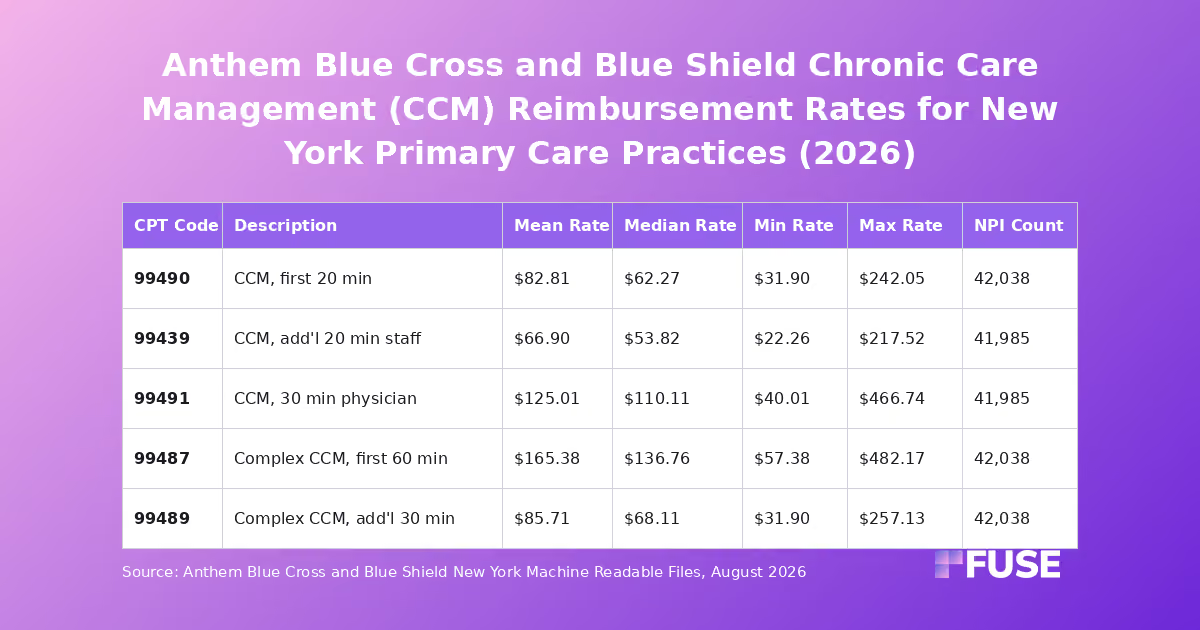
Anthem Blue Cross and Blue Shield publishes negotiated rates for chronic care management through its New York Machine Readable Files. The table below reflects August 2026 data for five CCM codes. One reading note before the numbers: 99491 is a base code in its own right, covering the physician’s or qualified health professional’s personal time. It is not an add-on tier of 99490, which covers clinical-staff time; the two run on parallel tracks.
| CPT Code | Description | Mean Negotiated Rate | Median Negotiated Rate | Min | Max | Unique NPI Count |
|---|---|---|---|---|---|---|
| 99490 | Chronic care management, first 20 minutes of clinical staff time | $82.81 | $62.27 | $31.90 | $242.05 | 42,038 |
| 99439 | Chronic care management, each additional 20 minutes of clinical staff time | $66.90 | $53.82 | $22.26 | $217.52 | 41,985 |
| 99491 | Chronic care management, first 30 minutes of physician/QHP time | $125.01 | $110.11 | $40.01 | $466.74 | 41,985 |
| 99487 | Complex chronic care management, first 60 minutes | $165.38 | $136.76 | $57.38 | $482.17 | 42,038 |
| 99489 | Complex chronic care management, each additional 30 minutes | $85.71 | $68.11 | $31.90 | $257.13 | 42,038 |
Rates extracted from Anthem’s August 2026 New York machine readable files.
On the two-brand question: Anthem’s in-network files for New York all report under a single entity name, Empire BlueCross BlueShield, the legacy umbrella behind both successor brands, and carry no field that reliably splits downstate networks from upstate ones. This page therefore presents one statewide table covering both brand regions, the same structure as the companion RPM and RTM pages. The files are refreshed monthly, so the table is tied to its extraction date rather than being a standing figure.
What Anthem’s New York CCM Rates Actually Tell You
A single statewide number hides how the underlying file is put together. Anthem organizes its New York data by employer EIN for group plans and by HIOS identifier for individual plans, so the mean for a code like 99490 is an average over thousands of independently negotiated contracts, and two practices in the same borough can sit at opposite ends of the min-max spread for identical work. The spread columns, not the mean, describe what any one practice should expect to encounter.
Timing matters as much as aggregation. Anthem describes its machine readable files as as-of-date snapshots published monthly (Anthem, Machine Readable Files), and each release supersedes the previous one. A rate in the file is evidence of what the network pays as of the extraction date, not confirmation that a given claim will be paid: coverage criteria, plan-level edits and documentation requirements all sit between the published rate and the remittance.
Physician-Led Chronic Care Management Billing With CPT 99491
Practices where the physician or qualified health professional performs the care-management work personally, rather than directing clinical staff, bill under CPT 99491. CMS’s descriptor is direct: chronic care management services by a qualified health care professional, 30 minutes or more per calendar month (CMS, chronic care management guidance). The 30 minutes must be the practitioner’s own time, which is what separates it from 99490’s 20 minutes of directed clinical-staff time; both are first-increment base codes for the month, never stacked on each other. That is the code descriptor. Anthem-specific coverage, reimbursement and authorization for 99491 in New York should be confirmed against the member plan like any other CCM claim.
Anthem’s Coverage Requirements for CCM in New York
The finding here is an absence, confirmed for New York directly rather than assumed from other states. Anthem’s published monitoring policy CG-MED-91, hosted for its New York plans, covers remote patient and remote therapeutic monitoring but does not address chronic care management, and Fuse did not identify a separate Anthem New York CCM clinical policy or prior-authorization requirement in the materials reviewed. Practices should confirm current coverage and authorization requirements for the applicable member plan before billing.
New York adds one piece of background worth knowing without overreading it: under the state’s telehealth non-exclusion rule (NY Department of Financial Services, Insurance Law sections 3217-h and 4306-g), an insurer may not exclude an otherwise-covered service solely because it is delivered via telehealth. That rule does not establish CCM’s coverage, a negotiated rate, or freedom from prior authorization; it only removes delivery method as a standalone reason for exclusion.
Why CCM Can’t Be Billed on the Same Clock as RPM or RTM
The denial-risk mechanism specific to CCM is time accounting. A patient can qualify for CCM alongside remote patient monitoring or remote therapeutic monitoring in the same calendar month, but no minute of clinical-staff or practitioner time may count toward more than one of those services, and the documentation must show separately qualifying work for each service billed. Practices running combined programs should read this page together with Anthem’s New York RPM reimbursement rates and Anthem’s New York RTM reimbursement rates.
What This Means for Your Practice
CCM in New York pairs an unusual amount of contract variation with no standalone payer policy to consult, which leaves plan-level verification as the only dependable source of truth for what a specific patient’s coverage requires. Guessing is expensive twice over: once through the statewide-average assumption baked into program economics, and again through the non-double-counting rule when combined programs document loosely. Fuse addresses the verification side by checking reimbursements against a practice’s own past claims and placing automated phone calls to payers to confirm coverage, so payment surprises surface before they compound across an enrolled panel.
Verify CCM Coverage and Billing Before Every Claim
The practical sequence for a New York CCM program is to treat the statewide table as a benchmark, confirm the member plan’s coverage and authorization requirements before billing, and keep CCM time cleanly separated from any RPM or RTM work on the same patient. Fuse verifies current eligibility and plan-specific benefits at the CPT code level before the visit, combining past claims data with automated phone calls to payers, helping practices estimate expected copay, coinsurance and deductible responsibility and get paid what they are contractually owed. See how CPT-level verification works.
Disclaimer: This article uses rate information from the Machine Readable Files that Anthem Blue Cross and Blue Shield publishes under the federal Transparency in Coverage rule. These files are posted to satisfy the regulation, not to be read: the file behind this analysis unpacks to 17 gigabytes of raw pricing data, millions of negotiated rates that no spreadsheet can open. Fuse built its own pipeline to extract and verify the figures above. This analysis focuses on a single payer and will not reflect rates from all available insurance options in New York. Fuse makes every effort to provide accurate and current information, but healthcare pricing can change frequently, and individual circumstances may affect actual costs. This information does not guarantee specific pricing. Practices should verify current rates directly with Anthem before relying on them for billing or negotiation decisions.

Fuse analyzes your claims data to estimate how many patients could be eligible, benchmarks your contracted rates against the market medians, and sizes the revenue uplift.
Get Your Free AnalysisFAQs
What does Anthem Blue Cross and Blue Shield pay for chronic care management (CCM) in New York?
Fuse's review of Anthem Blue Cross and Blue Shield's New York rate data shows the negotiated rate for CPT 99490, the first 20 minutes of chronic care management per calendar month, varies by plan and provider. As of the August 2026 extraction, the statewide mean negotiated rate was $82.81 and the median was $62.27. Treat the statewide figure as a benchmark, not a guaranteed reimbursement amount for an individual provider.
What is the difference between CPT 99490 and CPT 99491 for chronic care management?
Both are base codes for the first qualifying increment of chronic care management time in a calendar month - they are not tiers of each other. CPT 99490 covers the first 20 minutes of clinical staff time directed by a physician or other qualified health care professional, while CPT 99491 covers the first 30 minutes of the physician's or QHP's own time. In Anthem's New York data, 99490 had a median negotiated rate of $62.27 versus $110.11 for 99491, reflecting the difference in whose time each code represents.
Does Anthem Blue Cross and Blue Shield require prior authorization for CCM in New York?
Fuse did not identify a separate Anthem CCM clinical policy or prior-authorization requirement in the materials reviewed - Anthem's published monitoring policy CG-MED-91 covers remote patient monitoring and remote therapeutic monitoring but does not address chronic care management. That absence is not a guarantee: practices should confirm the applicable member plan's current coverage and authorization rules before billing CCM.
Can a practice bill CCM and RPM for the same patient?
Yes. A patient can generally qualify for chronic care management and remote patient monitoring in the same calendar month, but the same clinical-staff or practitioner time cannot be counted toward more than one service. Documentation has to support separately qualifying work for each service billed, and commercial plans can impose their own edits, so Fuse recommends confirming the combination against the patient's specific Anthem plan.
Why do Anthem's negotiated CCM rates vary so much across New York?
Fuse's analysis of Anthem's New York machine readable files shows rates vary because the data pools many distinct plans, organized by employer EIN for group coverage or HIOS number for individual coverage. The provider's credential, contract and geographic service location all factor into what a specific arrangement actually pays, which is why a statewide average is a benchmark rather than a payment guarantee for any one practice.
Does Anthem Blue Cross and Blue Shield cover CCM for patients with only one chronic condition?
Fuse did not identify an Anthem-specific chronic-condition threshold in the materials reviewed. Under CMS's Medicare CCM standard, a patient generally must have two or more chronic conditions expected to last at least 12 months or until death, and the conditions must place the patient at significant risk of death, acute exacerbation or decompensation, or functional decline. This is CMS/Medicare guidance; Anthem's commercial coverage requirements may differ by plan.
Is Anthem Blue Cross and Blue Shield the same company as Empire BlueCross BlueShield?
Yes, in eastern and southeastern New York. Effective January 1, 2024, Empire BlueCross BlueShield was renamed Anthem Blue Cross and Blue Shield in that region, and Empire BlueCross became Anthem Blue Cross in upstate New York. The two remain distinct regional brands rather than one identical statewide plan. In the machine readable files behind this analysis, the data is still filed under the Empire BlueCross BlueShield reporting-entity name as one statewide filing, which is why this page presents a single statewide table.