 Digital patient intake
 Patient cost estimates
 Claims automation
 Revenue intelligence
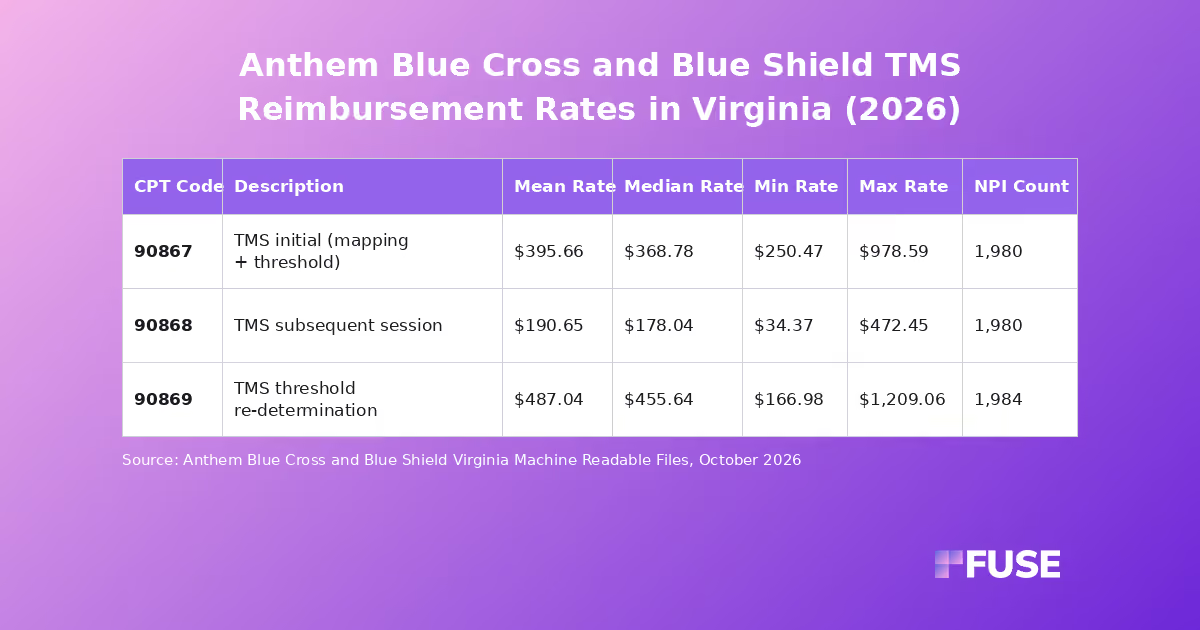
Anthem Blue Cross and Blue Shield TMS Reimbursement Rates in Virginia (2026)
Anthem’s main Virginia employer network pays psychiatrists $188.52 to $198.99 per TMS session, and $215.85 in Northern Virginia.
Nurse practitioners get 85 percent of those amounts on every code, about $1,050 less per course in the Richmond area. That matters because 59 percent of the clinicians Anthem lists with TMS rates in Virginia are nurse practitioners. Medicare in Virginia only covers TMS ordered by a psychiatrist.
How Did We Read Anthem’s Virginia TMS Rates?
We read 7 of Anthem’s 18 Virginia rate files for October 2026, 27 gigabytes of pricing data once unzipped. Of the 57,586 plans on Anthem’s Virginia list, 98 percent use only those 7 files. That counts plans, not members. The files cover Anthem’s HealthKeepers employer network, its HealthKeepers Select POS network, two smaller employer networks, and its individual plans, including those sold on the Virginia marketplace.
We kept dollar rates for professional claims in the office setting and dropped rows under $5. Each clinician also has a facility rate, which is far lower and not what a TMS practice bills. We matched each NPI against the federal NPPES registry and kept the 1,980 psychiatrists, psychiatric nurse practitioners and clinical nurse specialists who practice in Virginia. A clinician listed at the same rate in several files is counted once in the medians.
What Does Anthem Pay for TMS in Virginia?
The median is $178.04 for each treatment session and $368.78 for the first session with mapping.
| CPT Code | Description | Mean Negotiated Rate | Median Negotiated Rate | Min | Max | Unique NPI Count |
|---|---|---|---|---|---|---|
| 90867 | TMS treatment, initial, including cortical mapping, motor threshold determination, delivery and management | $395.66 | $368.78 | $250.47 | $978.59 | 1,980 |
| 90868 | TMS treatment, subsequent delivery and management, per session | $190.65 | $178.04 | $34.37 | $472.45 | 1,980 |
| 90869 | TMS treatment, subsequent motor threshold re-determination with delivery and management | $487.04 | $455.64 | $166.98 | $1,209.06 | 1,984 |
Rates extracted from Anthem Blue Cross and Blue Shield’s October 2026 machine readable files for Virginia, office setting, professional claims.
CPT 90867 is the first session, where the clinician finds the patient’s motor threshold and sets the treatment plan. It is billed once per course. 90868 is each treatment session after that, and 90869 is a session where the threshold is measured again, at a median of $455.64.
The medians blend networks that pay differently, so few clinicians are paid them. The $178.04 session median happens to be what the small employer networks pay nurse practitioners. Almost every clinician has a separate rate in each network file, and the rate in each file follows the same pattern by license, region and network.
Which Anthem TMS Rate Do You Get in Virginia?
It depends on three things, your license, where you practice, and which network the patient’s plan uses. Anthem’s main employer network is the one most plans use, and it pays these per-session amounts.
- Psychiatrists outside Northern Virginia. About 3 in 4 have one of three amounts, roughly by region. Around Richmond it is usually $188.52, in Hampton Roads $192.71, and around Roanoke and the Southwest $198.99.
- Psychiatrists in Northern Virginia. Two in three have a $215.85 rate. About 3 in 10 have a higher contract at $303.56.
- Nurse practitioners outside Northern Virginia. Nearly 9 in 10 have $160.24, $163.80 or $169.14, following the same regions.
- Nurse practitioners in Northern Virginia. 88 percent have a $183.48 rate.
Some clinicians have more than one rate in the file, usually because they bill through more than one practice, each with its own contract. By Northern Virginia we mean practice ZIP codes starting with 201 and 220 to 223. The first session and the remeasurement session follow the same pattern. For example, a Richmond-area psychiatrist is usually paid $390.48 for 90867 and $482.44 for 90869.
The network changes the amount for nearly everyone. The HealthKeepers Select POS network pays the main network rates. Anthem’s individual plans pay most clinicians 88.2 percent of the main network rate, so a Richmond-area psychiatrist gets $166.31 per session instead of $188.52. Two small employer networks pay 9 to 11 percent more than the main network, at $209.47 for most psychiatrists outside Northern Virginia and $178.04 for most nurse practitioners. Network-driven TMS pricing is not unique to Anthem, as our Blue Cross Blue Shield of Illinois TMS rates page shows.
For therapy codes, see our Anthem behavioral health rates in Virginia, which shows the same Northern Virginia break.
What Does a Full TMS Course Pay Under Anthem in Virginia?
About $6,600.18 at the medians, for one first session and 35 treatment sessions. Anthem’s TMS request form allows up to 30 daily sessions over six weeks, then a taper. With a common three-week taper of three, two and one session, the course comes to 36.
On the main employer network, the same course pays:
- Psychiatrist, Richmond area. About $6,990.
- Psychiatrist, Roanoke and the Southwest. About $7,380.
- Psychiatrist, Northern Virginia. About $8,000.
- Nurse practitioner, Richmond area. About $5,940, roughly $1,050 less than a psychiatrist there.
- Nurse practitioner, Roanoke and the Southwest. About $6,270.
- Nurse practitioner, Northern Virginia. About $6,800, roughly $1,200 less than a psychiatrist there.
On an individual plan, each of those courses pays about 12 percent less, around $820 less for a Richmond-area psychiatrist.
Run your own numbers with your contracted rates:
What Does Anthem Require Before Covering TMS in Virginia?
Severe treatment-resistant depression in an adult, with failed antidepressants from at least two drug classes. Those are the terms of Anthem’s TMS request form, a multi-state form that names Anthem Health Plans of Virginia and HealthKeepers, revised September 2024.
The form asks you to confirm each of these.
- Diagnosis. Severe treatment-resistant major depressive disorder, single or recurrent episode, in a patient 18 or older.
- Medication history. An inadequate response to antidepressants from two or more classes, each at an adequate dose and duration with documented adherence. Or the patient could not tolerate two trials because of documented side effects.
- Device and course. An FDA-approved device, and no more than five sessions a week for six weeks, 30 sessions in all, followed by a taper.
- Safety. Any implanted device or metal within 30 centimeters of the coil.
The form does not ask for a failed psychotherapy trial. It does ask whether the request is for maintenance TMS after remission, so expect that to be reviewed separately. We read the form on October 20, 2026.
Can Virginia’s Parity Law Help When Anthem Denies TMS?
Yes, for plans regulated by Virginia. Since July 1, 2025, those plans must review mental health care against generally accepted standards of care, not stricter criteria of their own.
The change came from HB 2738, which amended Va. Code § 38.2-3412.1. When an insurer reviews a mental health service, it may not “apply criteria that are different from, additional to, conflicting with, or more restrictive than” generally accepted standards. The law lists where those standards come from, including consensus guidelines of nonprofit professional associations and specialty societies, and guidelines of federal agencies.
The standards do not agree with each other on TMS, which is where the room is.
- The Clinical TMS Society. Its coverage guidance, approved August 25, 2025, covers moderate or severe depression after one failed medication trial in the current episode. The society is a nonprofit whose members are TMS providers, so Anthem may give it less weight than you would.
- Medicare’s Novitas policy. L34998, which applies to physician claims from Arlington and Fairfax counties and the city of Alexandria, covers severe depression after one or more failed or poorly tolerated medications.
- Medicare’s Palmetto GBA policy. L34869, for the rest of Virginia, asks for two drug classes, like Anthem’s form, plus a failed psychotherapy trial.
Say Anthem denies TMS because a patient has failed only one antidepressant, or has moderate rather than severe depression. The law gives you a basis to ask which generally accepted standard the denial relies on. Cite § 38.2-3412.1 in the appeal and attach the guidance that supports your patient. If the appeal fails, the State Corporation Commission’s Bureau of Insurance takes complaints about insured plans.
The law reaches individual plans and fully insured employer plans. It does not reach self-funded employer plans, which federal law governs, and Anthem administers many of those. Ask Anthem’s provider services or the patient’s employer whether the plan is fully insured before relying on it. We read the statute on October 20, 2026.
What This Means for Your Practice
Build your TMS service around a psychiatrist. Anthem pays nurse practitioners 85 percent of the psychiatrist rate on every TMS code, about $1,050 less per course in the Richmond area and $1,200 less in Northern Virginia.
Medicare adds a second reason. Both Medicare policies that apply in Virginia require that a psychiatrist (MD or DO) who has examined the patient write the TMS order. Nurse practitioners make up 59 percent of the clinicians Anthem lists with Virginia TMS rates, and a practice whose TMS orders come only from them cannot bill Medicare for TMS.
A model that fits both payers looks like this.
- The psychiatrist evaluates and orders. They examine each patient, write the order and set the protocol, which meets both Medicare policies and the Clinical TMS Society guidance.
- Nurse practitioners and technicians run sessions. Confirm with Anthem whose NPI it expects on the claim when someone other than the ordering psychiatrist delivers the session, before you bill.
- Check the network before you quote. The same course pays about 12 percent less on an individual plan than on the main employer network.
If you practice in Northern Virginia, about 3 in 10 psychiatrists there have a $303.56 session rate on the main network, 41 percent above the common $215.85. Our guide to negotiating insurance contract rates covers how to make that ask. To compare another Anthem state, see our Anthem TMS rates in Colorado.
Once good rates are in place, Fuse helps make sure you actually get paid them. We check claims against your contracted rates so underpaid sessions do not slip through. Reach out if you’d like to chat.
Disclaimer: This article uses rate information from the Machine Readable Files that Anthem Blue Cross and Blue Shield publishes under the federal Transparency in Coverage rule. These files are posted to satisfy the regulation, not to be read. The files behind this analysis unpack to 27 gigabytes of raw pricing data, and Fuse built its own software to extract and verify the figures above. This analysis covers a single payer and will not reflect rates from all available insurance options in Virginia. Healthcare pricing and coverage policy change frequently, and individual circumstances affect actual payment. Practices should verify current rates and authorization requirements directly with Anthem Blue Cross and Blue Shield before relying on them for billing or treatment decisions.
Fuse reads your paid claims and shows what each payer actually pays you per CPT code, next to these medians.
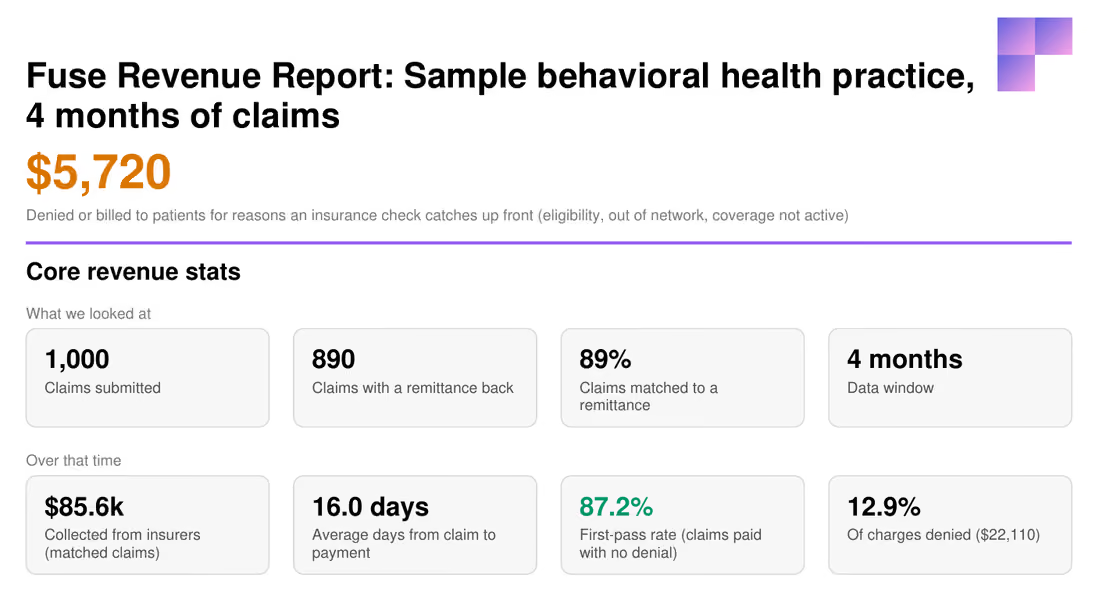
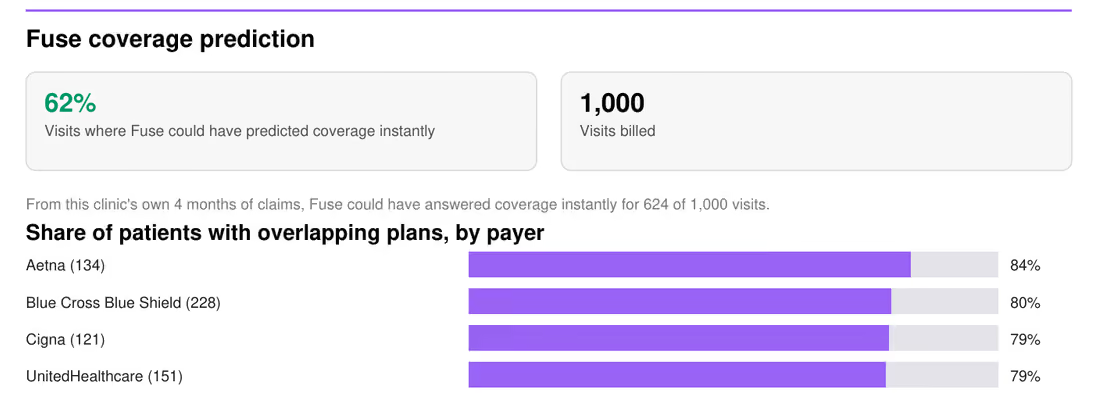

Fuse analyzes your claims data to estimate how many patients could be eligible, benchmarks your contracted rates against the market medians, and sizes the revenue uplift.
Get Your Free AnalysisFAQs
What does Anthem pay for TMS mapping (CPT 90867) in Virginia?
The Virginia median is $368.78 for the first session with mapping, billed once per course. On Anthem's main employer network, psychiatrists outside Northern Virginia are paid $390.48 to $412.17 and those in Northern Virginia $447.10. Nurse practitioners get 85 percent of those amounts.
Does Anthem pay for accelerated TMS (CPT 0858T) in Virginia?
Only for a few clinicians. In the October 2026 files, 25 Virginia psychiatrists and nurse practitioners have an office rate for 0858T, all at $249.87 in every network file. The other 1,955 Virginia TMS prescribers have no office rate for it, so ask Anthem how it would pay before scheduling an accelerated course.
Does Medicare cover TMS in Virginia?
Yes, for adults with severe major depression, under two policies. Palmetto GBA's L34869 covers most of Virginia and asks for two failed drug classes plus a failed psychotherapy trial. Novitas's L34998, for Arlington and Fairfax counties and Alexandria, asks for one failed or poorly tolerated medication. Both require a psychiatrist's order.
Does Anthem pay less for TMS on individual plans in Virginia?
Yes. Anthem's individual plans, including those sold on the Virginia marketplace, pay most clinicians 88.2 percent of the main employer network rate. For a psychiatrist in the Richmond area, that is $166.31 per session instead of $188.52, about $820 less per course.