 Digital patient intake
 Patient cost estimates
 Claims automation
 Revenue intelligence
Blue Cross Blue Shield of Illinois TMS Reimbursement Rates (2026)
Blue Cross Blue Shield of Illinois most often pays psychiatrists $283.40 per TMS session on PPO plans and $221.41 on Blue Choice plans.
About two in three Illinois psychiatrists in the files get both, $283.40 for PPO patients and $221.41 for Blue Choice and Blue Options patients. Over a 36-session course, the gap is about $2,300 per patient for the same treatment.
How Did We Read Blue Cross Blue Shield of Illinois’s TMS Rates?
We read all ten of Blue Cross and Blue Shield of Illinois’s statewide network files for September 2026, 20 gigabytes of pricing data once unzipped. They cover its PPO, TraditionalBlue, Blue Choice PPO, Blue Choice Preferred PPO, Blue Options, MyBlue Plus, HMO Illinois, Blue Advantage HMO, Blue Precision HMO and BlueCare Direct networks.
We kept dollar rates labeled negotiated, billed as professional claims, for office visits, and dropped rates set as a percentage of charges. We matched each provider ID number against the federal NPPES registry. That left 2,614 individual psychiatrists, psychiatric nurse practitioners and clinical nurse specialists practicing in Illinois. A clinician listed in several files at the same rate is counted once in the medians.
What Does Blue Cross Blue Shield of Illinois Pay for TMS?
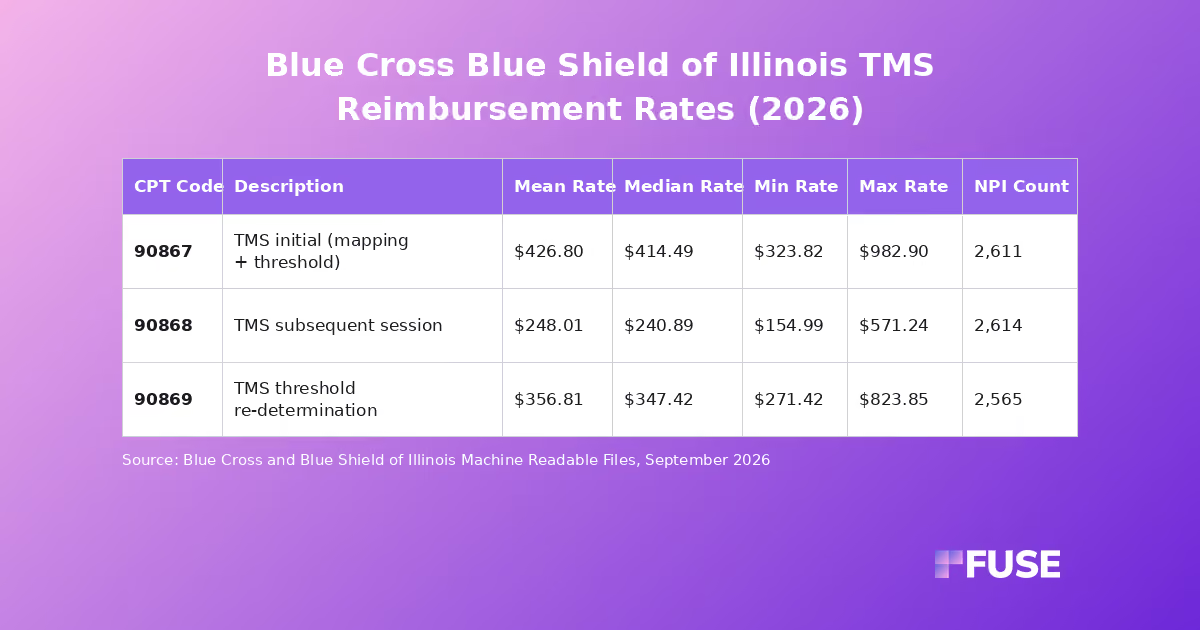
The median is $240.89 for each treatment session and $414.49 for the first session with mapping.
| CPT Code | Description | Mean Negotiated Rate | Median Negotiated Rate | Min | Max | Unique NPI Count |
|---|---|---|---|---|---|---|
| 90867 | TMS treatment, initial, including cortical mapping, motor threshold determination, delivery and management | $426.80 | $414.49 | $323.82 | $982.90 | 2,611 |
| 90868 | TMS treatment, subsequent delivery and management, per session | $248.01 | $240.89 | $154.99 | $571.24 | 2,614 |
| 90869 | TMS treatment, subsequent motor threshold re-determination with delivery and management | $356.81 | $347.42 | $271.42 | $823.85 | 2,565 |
Rates extracted from Blue Cross and Blue Shield of Illinois’s September 2026 machine readable files, office setting, professional claims.
CPT 90867 is the first session, where the clinician finds the patient’s motor threshold and sets the treatment plan. It is billed once per course. 90868 is each treatment session after that, and 90869 is a session where the threshold is measured again, at a median of $347.42. Few clinicians are paid the median itself. Most are paid one of a handful of fixed amounts. Which one you get depends on whether you are a psychiatrist or a nurse practitioner, and on which network the patient’s plan uses.
Does the Patient’s Plan Change Your TMS Rate in Illinois?
Yes. Blue Choice PPO, Blue Choice Preferred PPO, Blue Options and MyBlue Plus pay most prescribers 78 percent of what the PPO network pays.
Some clinicians have two rates in the same network file. Each sits under a different billing group, so it usually means the clinician bills through two practices with different contracts. The shares below count each clinician once per network.
- PPO and TraditionalBlue. The two files pay identical rates. 71 percent of psychiatrists are paid $283.40 per session and $487.64 for the first session, and no other amount. Another 12 percent have $283.40 under one contract and a different amount under another. 87 percent of nurse practitioners are paid only $240.89 and $414.49.
- HMO Illinois, Blue Advantage HMO, Blue Precision HMO and BlueCare Direct. 98 percent of psychiatrists are paid only the PPO amounts. Every nurse practitioner on Blue Advantage HMO and Blue Precision HMO is paid $240.89. On HMO Illinois and BlueCare Direct, nurse practitioners split between $240.89 and $248.12, and about one in six has both.
- Blue Choice PPO, Blue Choice Preferred PPO and Blue Options. About 4 in 10 psychiatrists are paid only $221.41 per session and $380.97 for the first session. About 2 in 10 are paid only the PPO amounts, and about 1 in 7 have both under separate contracts. About 6 in 10 nurse practitioners are paid only $188.20 and $323.82.
- MyBlue Plus. 73 percent of psychiatrists are paid only $221.41 and 88 percent of nurse practitioners only $188.20. Almost no one gets the PPO amounts here.
Nurse practitioners get 85 percent of the psychiatrist amount on every network. The lower networks pay 78 percent of the PPO amount on all three TMS codes.
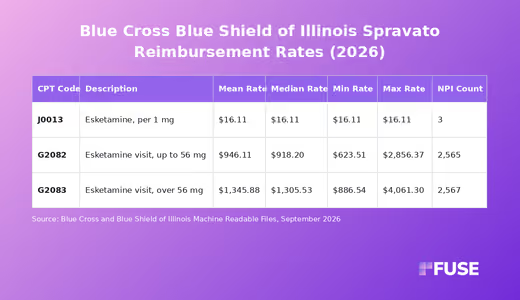
Spravato works differently. Most Illinois prescribers get the same Spravato session rate in the PPO and Blue Choice files, as our Blue Cross Blue Shield of Illinois Spravato rates page shows. For TMS, the network matters as much as the contract.
What Does a Full TMS Course Pay Under Blue Cross Blue Shield of Illinois?
About $8,845.64 at the medians, for one first session and 35 treatment sessions. Blue Cross Blue Shield of Illinois’s prior authorization list describes a usual course of 36 sessions. That is five sessions a week for up to six weeks, then a three-week taper of three, two and one session. Its medical policy says the daily phase usually stays within 30 sessions.
On the four standard amounts, the same course pays:
- Psychiatrist, PPO or HMO plan. About $10,410.
- Psychiatrist, Blue Choice, Blue Options or MyBlue Plus plan. About $8,130, roughly $2,300 less.
- Nurse practitioner, PPO or HMO plan. About $8,850.
- Nurse practitioner, Blue Choice, Blue Options or MyBlue Plus plan. About $6,910, roughly $1,900 less.
Chicago-area cash prices span most of that range. An Oak Park clinic charges $3,700 for a 36-session course, and a Lincoln Park psychiatry practice charges $5,500. A group with offices in the Loop and Arlington Heights charges $11,475 for standard TMS and says it bases self-pay prices on what insurers usually pay it (all checked October 15, 2026). Even the lowest standard course above pays more than the Oak Park and Lincoln Park prices.
Run your own numbers with your contracted rates:
Does Blue Cross Blue Shield of Illinois Require Prior Authorization for TMS?
Not for the first two business days on plans regulated by Illinois, but private self-funded employer plans need it before the first session.
Since January 1, 2026, Illinois law says state-regulated plans may not require prior authorization for outpatient mental health treatment, under 215 ILCS 5/370c(w). A plan may require you to tell it within two business days that treatment has started. It may review ongoing care after that deadline, and it may review claims after the fact.
Blue Cross Blue Shield of Illinois’s January 12, 2026 provider notice describes its TMS process this way. There is no review during the first two business days, and “preservice reviews may be required” after that. By plan type:
- Plans regulated by Illinois. These are individual and student plans, fully insured employer plans (PPO, HMO and POS), and public employer plans such as the State Employees plan. Send the first treatment date with your request, since the two days are counted from it. If you have no authorization for the later sessions, Blue Cross Blue Shield of Illinois asks for medical records to review them.
- Private self-funded employer plans. Federal law governs these plans, so the Illinois rule does not apply. Blue Cross Blue Shield of Illinois’s commercial behavioral health prior authorization list, updated August 2026, still lists 90867, 90868 and 90869 for some non-HMO members. Get authorization before the first session.
- HMO members. Blue Cross Blue Shield of Illinois says each HMO member’s medical group manages all of that member’s behavioral health care. Ask the medical group how it handles TMS.
On plans regulated by Illinois, the law also protects patients. If Blue Cross Blue Shield of Illinois later decides sessions were not medically necessary, you cannot bill the patient for sessions up to the denial date, other than their copay, coinsurance or deductible. Confirm the patient meets the criteria below before the first session.
We read the notice, the authorization list and the statute on October 15, 2026.
What Does Blue Cross Blue Shield of Illinois Require Before Covering TMS?
Severe major depression, a medication history that meets one of four tests, and a psychotherapy trial that did not help. Those are the terms of its public TMS medical policy, PSY301.015, effective January 1, 2026, the newest version we found on October 15, 2026.
- Diagnosis. Severe major depressive disorder, single or recurrent, in a patient over 15, measured on a standardized depression scale.
- Medication history. Any one of these. Two antidepressants from different classes that did not work, each taken at least six weeks with at least 80 percent adherence. Side effects that prevented a therapeutic dose. A response to TMS in an earlier episode at least three months before. Or the patient is a candidate for electroconvulsive therapy and it would not work better than TMS.
- Psychotherapy. A trial of an evidence-based therapy for depression, of adequate frequency and length, without significant improvement on a rating scale.
The policy is not the only test. Blue Cross Blue Shield of Illinois’s behavioral health program page says its reviewers use MCG Care Guidelines for mental health requests, along with its medical policies. MCG is a licensed set of criteria that providers can read only after logging in to Availity, so check the TMS guideline there before you submit.
The policy also needs an attendant trained in basic cardiac life support present during every session, and emergency help available within five minutes. Maintenance TMS after the course is not covered. The January 2026 version also treats TMS for obsessive-compulsive disorder as unproven, though versions since July 2021 had covered it when criteria were met.
Does Illinois Medicaid Cover TMS?
Yes. The Illinois Department of Healthcare and Family Services pays $155.03 per treatment session, 64 percent of Blue Cross Blue Shield of Illinois’s median.
Its practitioner fee schedule, effective January 1, 2026 and updated April 14, 2026, pays $266.68 for the first session and $223.52 for a session with threshold remeasurement. Those rates have applied since April 1, 2025. A 36-session course comes to about $5,700, below even the lowest standard Blue Cross Blue Shield of Illinois course. Medicaid managed care plans, including Blue Cross Community Health Plans, run their own review steps, so check each plan before the first session.
What This Means for Your Practice
If Blue Choice and Blue Options pay you $221.41 per session, ask for the PPO amount of $283.40 on those networks too. About a third of Illinois psychiatrists in those files already have it there under at least one contract, so you are asking for a rate the plan already pays.
The ask is worth about $2,300 per 36-session course. For nurse practitioners, it moves $188.20 to $240.89, about $1,900 per course, and about one in four nurse practitioners in those files already has $240.89 there.
Bring three things to the conversation:
- Your patient counts. How many of your TMS patients are on Blue Choice PPO, Blue Choice Preferred PPO or Blue Options. Add how many courses they started last year.
- Your gap on every code. Your PPO and Blue Choice amounts for 90867, 90868 and 90869. On the common contracts each one is 78 percent of the PPO amount.
- The plan’s own numbers. The PPO amount appears in Blue Cross Blue Shield of Illinois’s own Blue Choice and Blue Options files for many of your peers.
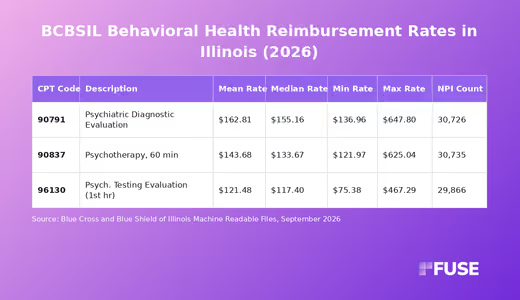
Expect less room on MyBlue Plus, where almost no clinician has the PPO amount. Our guide to negotiating insurance contract rates covers how to make the ask. Our Blue Cross Blue Shield of Texas TMS rates page shows how the same parent company prices TMS in Texas. The therapy codes are in our Blue Cross Blue Shield of Illinois behavioral health rates page.
Once good rates are in place, Fuse helps make sure you actually get paid them. We check claims against your contracted rates so underpaid sessions do not slip through. Reach out if you’d like to chat.
Disclaimer: This article uses rate information from the Machine Readable Files that Blue Cross and Blue Shield of Illinois publishes under the federal Transparency in Coverage rule. These files are posted to satisfy the regulation, not to be read. The files behind this analysis unpack to 20 gigabytes of raw pricing data, and Fuse built its own software to extract and verify the figures above. This analysis covers a single payer and will not reflect rates from all available insurance options in Illinois. Healthcare pricing and coverage policy change frequently, and individual circumstances affect actual payment. Practices should verify current rates and authorization requirements directly with Blue Cross and Blue Shield of Illinois before relying on them for billing or treatment decisions.
Fuse reads your paid claims and shows what each payer actually pays you per CPT code, next to these medians.
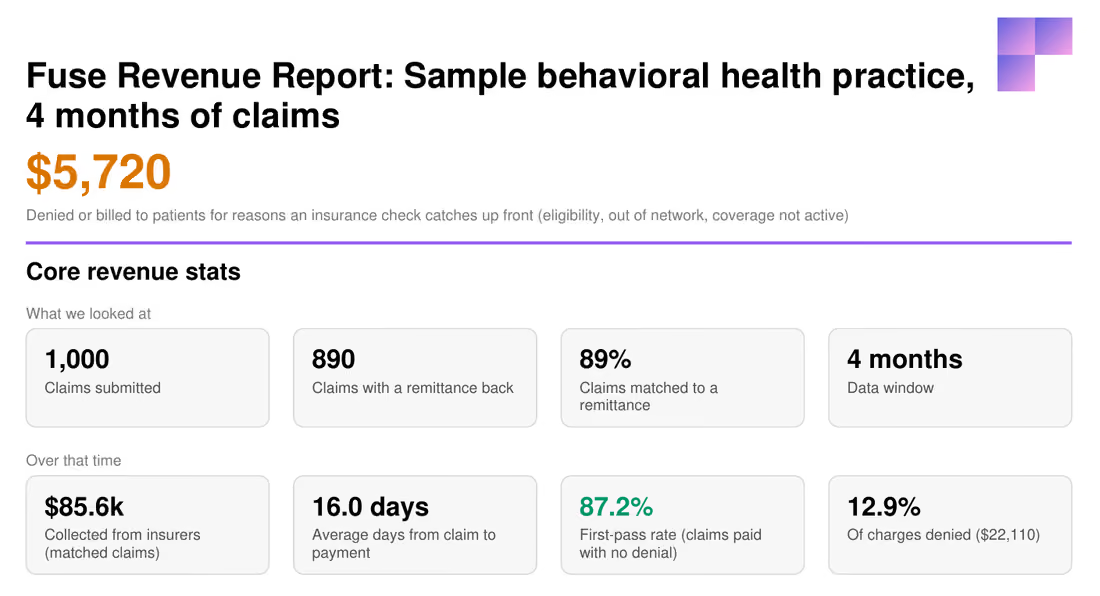
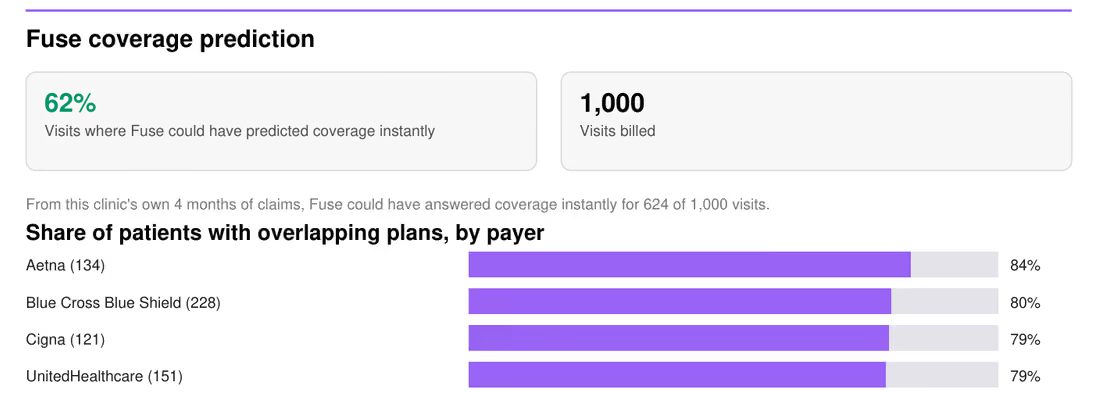

Fuse analyzes your claims data to estimate how many patients could be eligible, benchmarks your contracted rates against the market medians, and sizes the revenue uplift.
Get Your Free AnalysisFAQs
What does Blue Cross Blue Shield of Illinois pay for TMS mapping (CPT 90867)?
The Illinois median is $414.49 for the first session with mapping, billed once per course. The most common psychiatrist amounts are $487.64 on PPO and HMO plans and $380.97 on Blue Choice and Blue Options plans. Nurse practitioners get 85 percent of those amounts.
Does Blue Cross Blue Shield of Illinois pay for accelerated TMS (CPT 0858T)?
We found no rate for it. The September 2026 files list 0858T, but no Illinois psychiatrist or nurse practitioner in them has a rate for the code. The January 2026 medical policy names accelerated theta burst protocols among TMS methods, so ask Blue Cross Blue Shield of Illinois how it would pay before scheduling one.
Does Medicare cover TMS in Illinois?
Yes, for adults with major depressive disorder. Wellpoint Federal, formerly National Government Services, covers it under local coverage determination L33398, revised August 9, 2026. The patient needs failed or poorly tolerated antidepressants and a failed trial of psychotherapy. A nurse practitioner may order it within Illinois scope of practice.
Does Blue Cross Blue Shield of Illinois reimburse TMS for OCD?
No, not since January 1, 2026. That version of its TMS medical policy, PSY301.015, treats TMS for obsessive-compulsive disorder as unproven. Versions since July 2021 had covered it when criteria were met. Major depressive disorder is the only covered use.