 Digital patient intake
 Patient cost estimates
 Claims automation
 Revenue intelligence
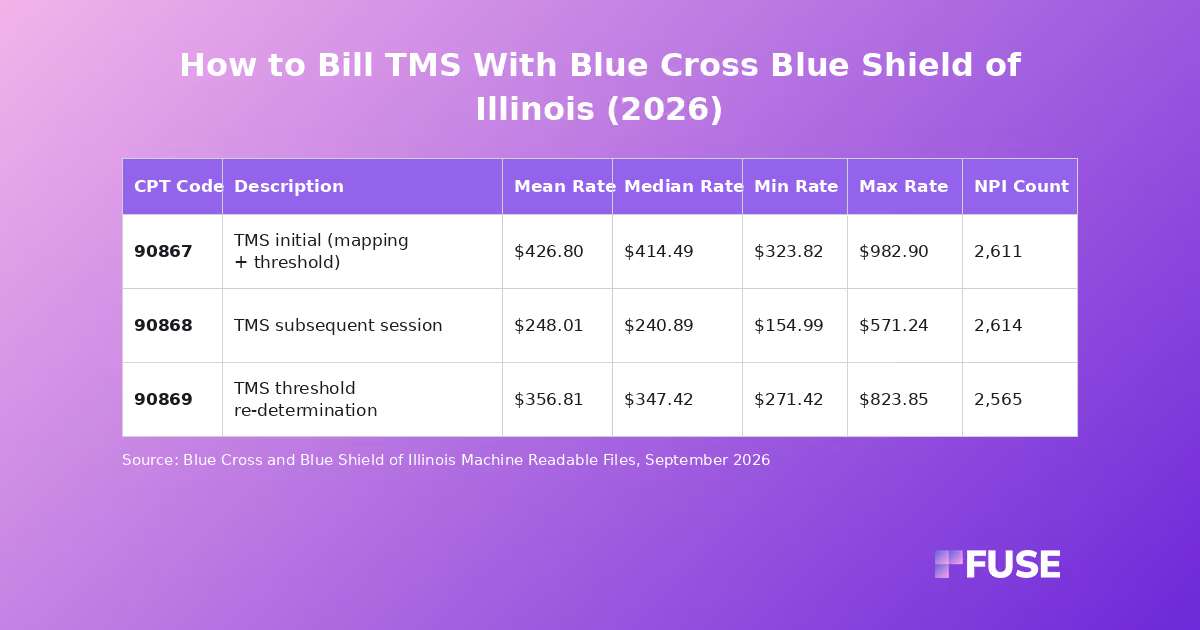
How to Bill TMS With Blue Cross Blue Shield of Illinois (2026)
To get paid for a full TMS course with Blue Cross Blue Shield of Illinois, get the whole course approved before the patient’s first session. This is because Blue Cross can require approval for sessions after the first two business days of treatment. At the standard PPO rate, a 36-session course pays a psychiatrist about $10,410.
This guide is for practice owners, front desk staff and billers. The billing rules come from Blue Cross’s commercial TMS request form, its Illinois TMS medical policy, its prior authorization lists and its provider notices. The rates come from all ten of Blue Cross’s statewide Illinois network files for September 2026, covering its PPO, TraditionalBlue, Blue Choice, Blue Options, MyBlue Plus, BlueCare Direct and HMO networks. Blue Cross lists at least one of these ten files for about 99 percent of the plans in its Illinois index. The rest list only other states’ Blue networks or a vision plan’s file. The share counts plans, not patients.
What Does Blue Cross Blue Shield of Illinois Pay for a TMS Course?
It depends on the patient’s network. At psychiatrists’ standard rates, a 36-session course pays about $10,410 in the PPO and HMO networks and about $8,130 in the Blue Choice networks.
| CPT Code | Session | Sessions per course | PPO, TraditionalBlue and HMO standard | Blue Choice, Blue Options and MyBlue Plus standard | Median, all prescribers | Prescribers |
|---|---|---|---|---|---|---|
| 90867 | First session, with mapping | 1 | $487.64 | $380.97 | $414.49 | 2,611 |
| 90868 | Each later session | 35 | $283.40 | $221.41 | $240.89 | 2,614 |
| 90869 | Session with a new motor threshold | in place of a 90868 | $408.73 | $319.32 | $347.42 | 2,565 |
| Full course | 36 | about $10,410 | about $8,130 | about $8,850 |
Rates extracted from Blue Cross Blue Shield of Illinois’s September 2026 Illinois machine readable files (20 gigabytes), for psychiatrists and psychiatric nurse practitioners practicing in Illinois, office setting, professional claims. Standard rates are psychiatrists’ rates.
Most psychiatrists get the standard rates in the table. In the PPO and TraditionalBlue networks, 1,142 of 1,369 psychiatrists get $283.40 for 90868. In the Blue Choice networks, 931 of 1,378 get $221.41, about 22 percent less. Nurse practitioners get 15 percent less than psychiatrists in every network, $240.89 a session in the PPO network and $188.20 in the Blue Choice networks. The medians sit lower than the psychiatrist rates because they pool nurse practitioners and every network.
Why Might Your Blue Cross Blue Shield of Illinois TMS Rate Be Lower?
Usually because the patient’s plan uses a Blue Choice network, or because the clinician is a nurse practitioner.
- Blue Choice networks. Blue Choice PPO, Blue Choice Preferred PPO, Blue Options and MyBlue Plus plans use them. Blue Choice PPO plans are PPOs too, so a PPO plan can still pay the lower rate. At psychiatrists’ standard rates, a Blue Choice course pays about $2,280 less than a PPO course. Some psychiatrists keep the PPO rate there. Of the 1,378, 612 have $283.40 in at least one Blue Choice network, so check your own fee schedule for each one.
- Nurse practitioner license. A 36-session course pays a nurse practitioner about $8,850 in the PPO network and about $6,910 in the Blue Choice networks.
How Do You Request TMS Authorization From Blue Cross Blue Shield of Illinois?
Request it online through BlueApprovR in Availity, fax Blue Cross’s TMS request form to 877-361-7656, or call the number on the member’s ID card.
BlueApprovR is the tool Blue Cross uses for behavioral health requests inside Availity Authorizations, under Patient Registration, then Authorizations & Referrals, then Authorization Requests. Blue Cross’s BlueApprovR page says a request started in Availity can be extended in Availity, but one started by phone or fax must be extended by phone or fax. The page also says the tool isn’t available for Illinois Medicaid members.
The TMS request form, which Blue Cross’s forms page lists as commercial only, shows what Blue Cross wants to see. It asks for:
- Whether this is a first or follow-up request, and whether it is repetitive TMS or deep TMS.
- The requested service dates and the number of sessions for 90867 and for 90868. The form has no line for 90869.
- The diagnosis code, the date the depression began and the maker of your TMS device.
- At least two antidepressants from two drug classes, each with its highest dose and trial dates.
- Current or past psychotherapy for depression, with the therapist’s name, license and dates, or the reason the patient can’t do it.
- The standardized rating scale given before, weekly during and after treatment.
- Whether any excluded condition applies, such as a seizure disorder or psychosis. It also asks about excessive alcohol or drug use in the last 30 days, no response to an earlier course, and another acute course in the last six months.
The form also says to call 800-851-7498 to check the member’s benefits first.
Does Blue Cross Blue Shield of Illinois Review the First Two Days of TMS?
Not on plans covered by Illinois law. On those plans, Blue Cross may require approval for sessions after the first two business days.
Not every plan requires approval for TMS. Blue Cross’s commercial behavioral health prior authorization list (updated August 2026) says 90867, 90868 and 90869 may need it for some members of its PPO, Blue Choice, Blue Options and Blue High Performance Network plans. Its 2027 summary still lists TMS. Check each patient’s benefits in Availity, which Blue Cross says confirms whether the plan requires approval.
- Plans covered by Illinois law. Blue Cross’s November 2025 notice to brokers on the law lists individual, family and student plans, and fully insured employer plans (PPO, HMO and POS). It also lists public employer plans for counties, cities, schools and state employees, and Blue Balance Funded plans. These have no review or prior authorization for the first two business days of TMS. Blue Cross’s January 2026 notice asks for the first treatment date to count those days and says “preservice reviews may be required” after them. Sessions after them with no approval get a medical records request.
- HMO members. Blue Cross says each HMO member’s medical group manages all of that member’s behavioral health care, so ask the medical group how it approves TMS.
- Other plans. For a plan not on that list, check with Blue Cross before the first session.
On plans covered by Illinois law, Blue Cross may later deny sessions as not medically necessary. Its January notice says neither Blue Cross nor the clinic may then bill the patient for sessions up to the denial date, other than copays, coinsurance or deductible.
How Many TMS Sessions Are in a Blue Cross Blue Shield of Illinois Course?
Blue Cross’s authorization list describes 36 sessions, and its medical policy says a course usually stays within 30.
The list describes one session a day, five days a week for up to six weeks, then a three-week taper of three, two and one session. Blue Cross’s TMS medical policy, PSY301.015 (effective January 1, 2026) says a course usually does not exceed five sessions a week for six weeks, 30 in all. It adds that the plan can be individualized for the device, side effects and response. The request form asks for the number of 90867 and 90868 sessions.
The authorization list says a course “may be repeated after a 6-month cessation period,” and the form asks whether the patient had another acute course in the last six months. The form also asks whether the last course worked, meaning at least a 50 percent drop on a rating scale such as the PHQ-9 by the end of the acute course. Keep each course’s dates and scores for the next request.
Which Code Do You Bill Blue Cross Blue Shield of Illinois for Each TMS Session?
Bill 90867 for the first session and 90868 for each later one. Bill 90869 in place of a 90868 when the motor threshold is measured again.
- 90867 covers mapping, the first motor threshold and the first treatment. The medical policy says to report it once per course.
- 90868 is each routine session after the first.
- 90869 is a session where the clinician measures the motor threshold again and then treats. The policy says 90868 and 90869 cannot be billed for the same session.
At psychiatrists’ standard rates, 90869 pays about $125 more than a 90868 in the PPO network ($408.73 against $283.40) and about $98 more in the Blue Choice networks. The request form has no line for it, so before the first 90869, ask Blue Cross how it wants those sessions requested.
What Gets Blue Cross Blue Shield of Illinois TMS Claims Denied?
Each of these breaks a rule in Blue Cross’s TMS medical policy, its authorization list, its TMS request form or its January 2026 notice:
- Billing 90867 twice in one course. The policy allows it once per course. Later sessions are 90868 or 90869.
- Billing 90868 and 90869 for the same session. The policy bars it, so each session gets one TMS code.
- TMS on the same day as partial hospitalization, intensive outpatient care, ECT or ABA. The authorization list says TMS cannot be given on the same day as those services.
- Starting a new course within six months. The list says a course may be repeated after a six-month break, and the form asks about any acute course in the last six months.
- Maintenance sessions after the course. The policy calls maintenance TMS “experimental, investigational and/or unproven.”
- Treating anything other than major depressive disorder. The January 2026 policy treats TMS for OCD and every other condition as unproven. The request form, which predates that policy, still asks about OCD medicine trials.
- Missing rating scale scores. The policy needs the depression and the failed psychotherapy documented with standardized rating scales, and the form asks for a scale before, weekly during and after treatment.
- Leaving out the first treatment date. Blue Cross’s January notice says a claim without it gets a request for the date and a medical records request for the later sessions.
- Running past the approved dates or session count. Sessions outside the dates and counts on the request have no approval behind them. Ask for more before the last approved session, not after.
Our page on Blue Cross Blue Shield of Illinois’s TMS rates covers Blue Cross’s coverage criteria and Illinois Medicaid rates. For other states, see our TMS rates by state.
How Fuse Can Help With TMS Billing
Fuse runs the checks in this guide for every payer your practice bills, not only Blue Cross. It verifies benefits at the billing code level before the first session, including whether the plan needs prior authorization for TMS. It checks claims for errors before they go out, such as a second 90867 or a 90868 and 90869 on the same day. And it compares each payment with your contract, so a PPO patient paid at the Blue Choice rate shows up after one session instead of a whole course.
Disclaimer: Billing rules and criteria come from Blue Cross and Blue Shield of Illinois’s published documents and the CPT code descriptions as of November 19, 2026, and individual plans can differ. Rates come from the machine readable files Blue Cross Blue Shield of Illinois publishes under the federal Transparency in Coverage rule. This information does not guarantee payment. Verify current benefits, criteria and rates with Blue Cross Blue Shield of Illinois before relying on them.
Fuse reads your paid claims and shows what each payer actually pays you per CPT code, next to these medians.
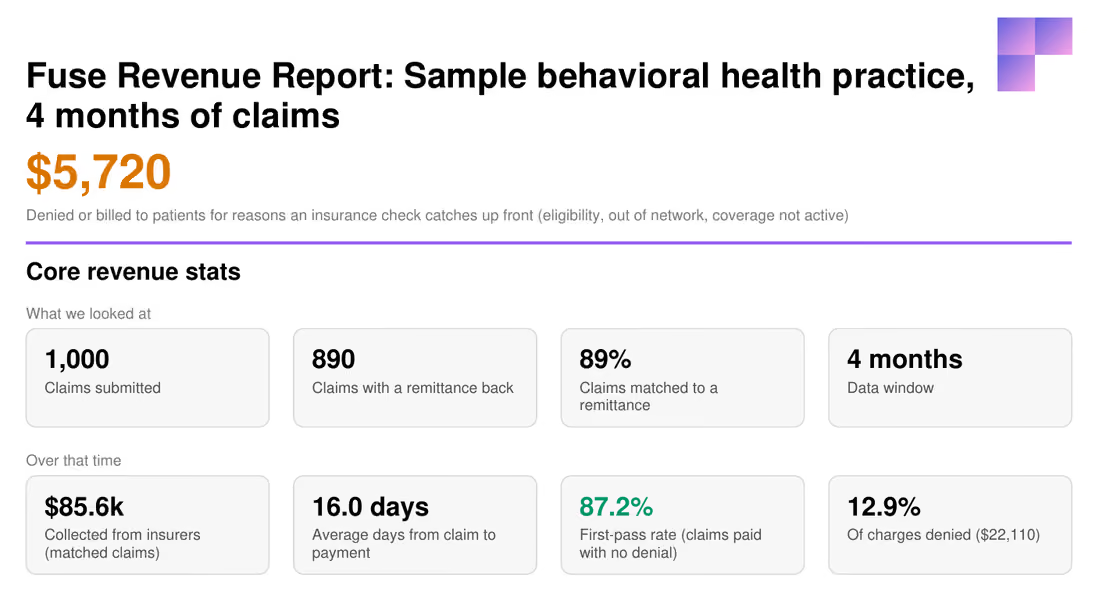
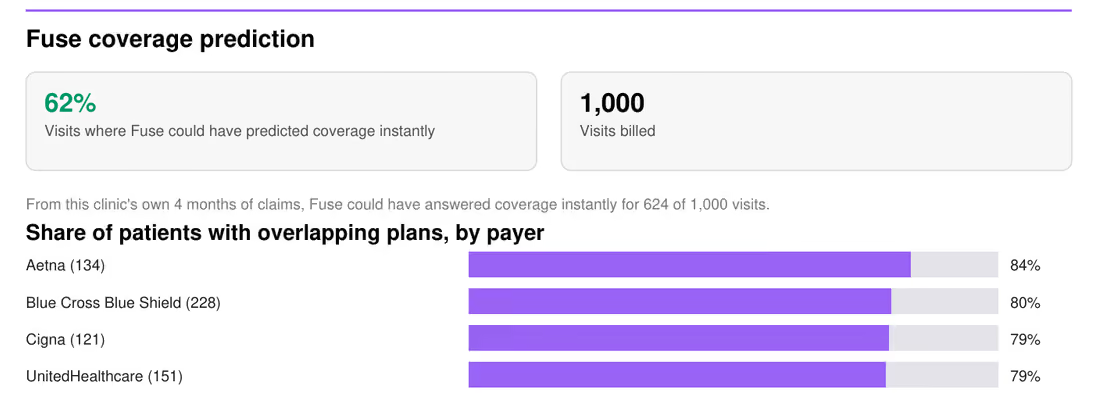

Fuse compares your remittances with your contracted rates code by code, so underpaid or denied TMS sessions show up before the course ends.
Get Your Free AnalysisFAQs
Who approves TMS for Blue Cross Blue Shield of Illinois HMO members?
The member's medical group. Blue Cross says each HMO member's medical group or independent practice association manages all of that member's behavioral health care, so ask the medical group how it handles TMS. In the HMO network files, nearly all psychiatrists have the same standard TMS rates as in the PPO network.
How does TMS notification work for Blue Cross Community Health Plans members?
Blue Cross's January 2026 notice asks clinicians to notify it within 24 hours of starting outpatient behavioral health care for Blue Cross Community Health Plans, its Medicaid plan, and says review may begin after that. Blue Cross says different processes may apply to these members, and the TMS form in this guide is for commercial plans.
Do Federal Employee Program members need prior authorization for TMS in Illinois?
No. Blue Cross Blue Shield of Illinois's behavioral health page says applied behavior analysis is the only behavioral health service that needs prior authorization for Federal Employee Program members, and that different processes may apply to them. Check the member's benefits before the first session.
Does Blue Cross Blue Shield of Illinois pay for accelerated TMS (CPT 0858T)?
Not at a published rate for Illinois prescribers. The September 2026 files list 0858T, but no Illinois psychiatrist or nurse practitioner in them has a rate for it. The medical policy names accelerated theta burst protocols such as SAINT among the TMS methods it can cover, so ask Blue Cross how it would pay before scheduling one.