 Digital patient intake
 Patient cost estimates
 Claims automation
 Revenue intelligence
How to Bill TMS With Anthem in Colorado (2026)
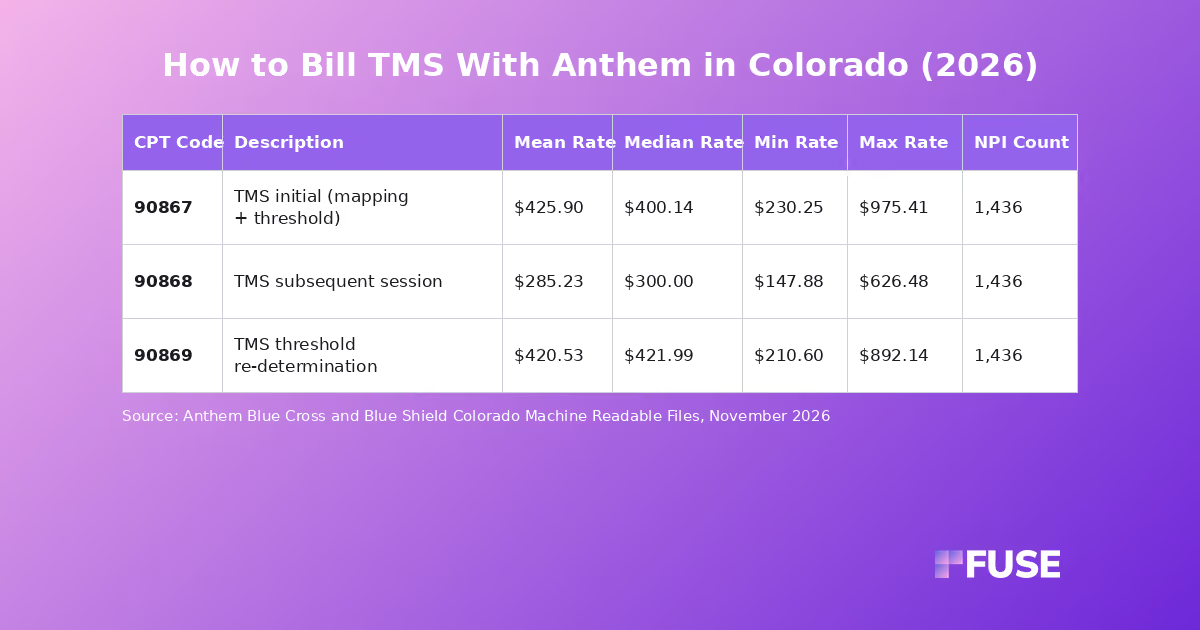
To get paid for a full TMS course with Anthem in Colorado, send Anthem a TMS authorization request before the patient’s first session. This is because Anthem’s Colorado prior authorization list includes all three TMS codes. At the most common rate, $300 a session, a 36-session course pays about $10,850.
This guide is for practice owners, front desk staff and billers. The billing rules come from Anthem’s Colorado prior authorization list, its TMS request form, its Colorado provider notices and the CPT code descriptions. The rates come from all 34 network files Anthem names for Colorado in its November 2026 index, so they cover every plan in that index, from individual Pathway plans to large employer PPOs. The share counts plans, not patients.
What Does Anthem Pay for a TMS Course in Colorado?
Most Colorado prescribers have one of two Anthem rates, $300 or $237 a session. With a six-session taper, a 36-session course pays about $10,850 at the first rate and about $8,730 at the second.
| CPT Code | Session | Sessions per course | With the $300 rate | With the $237 rate | Median, all prescribers | Prescribers |
|---|---|---|---|---|---|---|
| 90867 | First session, with mapping | 1 | $345.12 | $432.00 | $400.14 | 1,436 |
| 90868 | Each later session | 35 | $300.00 | $237.00 | $300.00 | 1,436 |
| 90869 | Session with a new motor threshold | in place of a 90868 | $421.99 | $425.00 | $421.99 | 1,436 |
| Full course | 36 | about $10,850 | about $8,730 | about $10,900 |
Rates extracted from Anthem’s November 2026 Colorado machine readable files (29 gigabytes), for psychiatrists and psychiatric nurse practitioners practicing in Colorado, office setting, professional claims. In the two rate columns, the first-session and threshold rates are the ones most often paired with that session rate.
Of the 1,436 Colorado prescribers in Anthem’s files, 697 (49 percent) have $300 for 90868 in at least one file, and 467 (33 percent) have $237. Together, 72 percent have one or both. In every file they appear in, 336 prescribers have only $300 and 263 have only $237.
Nurse practitioners get the same two rates as psychiatrists. Half of the nurse practitioners have $300, and so do 45 percent of psychiatrists. Our Colorado TMS rates page used October data from one network file, so its medians differ.
Why Might Your Anthem TMS Rate Be Lower?
Usually because you have the $237 rate, or one of the rates under $200.
- The $237 rate. Prescribers with this rate get $432.00 for the first session, $86.88 more than prescribers with the $300 rate. But each later session pays $63 less. Over a 36-session course, they get about $8,730 instead of about $10,850, or about $2,120 less.
- Rates under $200. For 102 prescribers, every 90868 rate in Anthem’s files is under $200. The most common of these is $192.77, which pays about $7,050 for a 36-session course.
Check your fee schedule with Anthem before you plan a course around $10,850.
How Do You Request TMS Authorization From Anthem in Colorado?
Request it in Availity’s Authorization application, under the Patient Registration tab, or fax Anthem’s TMS request form to 866-834-7469. Anthem’s Colorado list gives 800-424-4014 as its behavioral health number for outpatient services.
The TMS request form is a multi-state form last revised in 2024, and its footer names Anthem’s Colorado companies. It calls itself a requirement. You can add the TMS intake evaluation or a psychiatric evaluation done within three months of the requested start. The form says that “does not however substitute” for completing it. It asks for:
- The physician, a TMS coordinator, and the provider NPI and tax ID.
- A requested start date and a number of sessions for 90867 and for 90868. The form has no line for 90869.
- Whether the request is for theta burst stimulation, and whether the protocol uses frequencies of less than 1 Hz to 20 Hz.
- Confirmation that the patient is 18 or older with severe, treatment-resistant major depressive disorder, plus every current diagnosis code.
- Antidepressant trials from two or more drug classes at an adequate dose and length with documented adherence, or two trials stopped for side effects. Each trial needs its date, highest dose, length and outcome.
- The FDA-approved device by name, and any implant within 30 centimeters of the coil, such as a pacemaker or a vagus nerve stimulator.
- Confirmation that the course will not exceed five sessions a week for six weeks, followed by a taper.
The signature line is labeled for an MD. If a nurse practitioner runs your TMS program, ask Anthem who should sign. The Colorado list says Anthem reviews TMS against MCG’s TMS guideline (B-801-T), which is licensed and not public. If a request is denied, ask Anthem for the criteria the reviewer used.
Does Every Anthem Plan in Colorado Need TMS Approval?
Not every plan. Anthem’s Colorado prior authorization list (updated October 19, 2026) describes three groups of members:
- Local members. A note at the top says the list “applies to all local members” in Colorado. The list also says certain items and criteria apply to local fully insured members and to some self-funded plans that bought Anthem’s medical management program. It does not say which items.
- Self-funded plans without that program. The list says “precertification is not required and clinical review will not be performed” for those members.
- BlueCard, Medicare Advantage, Medicaid, Medicare Supplement and Federal Employee Program members. The list does not apply. Check with the member’s own plan.
The list also says Anthem will tell you, when you request approval, whether the member’s plan requires it.
How Many TMS Sessions Does Anthem Approve in Colorado?
Anthem’s form describes a standard course of up to five sessions a week for six weeks, 30 in all, followed by a taper. It does not say how many sessions the taper can have, so ask Anthem how it handles taper sessions before you schedule them.
For a second course, the form asks how recent the last one was and how well it worked. Keep the earlier course’s dates and rating scale scores. It asks:
- Whether the patient had TMS in the past 30 days. If so, give the earlier authorization number if you have it.
- Whether the request is for maintenance, which the form defines as treatment that continues after remission. Remission means no significant signs or symptoms of depression for at least two months.
- Whether the request is for continuation, a course that starts after the first one and lasts up to six months for a patient not yet in remission.
- Whether the patient responded to the first course, meaning symptoms fell by at least 50 percent on a rating scale and have since clearly worsened again.
- The first and last scores on a standardized rating scale, with dates.
Which Code Do You Bill Anthem for Each TMS Session?
Bill 90867 for the first session and 90868 for each later one. Bill 90869 in place of a 90868 when the motor threshold is measured again.
- 90867 covers mapping, the first motor threshold and the first treatment. CPT says to report it only once per course.
- 90868 is each routine session after the first.
- 90869 is a session where the clinician measures the motor threshold again and then treats. CPT bars billing it with 90867 or 90868, so each session gets one TMS code.
Anthem sends every 90869 request to a clinician reviewer. Its August 2024 notice to Colorado commercial providers says those requests “will be referred for peer clinical review” to determine medical necessity. The notice adds that MCG’s TMS guideline now puts measuring the threshold again after treatment starts under “inconclusive or non-supportive evidence.” The summary in Anthem’s June 2026 MCG update for Colorado lists no TMS change.
The form has no 90869 line, so ask Anthem how to add 90869 sessions to a request. A 90869 pays $121.99 more than a 90868 at the $300 rate and $188.00 more at the $237 rate.
What Gets Anthem TMS Claims Denied in Colorado?
Each of these breaks a rule in Anthem’s Colorado list, its TMS form, its 90869 notice or the CPT code descriptions:
- Billing 90869 without a request. Anthem sends every 90869 request to peer clinical review, so a 90869 nobody requested has no review behind it.
- Billing 90867 twice in one course. CPT allows it once per course. Later sessions are 90868 or 90869.
- Billing two TMS codes for one session. CPT bars 90867, 90868 and 90869 from being billed together.
- Running past the approved session count. Sessions past the number on the approval have no approval behind them. Ask for more before the last approved session, not after.
- Treating before the approved start date. The form asks for a requested start date, and sessions before it fall outside the request.
- Billing under a different NPI or tax ID. The request names an NPI and tax ID. Bill with the same ones.
For plans with “CO-DOI” on the member’s ID card, Colorado law bars Anthem from denying an approved authorization after the fact. The law, C.R.S. 10-16-112.5(5), makes exceptions, including when the service provided “did not align with the service that was authorized,” when the patient’s coverage had ended or when a benefit maximum was reached.
Our page on Anthem’s TMS rates in Colorado also covers Colorado’s utilization review law and Medicare’s TMS rules. For other states, see our TMS rates by state.
How Fuse Can Help With TMS Billing
Fuse runs the checks in this guide for every payer your practice bills, not only Anthem. It verifies benefits at the billing code level before the first session, including whether the plan needs prior authorization for TMS. It checks claims for errors before they go out, such as a second 90867 or a 90869 with no request behind it. And it compares each payment with your contract, so a session paid at $237 instead of $300 shows up after one session instead of a whole course.
Disclaimer: Billing rules and criteria come from Anthem Blue Cross and Blue Shield’s published documents and the CPT code descriptions as of November 20, 2026, and individual plans can differ. Rates come from the machine readable files Anthem publishes under the federal Transparency in Coverage rule. This information does not guarantee payment. Verify current benefits, criteria and rates with Anthem before relying on them.
Fuse reads your paid claims and shows what each payer actually pays you per CPT code, next to these medians.
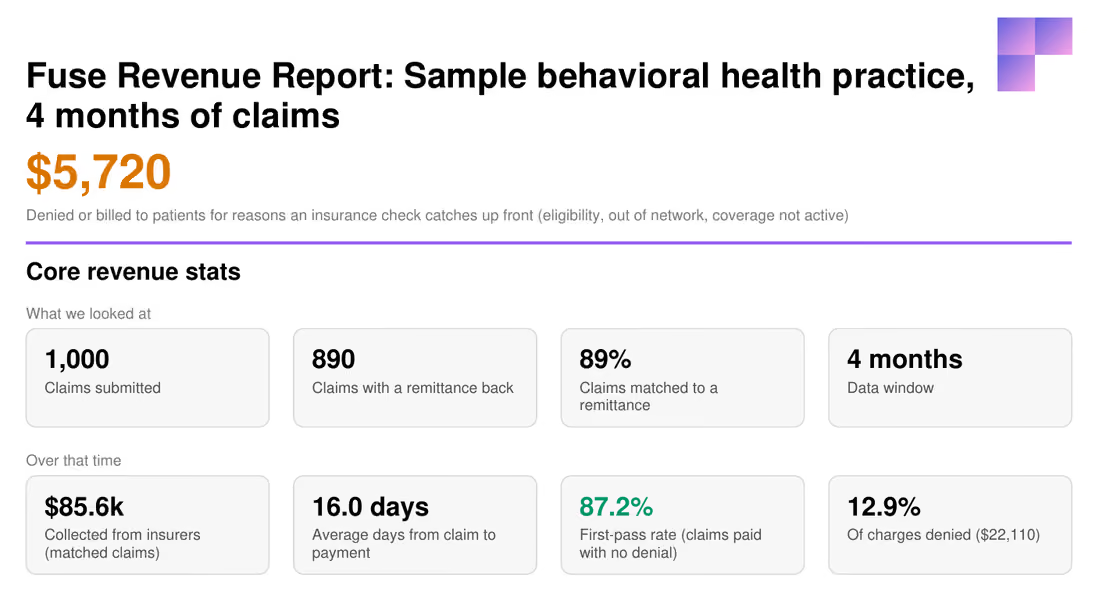
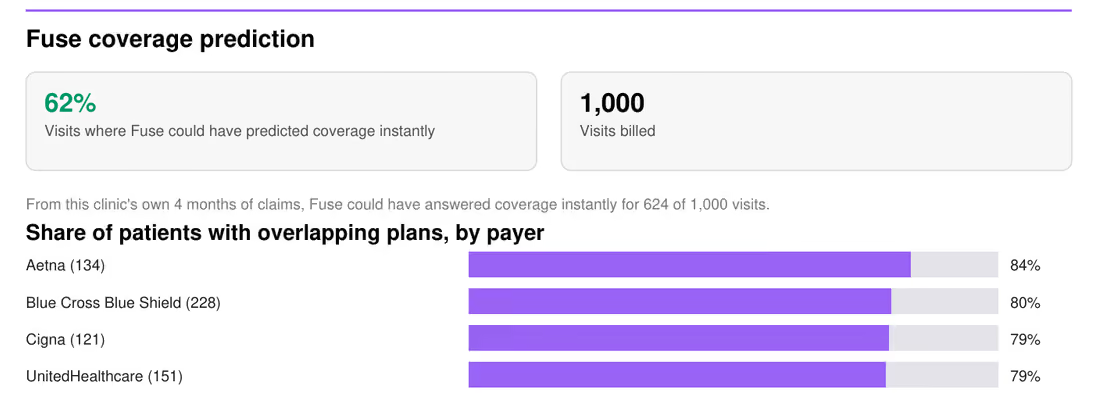

Fuse compares your remittances with your contracted rates code by code, so underpaid or denied TMS sessions show up before the course ends.
Get Your Free AnalysisFAQs
Does Anthem's Colorado TMS authorization rule apply to BlueCard members?
No. Anthem's Colorado prior authorization list says it does not apply to BlueCard members, whose plans come from another state's Blue Cross Blue Shield company. It also excludes Medicare Advantage, Medicaid, Medicare Supplement and Federal Employee Program members. For those patients, check the member's own plan before the first session.
Does Anthem pay nurse practitioners less for TMS in Colorado?
Not in Anthem's November 2026 Colorado files. Nurse practitioners have the same two common rates as psychiatrists. Half of the nurse practitioners have the higher one, and so do 45 percent of psychiatrists.
How do you request theta burst TMS from Anthem in Colorado?
Mark the theta burst line on Anthem's TMS request form, which has its own yes or no question for it. Anthem reviews TMS requests against MCG's TMS guideline, which is licensed and not public, so ask Anthem whether your theta burst protocol meets it before the first session.